The Rajasthan High Court has clarified that bail cannot be withheld solely on the basis of alleged commercial quantity under the NDPS Act when forensic evidence reveals the actual substance and weight fall below statutory thresholds. This decision reinforces the principle that bail determinations must be grounded in factual accuracy, not speculative prosecution narratives.
Background & Facts
The Dispute
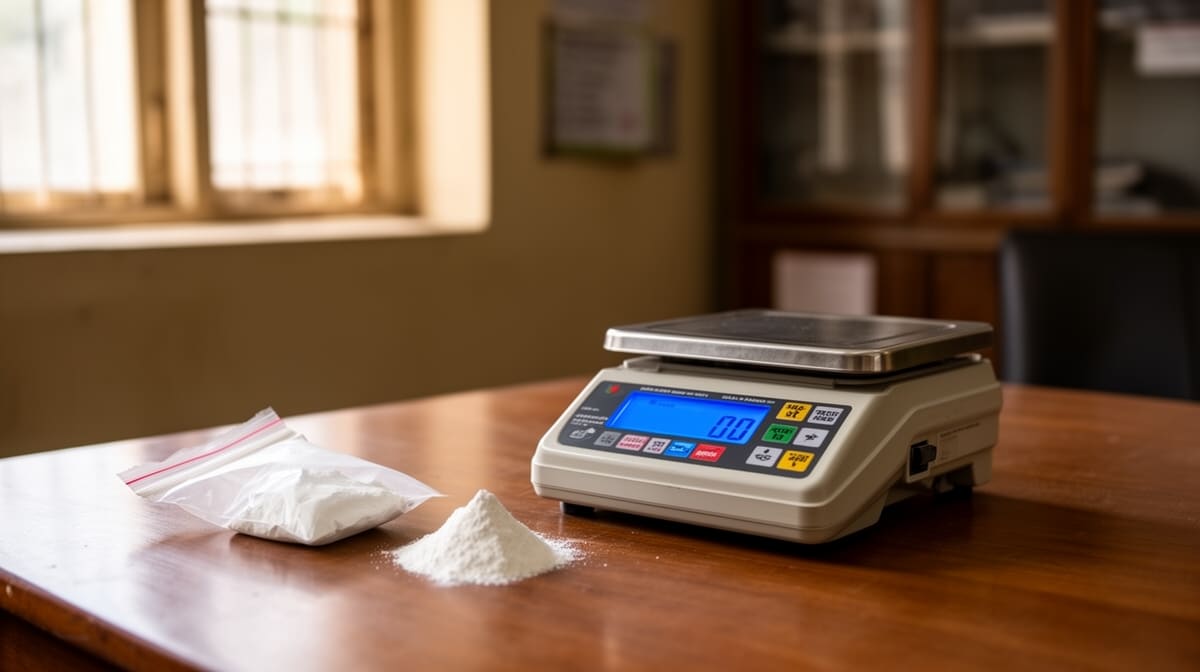
The petitioner, Sarafat Ali, was arrested in connection with FIR No. 126/2025 registered at Police Station Mandphiya, Chittorgarh, for alleged possession of 14.6 grams of MDMA under Sections 8 and 22 of the NDPS Act. The prosecution claimed the quantity constituted "commercial quantity," triggering stringent bail restrictions.
Procedural History
- 21 November 2025: Petitioner taken into judicial custody following arrest
- Forensic Analysis: Recovered substance sent to Forensic Science Laboratory (FSL)
- FSL Report: Identified substance as Mephedrone, not MDMA
- Statutory Threshold: Commercial quantity for Mephedrone is 50 grams under Section 2(viia) of the NDPS Act
- Bail Application Filed: Under Section 483 of the BNSS, challenging continued detention
Relief Sought
The petitioner sought release on bail, arguing that the actual recovered quantity (14.6 grams of Mephedrone) is below the commercial threshold, rendering the offense non-bailable only in theory, not in fact. He emphasized his clean record, prolonged custody since November 2025, and absence of need for further custodial interrogation.
The Legal Issue
The central question was whether bail under Section 483 of the BNSS can be denied merely because the prosecution initially alleged possession of a substance classified as commercial quantity, when subsequent forensic evidence proves the actual substance and quantity fall below that threshold.
Arguments Presented
For the Petitioner
Learned counsel argued that the FSL report conclusively established the substance as Mephedrone, not MDMA. Since the statutory commercial quantity for Mephedrone is 50 grams, 14.6 grams constitutes a lesser offense under Section 21 of the NDPS Act, which is bailable. Reliance was placed on State of Punjab v. Baldev Singh to assert that bail must be granted where the factual basis for non-bailability no longer exists. The petitioner had no criminal antecedents and had been in custody for over three months without custodial interrogation being necessary.
For the Respondent
The Public Prosecutor opposed bail on the grounds that the initial FIR invoked serious provisions of the NDPS Act and that the court should not interfere at the pre-trial stage. He contended that the nature of the offense, even if misclassified, warranted continued detention to prevent tampering with evidence or influencing witnesses.
The Court's Analysis
The Court emphasized that bail decisions must be based on the actual facts as established by evidence, not on the allegations in the FIR. The FSL report, being a scientific and objective document, superseded the initial classification. The Court noted that Section 2(viia) of the NDPS Act defines commercial quantity with precision, and courts are bound by such statutory definitions.
"The prosecution’s initial assumption regarding the nature of the substance cannot override the conclusive findings of the Forensic Science Laboratory. To deny bail on the basis of an erroneous classification would be to penalize the accused for the state’s own investigative oversight."
The Court further held that the petitioner’s prolonged detention without custodial interrogation, combined with his clean record and the fact that the offense no longer qualified as involving commercial quantity, satisfied the triple test for bail under Arnesh Kumar v. State of Bihar. The Court declined to speculate on the merits of the case but stressed that the legal basis for denying bail had evaporated.
The Verdict
The petitioner won. The Court held that bail must be granted when forensic evidence demonstrates the recovered substance and quantity fall below the statutory commercial threshold under the NDPS Act. The petitioner was released on personal bond of Rs. 50,000 with two sureties of Rs. 25,000 each, subject to appearing before the trial court.
What This Means For Similar Cases
Contraband Classification Must Be Verified Before Denying Bail
- Practitioners must immediately request FSL reports in all NDPS cases where commercial quantity is alleged
- If the substance or weight is reclassified below threshold, bail applications under Section 483 BNSS must be refiled or renewed
- Courts cannot rely on FIR allegations alone to deny bail in drug cases
Forensic Evidence Overrides Prosecution Narrative
- FSL reports are not merely corroborative - they are determinative of the offense’s classification
- Defense counsel should move to quash or amend charges if FSL findings contradict the FIR
- Prosecutors must disclose FSL results promptly; suppression may lead to adverse inferences
Custodial Duration Becomes a Factor in Bail Decisions
- Detention exceeding three months without custodial interrogation strengthens the case for bail
- Courts will weigh delay against the nature of the offense, especially when the original basis for non-bailability is invalidated
- Clean record and lack of prior convictions remain critical mitigating factors