The Chhattisgarh High Court has reaffirmed that the constitutional right to property under Article 300A entitles landowners to compensation even when their land is utilized for public projects without formal inclusion in the acquisition award. This judgment establishes a clear procedural obligation on authorities to adjudicate delayed claims expeditiously, reinforcing that administrative inaction cannot extinguish substantive rights.
Background & Facts
The Dispute
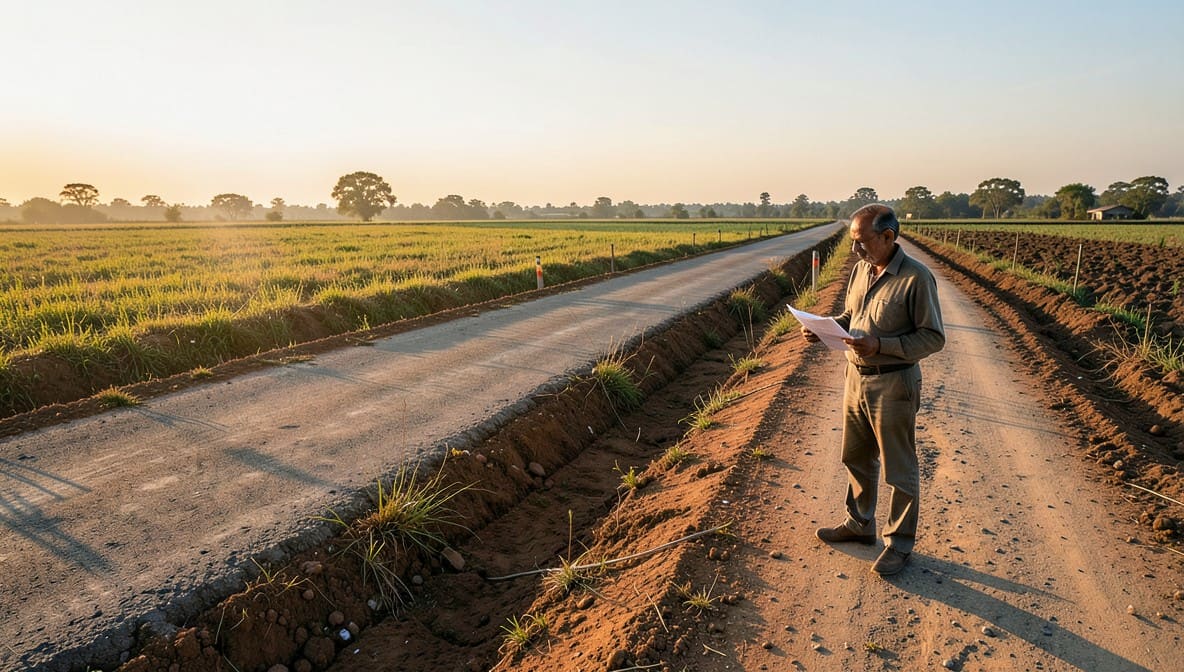
The petitioner, Khushram Manjhi, is the recorded owner of land bearing Khasra No. 412/1, measuring 0.14 acre, situated in Village Basantpur, Tahsil Bamhanidih, District Janjgir-Champa, Chhattisgarh. In 2017, the State undertook the construction of the Basantpur - Parsada - Ghoghari Road, acquiring land from multiple landowners in the village. An award dated 25.01.2017 was issued, and compensation was paid to other landowners whose properties were formally listed. However, the petitioner’s land, though physically utilized for the road alignment, was omitted from the award.
Key Facts
- The petitioner’s land is demarcated and physically used for the construction of the Basantpur - Parsada - Ghoghari Road
- The acquisition award dated 25.01.2017 did not include Khasra No. 412/1
- The petitioner became aware of the omission only after other landowners received compensation
- On 05.12.2025, the petitioner filed a representation before the Collector, Janjgir-Champa, seeking inclusion of his land in the award and payment of compensation
- The representation remained undecided for over 11 months
- No formal notice, inquiry, or demarcation process was initiated by the authorities prior to the filing of the writ petition
Procedural History
- 25.01.2017: Acquisition award issued for Basantpur - Parsada - Ghoghari Road, excluding petitioner’s land
- 05.12.2025: Petitioner filed representation before Collector, Janjgir-Champa (Annexure-P/2)
- 11 months: No decision rendered on the representation
- 2026: Writ Petition No. 1120 of 2026 filed under Article 226 of the Constitution
- 16.03.2026: Hearing before the High Court
Relief Sought
The petitioner sought a direction to the respondents, particularly the Collector (Respondent No. 3), to decide his representation dated 05.12.2025 without further delay and to provide compensation in accordance with law.
The Legal Issue
The central question was whether a landowner whose property is physically taken for a public project but omitted from the formal acquisition award is entitled to compensation under Article 300A of the Constitution, and whether the State can evade its obligation by citing delay in filing a claim.
Arguments Presented
For the Petitioner
Learned counsel for the petitioner submitted that the physical occupation and utilization of the petitioner’s land for the road project constituted a de facto acquisition. He relied on the principle that Article 300A protects property rights from arbitrary deprivation, regardless of whether the formal award includes the land. He emphasized that delay in filing a representation cannot extinguish a constitutional right, especially where the State has not initiated any inquiry or communicated with the landowner.
For the Respondent/State
The State’s counsel conceded that the petitioner’s land was indeed used for the road but argued that the representation was filed six to seven years after the award, rendering it time-barred or laches-ridden. He contended that the petitioner should have raised the issue immediately after the award was published and that the State was not obligated to re-open a concluded acquisition process.
The Court's Analysis
The Court observed that while property rights are no longer fundamental rights, they remain protected under Article 300A, which mandates that no person shall be deprived of property except by authority of law and with compensation. The Court held that the physical taking of land for a public purpose, irrespective of omission from the award, triggers the State’s obligation to provide compensation.
"If the petitioner’s land has been utilized for construction of the aforesaid road, then he is entitled to get compensation."
The Court rejected the State’s argument that delay alone could defeat the claim, noting that the petitioner had no notice or opportunity to challenge the award prior to its publication, and the State had not taken any steps to identify or notify him. The Court emphasized that administrative convenience cannot override constitutional obligations.
The Court further clarified that the remedy lies not in dismissing the claim on procedural grounds, but in directing the Collector to conduct a proper demarcation and determine entitlement based on factual evidence. The Court held that the State must follow due process, including verification, measurement, and assessment, before denying compensation.
The Verdict
The petitioner succeeded. The Court directed Respondent No. 3, the Collector of Janjgir-Champa, to decide the representation dated 05.12.2025 within 30 days of receipt of a copy of this order, after duly demarcating the land in question. If the demarcation confirms that the petitioner’s land was utilized for the road, the State shall provide appropriate compensation and consequential benefits in accordance with law within six months of such demarcation. All pending interlocutory applications were disposed of.
What This Means For Similar Cases
Constitutional Right Prevails Over Procedural Delay
- Practitioners must argue that Article 300A protects against de facto acquisition even without formal inclusion in an award
- Delay in filing a claim cannot be invoked by the State to deny compensation where the landowner had no notice or opportunity to object
- The burden shifts to the State to prove that the landowner was aware of the award and deliberately delayed
Demarcation Is a Mandatory Precondition
- Before denying compensation, authorities must conduct physical demarcation and verification
- Administrative silence or inaction cannot be treated as conclusive evidence of non-entitlement
- Courts will not permit the State to rely on technicalities when the factual deprivation is evident
Procedural Due Process Is Non-Negotiable
- Compensation must be determined following statutory procedures, including assessment, notice, and opportunity to be heard
- The six-month timeline set by the Court for payment after demarcation establishes a binding deadline for compliance
- Failure to comply may invite contempt proceedings or further judicial intervention