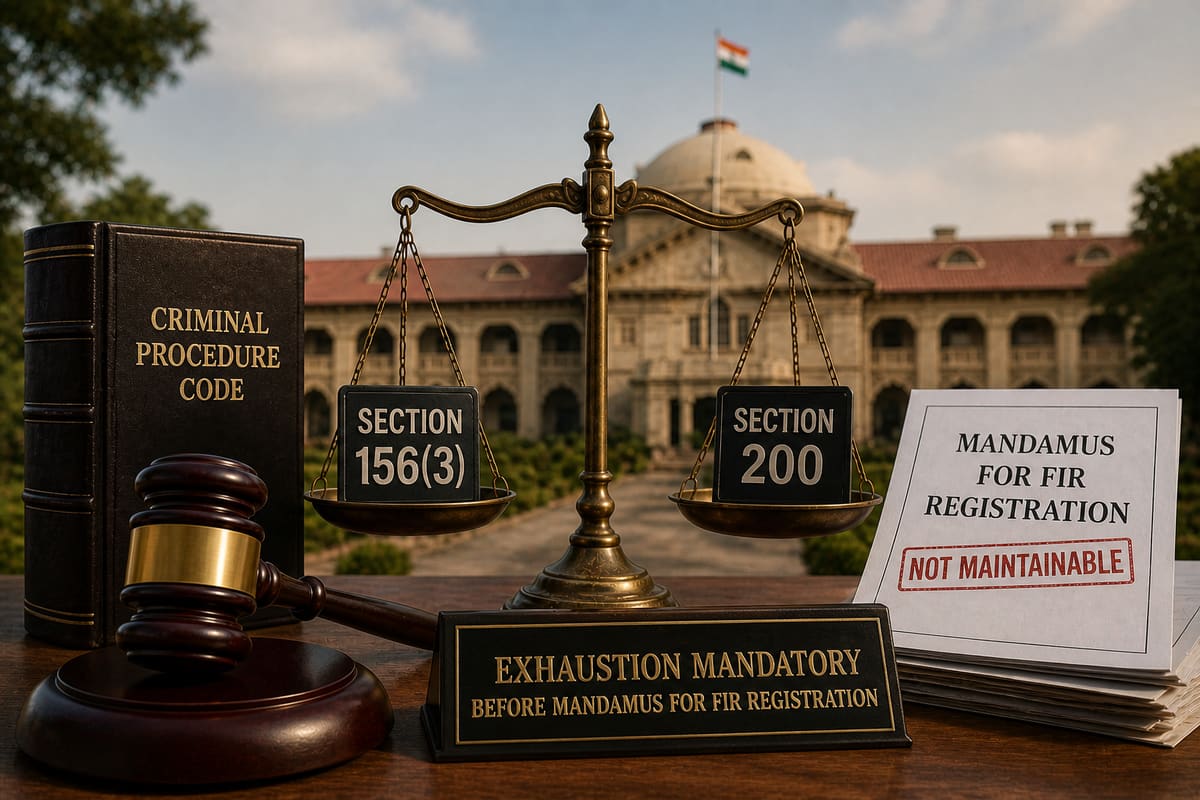
The Punjab and Haryana High Court has reaffirmed that the extraordinary writ jurisdiction under Article 226 of the Constitution cannot be invoked as a substitute for established statutory remedies, particularly when a complainant seeks FIR registration or investigation monitoring. The judgment underscores the principle of subsidiarity and judicial restraint, emphasizing that writ petitions must be grounded in demonstrable facts and not bald assertions.
Background & Facts
The Dispute
The petitioner, Lathesh Sanjeeva Kumble, alleged that private respondents No.6 to 9, associated with M/s Shri Lap Multiverse Pvt. Ltd., misrepresented the company’s financial status by falsely claiming a Rs.500 Crore bank guarantee. After the petitioner’s due diligence revealed the company’s bank account had been classified as a Non-Performing Asset (NPA), he refused to invest. Subsequently, he claims he was subjected to threats, physical assault, and coercive pressure to withdraw his objections. He further alleged that false criminal proceedings were initiated against him in Gujarat, while authorities in Haryana failed to act on his complaints.
Procedural History
The petitioner had previously approached the Court through multiple petitions:
- CRWPT-10098/2025: Disposed of on 17.09.2025 with directions to Respondent No.3 to pass a speaking order and ensure petitioner’s safety.
- CRMT-54167/2025: Transit anticipatory bail granted in Gujarat FIR No.11210015250116.
- COCPT-6093/2025: Contempt petition filed for non-compliance with earlier directions; notice issued on 11.12.2025.
- CRMT-3586/2026: Petition seeking SIT formation for investigation into threats.
- Representation dated 10.02.2026: Request for security personnel for petitioner and family.
Relief Sought
The petitioner sought protective directions under Article 226, including: (i) issuance of orders to ensure his safety; (ii) constitution of a Special Investigating Team (SIT); (iii) direction to register FIRs against the private respondents; and (iv) monitoring of ongoing investigations.
The Legal Issue
The central question was whether the High Court could invoke its extraordinary writ jurisdiction under Article 226 to direct FIR registration, SIT formation, or investigation monitoring when statutory remedies before a jurisdictional Magistrate under the Bharatiya Nagarik Suraksha Sanhita, 2023 (BNSS) were available and unexhausted.
Arguments Presented
For the Petitioner
The petitioner’s counsel argued that the petitioner’s life and liberty were under imminent threat, invoking Article 21. He contended that repeated complaints to police and administrative authorities had yielded no result, rendering statutory remedies ineffective. He relied on the Court’s earlier directions in CRWPT-10098/2025 and the subsequent non-compliance as grounds for invoking writ jurisdiction. He cited Arnesh Kumar v. State of Bihar to argue that the gravity of threats justified extraordinary intervention.
For the Respondent/State
The State did not file a detailed counter-affidavit, but the Court noted that the petitioner had not demonstrated any failure of the statutory mechanism. The Court observed that the petitioner had not shown why he could not approach the jurisdictional Magistrate under Sections 173 and 175 of BNSS, 2023, which explicitly empower Magistrates to direct FIR registration, monitor investigations, or change investigating officers.
The Court's Analysis
The Court conducted a thorough review of the petitioner’s pleadings and found them to be devoid of credible, corroborative material. It held that the petitioner’s allegations amounted to "bald assertions" lacking probative value. The Court emphasized that writ jurisdiction under Article 226 is not a substitute for criminal procedure and must be exercised only when no adequate alternative remedy exists.
"Mere bald and unsubstantiated averments, devoid of cogent material, do not confer upon the petitioner an entitlement to invoke the extraordinary writ jurisdiction of this Court."
The Court relied on its own precedent in AXXXX v. State of Punjab (2024), which clarified that jurisdictional Magistrates under BNSS, 2023 possess plenary powers to address grievances related to FIR registration and investigation. It further cited the Supreme Court’s ruling in Union of India v. T.R. Verma (1957), affirming that the existence of an efficacious statutory remedy is a decisive factor in refusing writ relief.
The Court held that the petitioner’s failure to exhaust remedies before the Magistrate - particularly after the Court had already directed a speaking order - constituted a clear departure from the principle of subsidiarity. It stressed that judicial discipline requires litigants to proceed through the hierarchy of remedies before approaching the High Court. To do otherwise would render legislative frameworks otiose and undermine the orderly administration of justice.
The Verdict
The petition was dismissed. The Court held that Article 226 cannot be invoked to circumvent statutory remedies under BNSS, 2023 for FIR registration or investigation oversight. The petitioner was directed to approach the jurisdictional Magistrate for any further relief.
What This Means For Similar Cases
Statutory Remedies Must Be Exhausted First
- Practitioners must advise clients to first approach the jurisdictional Magistrate under Sections 173 and 175 of BNSS, 2023 before filing a writ petition for FIR registration or investigation monitoring.
- Writ petitions filed prematurely will be dismissed unless the petitioner demonstrates exceptional circumstances, such as gross bias or complete inaction by the Magistrate.
Bald Assertions Are Insufficient for Writ Relief
- Petitions invoking Article 226 for personal safety must be supported by documentary evidence, medical reports, or police records - not mere allegations.
- Courts will not entertain speculative claims of threat without corroboration, even if the alleged offense is serious.
High Court’s Role Is Supervisory, Not Investigative
- The High Court is not a first-instance forum for criminal complaints.
- SIT formation or change of investigating officer must be sought through the Magistrate’s court unless there is clear evidence of systemic failure or collusion.