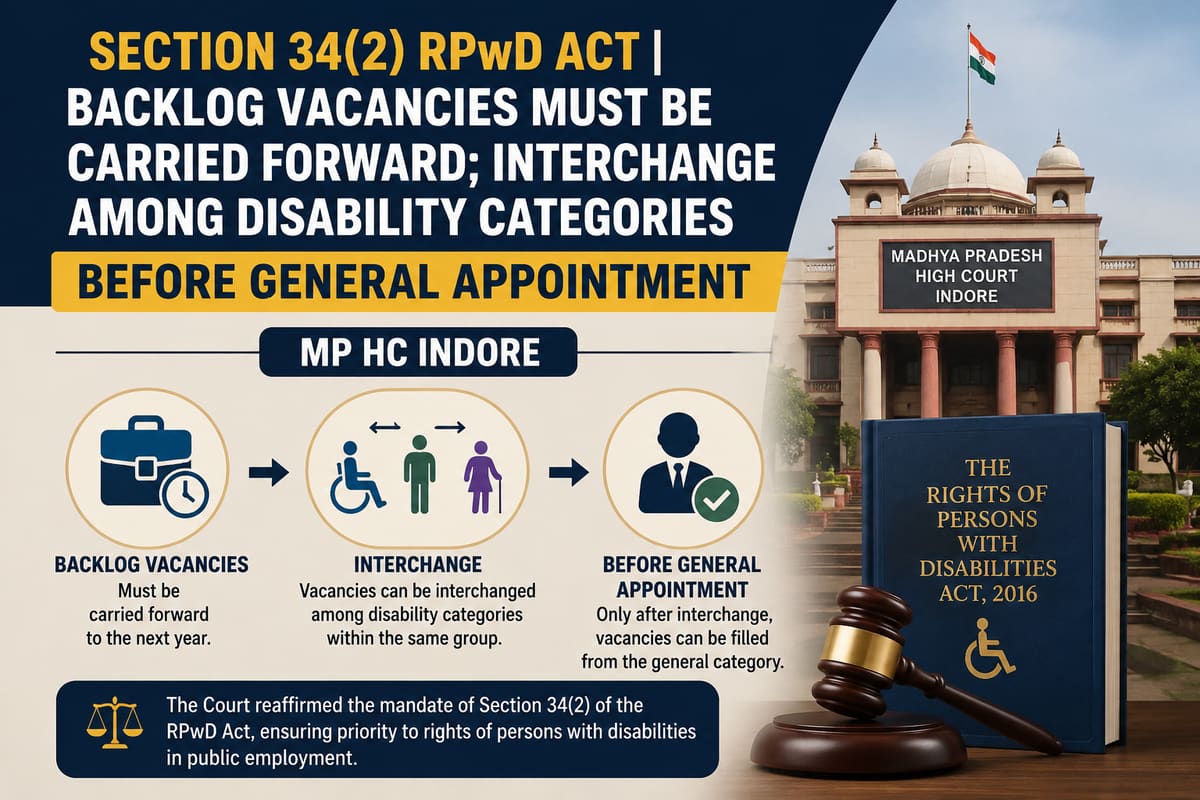
The Rajasthan High Court has intervened to protect the rights of a disabled candidate whose name appeared in a provisional selection list but was inexplicably omitted from the final list. The Court’s interim order reserving a post for the petitioner underscores the principle that administrative actions must comply with natural justice, particularly when dealing with reservations for disabled persons under the Rights of Persons with Disabilities Act, 2016.
Background & Facts
The Dispute
The petitioner, Arun Kumar Marmat, a candidate suffering from Locomotor Disability (LD) and Hearing Impairment (HI), applied for the post of Group Instructor/Surveyor/Assistant Apprenticeship Advisor (Grade-II) under the Multiple Disability category in the Rajasthan Technical Education Department. The respondents, including the Rajasthan Public Service Commission (RPSC), issued a provisional select list that included the petitioner’s roll number, with a cut-off mark of 32.43 for the Multiple Disability category. However, the final select list inexplicably marked the Multiple Disability category as ‘N.A.’ (Not Applicable) and omitted the petitioner’s roll number without any notice or justification.
Key Facts
- The petitioner applied for the post under the Multiple Disability category, citing Locomotor Disability (LD) and Hearing Impairment (HI).
- Provisional select list issued by the respondents included the petitioner’s roll number with a cut-off mark of 32.43.
- Final select list marked the Multiple Disability category as ‘N.A.’ and excluded the petitioner’s roll number.
- The respondents failed to provide any reason or intimation to the petitioner regarding his exclusion.
- The petitioner filed a writ petition challenging the arbitrary exclusion and seeking relief.
Procedural History
- Application submitted: Date not specified, but the petitioner applied for the post under the Multiple Disability category.
- Provisional select list issued: Included the petitioner’s roll number with a cut-off mark of 32.43.
- Final select list issued: Excluded the petitioner’s roll number and marked the category as ‘N.A.’.
- 13.07.2026: Writ Petition (S.B. Civil Writ Petition No. 14191/2026) filed before the Rajasthan High Court.
- 13.07.2026: Court issued notice to the respondents and passed an interim order reserving one post for the petitioner.
Relief Sought
The petitioner sought:
- Quashing of the final select list insofar as it excluded him without reason.
- A direction to the respondents to include his name in the final select list under the Multiple Disability category.
- An interim order reserving a post for him pending the final disposal of the writ petition.
The Legal Issue
The central question before the Court was whether the exclusion of a disabled candidate from the final select list, after their inclusion in the provisional list, without notice or justification, violates the principles of natural justice and the Rights of Persons with Disabilities Act, 2016.
Arguments Presented
For the Petitioner
- The petitioner’s counsel argued that the provisional select list included the petitioner’s roll number, establishing a legitimate expectation that he would be considered for the post.
- The arbitrary exclusion from the final list, without any reason or intimation, amounted to a violation of natural justice.
- The respondents’ action was discriminatory and contrary to the Rights of Persons with Disabilities Act, 2016, which mandates reservation and fair treatment for disabled candidates.
For the Respondents
- The judgment does not record any arguments presented by the respondents, as the matter was heard ex parte at the interim stage.
The Court's Analysis
The Court observed that the petitioner’s name was included in the provisional select list, which created a legitimate expectation that he would be considered for the post. The sudden exclusion from the final list, without any reason or notice, raised serious concerns about the fairness of the selection process.
The Court relied on the principle that administrative actions must comply with natural justice, particularly when dealing with reservations for disabled candidates. The Rights of Persons with Disabilities Act, 2016 imposes a statutory duty on authorities to ensure fair treatment and reservation for disabled persons. The respondents’ failure to provide any justification for the exclusion was arbitrary and unlawful.
"The respondents cannot be permitted to exclude a candidate from the final select list after including him in the provisional list, without assigning any reason or giving an opportunity of being heard."
The Court further noted that the interim relief granted by reserving a post for the petitioner was necessary to prevent irreparable harm and to ensure that the rights of disabled candidates are not defeated by arbitrary administrative actions.
The Verdict
The Court issued the following directions:
- Notice of the writ petition was issued to the respondents, returnable within four weeks.
- One post of Group Instructor/Surveyor/Assistant Apprenticeship Advisor (Grade-II) under the Multiple Disability category was reserved for the petitioner until the next date of hearing.
- The matter was listed for further consideration after the respondents file their reply.
What This Means For Similar Cases
Administrative Actions Must Comply With Natural Justice
- Authorities cannot exclude candidates from final selection lists without notice or justification, especially when they were included in provisional lists.
- Legitimate expectation arises when a candidate’s name appears in a provisional list, and any deviation must be reasoned and communicated.
- Practitioners should argue that arbitrary exclusions violate Article 14 of the Constitution and the principles of natural justice.
Rights of Disabled Candidates Must Be Protected
- The Rights of Persons with Disabilities Act, 2016 mandates reservation and fair treatment for disabled candidates.
- Courts are likely to intervene when authorities fail to comply with statutory duties under the Act.
- Disabled candidates can seek interim relief to prevent irreparable harm caused by arbitrary administrative actions.
Interim Relief as a Tool for Justice
- Courts may grant interim relief to reserve posts or maintain status quo when rights of disabled candidates are at stake.
- Practitioners should highlight the urgency and irreparable harm caused by arbitrary exclusions to secure interim orders.