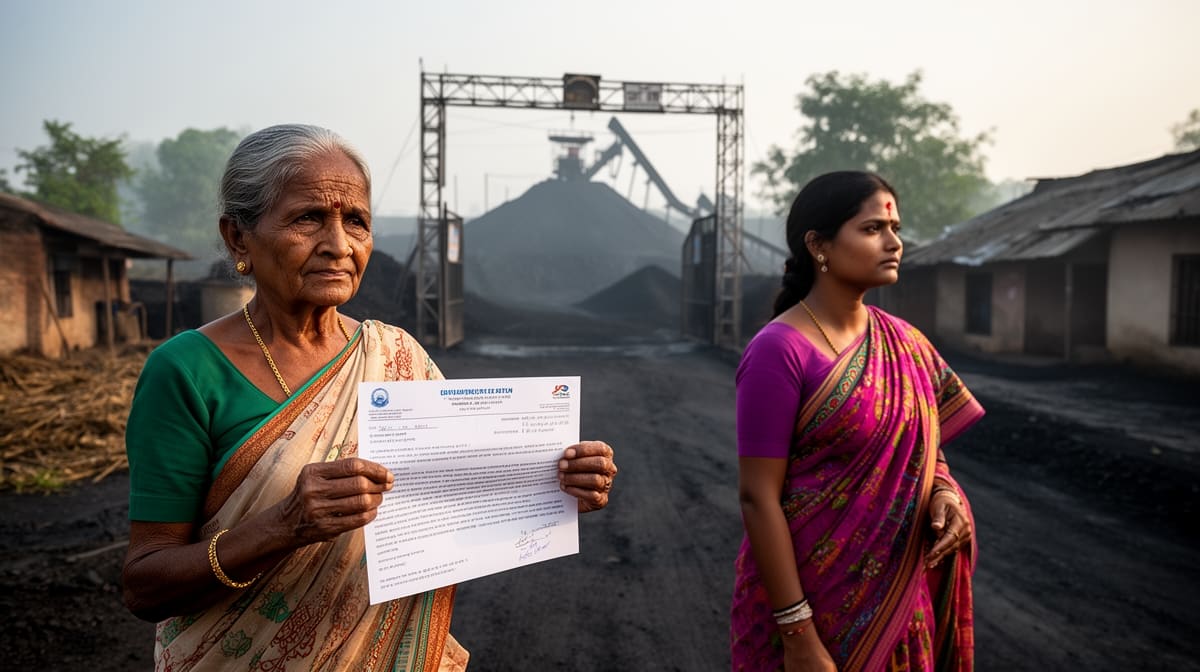
The Chhattisgarh High Court has decisively affirmed that exclusion of sisters from compassionate employment under the National Coal Wage Agreement violates constitutional guarantees of equality, establishing a binding precedent for all coal industry employers.
Background & Facts
The Dispute
The petitioners, Smt. Laxmaniya Binjhawar (72) and Smt. Beena Binjhawar (36), sought compassionate employment following the death of Rajaram, their son and brother, who died in a motor accident while working as a trainee with South Eastern Coalfields Limited (SECL). Rajaram was unmarried and the sole breadwinner for his widowed mother and widowed sister, both wholly dependent on his income. SECL rejected Beena’s application solely on the ground that its internal rules, aligned with NCWA Clause 9.3.3, do not recognize sisters as eligible dependents.
Procedural History
- 11 April 2022: Rajaram dies in harness while employed by SECL.
- December 2022: Beena Binjhawar applies for compassionate appointment.
- 24 December 2022: SECL issues a rejection letter citing Rule 9.3.3 of NCWA, which excludes sisters from the definition of "dependent."
- 2023: Writ Petition filed before the Chhattisgarh High Court challenging the rejection.
Relief Sought
The petitioners sought quashing of the rejection order and a direction to SECL to grant compassionate employment to Beena Binjhawar in place of her deceased brother, arguing that the exclusion of sisters is unconstitutional and discriminatory.
The Legal Issue
The central question was whether Clause 9.3.3 of the National Coal Wage Agreement (NCWA), which lists "brother" as a potential dependent but omits "sister," permits gender-based exclusion under Articles 14 and 15 of the Constitution, particularly when the sister is widowed and wholly dependent on the deceased.
Arguments Presented
For the Petitioner
Learned counsel argued that the exclusion of sisters constitutes gender discrimination in violation of Articles 14 and 15. He relied on Madhubala Sinha v. Central Coalfields Limited and Shimla D/o Late Satiram Rajbhar v. Western Coalfields Ltd., where High Courts held that the term "brother" in NCWA must be interpreted to include "sister" under Section 13 of the General Clauses Act, which mandates that masculine terms include females unless context dictates otherwise. He emphasized that the family had no other earning member and that the deceased’s employment arose from land acquisition, creating a moral and legal entitlement.
For the Respondent
SECL contended that NCWA Clause 9.3.3 is a binding contractual provision and cannot be judicially altered. It argued that Madhubala Sinha only directed monetary compensation, not appointment, and that Shimla was distinguishable as it involved Western Coalfields, not SECL. It further cited WPS No. 498/2016 to assert that prior judicial decisions did not bind SECL.
The Court's Analysis
The Court undertook a rigorous constitutional and statutory interpretation. It held that Clause 9.3.3 of the NCWA, while facially gender-neutral in structure, operates discriminatorily by granting employment rights to brothers while denying them to sisters under identical circumstances of dependency. The Court emphasized that Section 13 of the General Clauses Act mandates that masculine terms include females unless the context clearly indicates otherwise. The Court observed:
"If a brother, wholly dependent on the deceased, is eligible for compassionate appointment, there is no rational basis to deny the same to a sister who is equally dependent, equally destitute, and equally bereaved."
The Court distinguished Madhubala Sinha not on its outcome but on its reasoning, noting that the Jharkhand High Court had already held that excluding sisters violates Articles 14 and 15 and that the Supreme Court had dismissed the SLP against it, leaving the legal principle intact. The Court also relied on Shimla, where the Bombay High Court held that such exclusion is unreasonable and arbitrary. The Court rejected SECL’s argument that NCWA is a contractual document immune from constitutional scrutiny, noting that as a public sector entity under Article 12, SECL is bound by fundamental rights. The Court further noted that the deceased’s employment was tied to land acquisition, reinforcing the family’s legitimate expectation of benefit.
The Verdict
The petitioners succeeded. The Court held that the exclusion of sisters from compassionate employment under NCWA Clause 9.3.3 violates Articles 14 and 15 of the Constitution. The rejection order was quashed, and SECL was directed to consider Beena Binjhawar’s application afresh and grant her appointment within 60 days.
What This Means For Similar Cases
Compassionate Employment Must Be Gender-Neutral
- Practitioners must now argue that any policy excluding female blood relatives (sisters, married daughters) from compassionate appointments is unconstitutional.
- Employers under coal, mining, or public sector schemes must revise internal guidelines to align with constitutional equality.
Section 13 of the General Clauses Act Applies to Corporate Policies
- Even non-statutory schemes like NCWA, when implemented by state entities, are subject to Section 13 of the General Clauses Act.
- The term "brother" in any employment policy must be read to include "sister" unless explicitly and justifiably excluded.
Dependency, Not Marital Status, Is the Key Criterion
- Marital status of the claimant (e.g., widowhood) is irrelevant; actual dependency on the deceased is the sole legal test.
- Widowed sisters residing with the deceased family are entitled to the same consideration as widowed sons or brothers.
- Practitioners should collect and submit affidavits of dependency, income records, and proof of co-residence to strengthen claims.