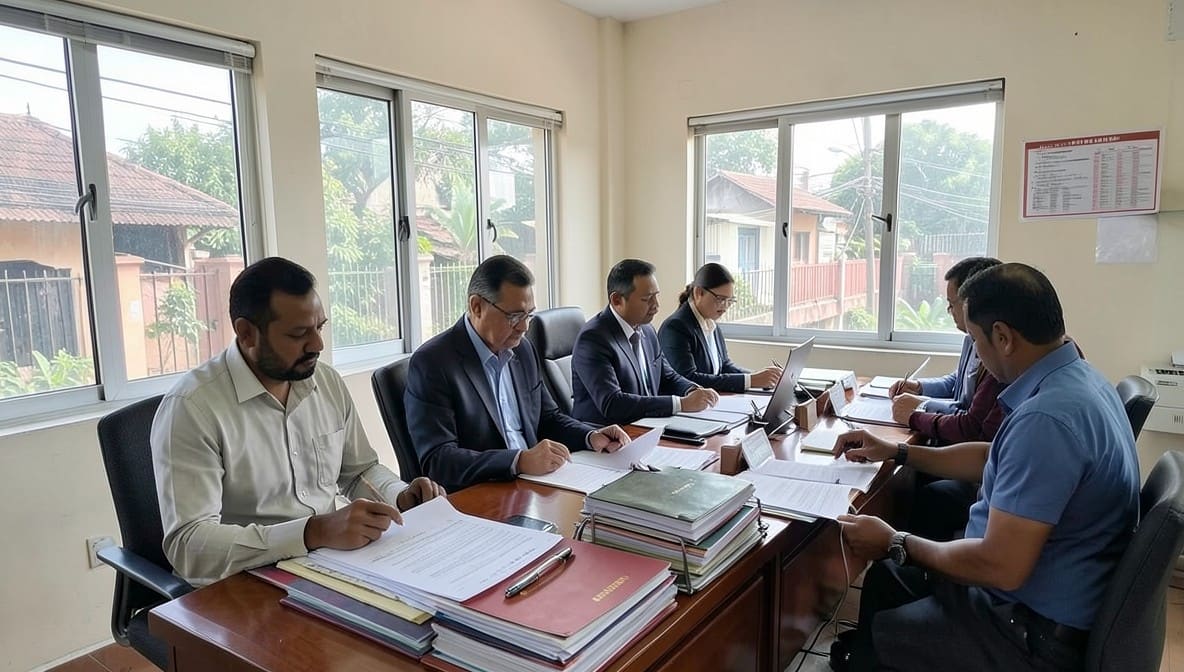
The Punjab and Haryana High Court has delivered a significant ruling affirming that public employers cannot enforce discriminatory policies in employee transfers, even when framed as administrative reforms. The judgment clarifies that constitutional guarantees under Article 14 demand uniformity in policy application, particularly when distinctions lack rational nexus to stated objectives.
Background & Facts
The Dispute
The petitioners, employees of Uttar Haryana Bijli Vitran Nigam Limited (UHBVN) and Dakshin Haryana Bijli Vitran Nigam Limited (DHBVN), sought inter-utility transfers between the two power distribution utilities. These transfers had historically been permitted on an ad hoc basis since 2006, with multiple batches of employees granted such transfers following judicial directions. The petitioners’ requests were repeatedly rejected after the promulgation of a policy dated 07.04.2026, which prohibited inter-utility transfers but applied only to Group C and D employees, excluding Group A and B officers.
Key Facts
- UHBVN and DHBVN are separate public sector utilities established under the Haryana Electricity Reform Act, 1997
- Inter-utility transfers were permitted informally from 2006 onwards, with multiple judicial orders (including Kashmeer Singh v. State of Haryana, CWP No. 25668 of 2017) directing consideration of such requests
- A formal transfer policy dated 26.07.2019 was issued for Group C recruits of 2019, permitting transfers under specified conditions
- On 08.07.2025, UHBVN rejected the petitioners’ transfer requests citing administrative discretion
- On 07.04.2026, UHBVN issued a comprehensive policy (Annexure R-2/1) prohibiting all inter-utility transfers between UHBVN and DHBVN
- The policy explicitly limited its scope to Group C and D employees only (Section 2)
- Group A and B officers remained exempt from the prohibition
- Petitioners had submitted transfer requests prior to the notification of the 07.04.2026 policy
- The policy cited objectives: avoiding administrative complexity, misuse of discretion, service disruptions, and workforce imbalance
Procedural History
- 2017 onwards: Multiple writ petitions filed before the High Court seeking inter-utility transfers; several were allowed with directions to consider requests
- 08.11.2023: Division Bench modified earlier order in LPA No. 58 of 2021, directing consideration of transfers for employees recruited in 2006, 2009, 2011, and 2023
- 27.09.2024: Contempt petition (COCP No. 1887 of 2024) filed; transfers granted to 16 employees in Kashmeer Singh’s case
- 19.02.2025: Writ Petition CWP No. 2311 of 2025 disposed of with direction to consider transfer requests within three months
- 08.07.2025: Speaking order issued rejecting petitioners’ requests
- 22.12.2025: Court directed the Principal Secretary, Energy Department, to file an affidavit proposing a coherent transfer policy
- 07.04.2026: UHBVN issued Policy on Prohibition of Inter-Utility Transfers (Annexure R-2/1), applicable only to Group C and D
- 08.04.2026: Final hearing held; petitioners challenged the discriminatory scope of the policy
The Parties' Positions
For the Petitioners
- The 07.04.2026 policy is arbitrary and violative of Article 14 because it excludes Group A and B officers while imposing a blanket ban on Group C and D employees
- The stated objective of administrative efficiency cannot justify differential treatment without intelligible differentia
- The policy cannot be applied retrospectively to deny benefits already sought before its notification
- Judicial precedents (Kashmeer Singh, Vinod Kumar) established a legitimate expectation of transfer consideration
- The policy violates the principles of fairness and non-arbitrariness under Articles 14 and 21
For the Respondent (UHBVN/DHBVN)
- Inter-utility transfers are not a vested right and are subject to administrative discretion
- The policy was framed to prevent chaos, misuse of discretion, and operational inefficiencies
- Group A and B officers are excluded because their transfers are governed by separate service rules and deputation policies
- The policy is intra-utility and does not affect fundamental rights
- The policy is still subject to Board approval and is not yet fully effective
Relief Sought
The petitioners sought:
- Quashing of the 07.04.2026 policy to the extent it excludes Group A and B employees
- Direction to consider their pending transfer requests under the principles established in prior judgments
- Declaration that the policy, as applied, violates Article 14
- In the alternative, direction to amend the policy to apply uniformly to all employee categories
The Legal Issue
The central question was whether a public employer’s policy prohibiting inter-utility transfers can constitutionally apply only to Group C and D employees while exempting Group A and B officers, and whether such classification bears a reasonable nexus to the stated objective of administrative efficiency.
Arguments Presented
For the Petitioner
The petitioners relied on Maneka Gandhi v. Union of India and Ajay Hasia v. Khalid Mujib Sehravardi to argue that Article 14 prohibits arbitrary classification. They contended that the policy’s exclusion of higher-ranking officers had no rational basis, as the stated objectives - administrative complexity, service disruption, and workforce imbalance - apply equally to all employees regardless of group. They emphasized that the policy was issued after their requests were pending, and thus could not be applied retrospectively to defeat legitimate expectations. The petitioners also cited L.I.C. v. Consumer Education & Research Centre to assert that fairness is an essential component of Article 21, and that public employers must act with transparency and non-discrimination.
For the Respondent
The respondents argued that inter-utility transfers are not a right but a privilege subject to administrative policy. They claimed that Group A and B officers operate under distinct service rules, including deputation and central government postings, and thus could not be equated with Group C and D employees. They further asserted that the policy was still under internal Board approval and not yet fully operative, and that the exclusion was a pragmatic administrative decision to avoid conflict with existing service regulations for senior officers.
The Court's Analysis
The Court began by acknowledging that transfer decisions are generally within the domain of administrative discretion, citing Union of India v. S.L. Abbas and N.K. Singh v. Union of India. However, it emphasized that while courts must not substitute their judgment for that of the employer, they are duty-bound to intervene when administrative action becomes arbitrary or discriminatory.
"The principle of reasonableness, which legally as well as philosophically, is an essential element of equality or non-arbitrariness pervades Article 14 like a brooding omnipresence."
The Court examined the 07.04.2026 policy and found that while its objective - promoting operational autonomy and preventing administrative chaos - was legitimate, its implementation was fundamentally flawed. The policy prohibited inter-utility transfers for Group C and D employees but made no such restriction for Group A and B officers. The Court held that this distinction lacked any intelligible differentia. The reasons cited for the policy - misuse of discretion, service disruption, and workforce imbalance - were not mitigated by exempting senior officers; in fact, senior officers were more likely to influence transfers through informal channels.
The Court further noted that the State, as a model employer, is held to a higher standard of constitutional compliance. The selective application of the policy created two classes within the same workforce, with no justification for privileging one group over another. The Court rejected the argument that Group A and B officers were governed by separate rules, observing that such rules did not logically justify excluding them from a policy designed to prevent the very problems those rules were meant to address.
The Court also dismissed the claim that the policy was not yet effective due to pending Board approval, noting that the policy had been formally notified and was being used to reject pending applications. The Court held that the policy’s retrospective application to pending requests was permissible only if the policy itself was constitutionally valid - which it was not, due to its discriminatory scope.
The Verdict
The petitioners succeeded. The Court held that:
- The policy dated 07.04.2026 (Annexure R-2/1) shall apply uniformly to all employees of UHBVN and DHBVN, without distinction based on Group classification
- Section 2 of the policy, which limits its application to Group C and D employees, is declared void and violative of Article 14 of the Constitution
- No inter-utility transfers shall be permitted between UHBVN and DHBVN except as provided under Section 4 of the policy (national emergencies, court orders, deputation, regulatory directives)
- The respondents are directed to amend the policy within six weeks to remove the discriminatory classification
- Pending transfer requests submitted prior to 07.04.2026 shall be reconsidered under the revised, non-discriminatory policy
- Any future violation of this order shall invite contempt proceedings under Article 215
What This Means For Similar Cases
Uniformity in Policy Application Is Non-Negotiable
- Public employers cannot create internal classifications that exempt senior staff from rules imposed on junior staff unless a rational, documented justification exists
- Any policy must be applied uniformly across all categories of employees if the stated objective is organizational efficiency or administrative fairness
- Discriminatory application of policies, even if framed as "practical" or "administrative convenience," will be struck down under Article 14
Legitimate Expectation Survives Policy Change
- Employees who have submitted transfer requests before a new policy is notified retain the right to have those requests considered under the principles of fairness and non-arbitrariness
- A new policy cannot be used to retrospectively nullify pending applications unless it is constitutionally valid and non-discriminatory
- Courts will protect legitimate expectations arising from past practice and judicial directions
Public Employers Must Act as Model Institutions
-
Government entities are held to a higher standard of constitutional compliance than private employers
-
Arbitrary or selective enforcement of rules undermines public trust and violates the spirit of Article 14
-
Administrative discretion must be exercised within the bounds of reasonableness, fairness, and equality
-
Practitioners must challenge policies that apply differently to different employee groups without objective justification
-
When drafting or reviewing service policies, ensure that exemptions are tied to functional necessity, not hierarchical privilege
-
Always verify whether a policy’s stated objectives are equally applicable to all affected classes before accepting its validity