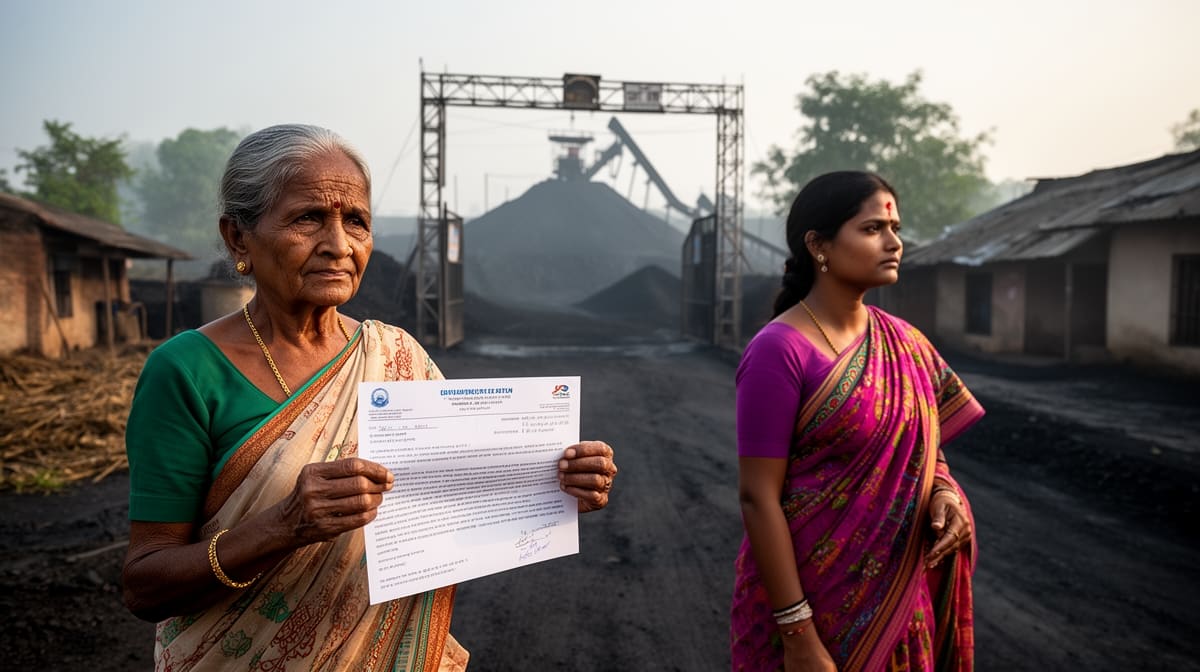
The Bombay High Court, Nagpur Bench, has unequivocally affirmed that marital status cannot be a disqualifying factor for compassionate appointment of a deceased employee’s daughter. This ruling reinforces the constitutional principle of non-discrimination and aligns public sector employment policy with evolving norms of gender equality.
Background & Facts
The Dispute
The petitioners, including Pooja Suresh Khadase (now Pooja Pravin Mandaokar), sought compassionate appointment to the post of a dependant daughter following the death of her father, a deceased employee of Western Coalfields Limited (WCL). The respondent rejected her application solely on the ground that she was a married daughter, invoking an internal policy that excluded married daughters from eligibility.
Procedural History
- 2022: Petitioner No.1 applied for compassionate appointment; application rejected on grounds of marriage.
- 2023: This Court, in Writ Petition No. 1177/2022, held that denying compassionate appointment to married daughters is legally unsustainable.
- 2025: Petitioners filed the present writ petition seeking enforcement of the 2023 precedent, as WCL again applied the same discriminatory criterion.
Relief Sought
The petitioners sought quashing of the communication dated 17/03/2022 rejecting their application and directed WCL to reconsider their applications without regard to marital status.
The Legal Issue
The central question was whether a married daughter of a deceased government employee can be categorically excluded from consideration for compassionate appointment under the principle of non-discrimination and equal protection under Article 14 of the Constitution.
Arguments Presented
For the Petitioner
The petitioners relied on the binding precedent set in Writ Petition No. 1177/2022, where this Court held that excluding married daughters from compassionate appointment violates Article 14 and Article 15(1). They argued that marital status has no rational nexus with the objective of providing financial relief to dependants, and that such exclusion perpetuates gender-based stereotypes. They further cited Vishaka v. State of Rajasthan to underscore the constitutional imperative of gender justice.
For the Respondent
The respondents conceded that the issue was already decided in the 2023 judgment but argued that internal office memoranda permitted exclusion of married daughters as a matter of administrative practice. They contended that the policy was rooted in historical norms and that reconsideration would require policy revision at the central level.
The Court's Analysis
The Court emphasized that administrative policies must conform to constitutional mandates, not the other way around. It held that the distinction drawn between married and unmarried daughters is arbitrary and lacks any reasonable classification. The Court observed that the primary objective of compassionate appointment is to alleviate financial hardship suffered by dependants, and marriage does not sever the emotional or economic dependency of a daughter on her deceased parent.
"The exclusion of married daughters from the ambit of compassionate appointment is not only discriminatory but also contrary to the spirit of equality enshrined in the Constitution. The state cannot perpetuate archaic notions of family structure under the guise of administrative convenience."
The Court further noted that the 2023 judgment was binding under Article 141 and that WCL’s continued application of the same discriminatory criterion amounted to defiance of judicial authority. The Court rejected the argument that policy change required central approval, holding that compliance with constitutional rulings is non-negotiable.
The Verdict
The petitioners succeeded. The Court held that marital status cannot be a ground for rejecting compassionate appointment applications by daughters of deceased employees. It quashed the impugned communication and directed WCL to reconsider the applications within six weeks, without reference to the petitioner’s marital status.
What This Means For Similar Cases
Compassionate Appointment Cannot Be Gendered
- Practitioners must now challenge any policy or circular that excludes married daughters, sisters, or widowed daughters from compassionate appointment schemes.
- Public sector employers must revise internal guidelines to remove gender-based eligibility criteria.
- Courts will treat such exclusions as prima facie violations of Article 14.
Precedent Binding Even Without Formal Policy Change
- A judicial order declaring a policy unconstitutional binds the implementing authority immediately, regardless of pending administrative revisions.
- Delayed compliance or continued application of invalidated rules constitutes contempt of court.
- Petitioners may seek contempt proceedings if deadlines for reconsideration are not met.
Administrative Convenience Cannot Override Constitutional Rights
- Arguments based on "historical practice" or "administrative burden" are legally untenable when they conflict with fundamental rights.
- Public employers must proactively audit their policies for gender-neutral compliance.
- This judgment sets a benchmark for similar cases under coal, steel, railways, and other public sector undertakings governed by similar schemes.