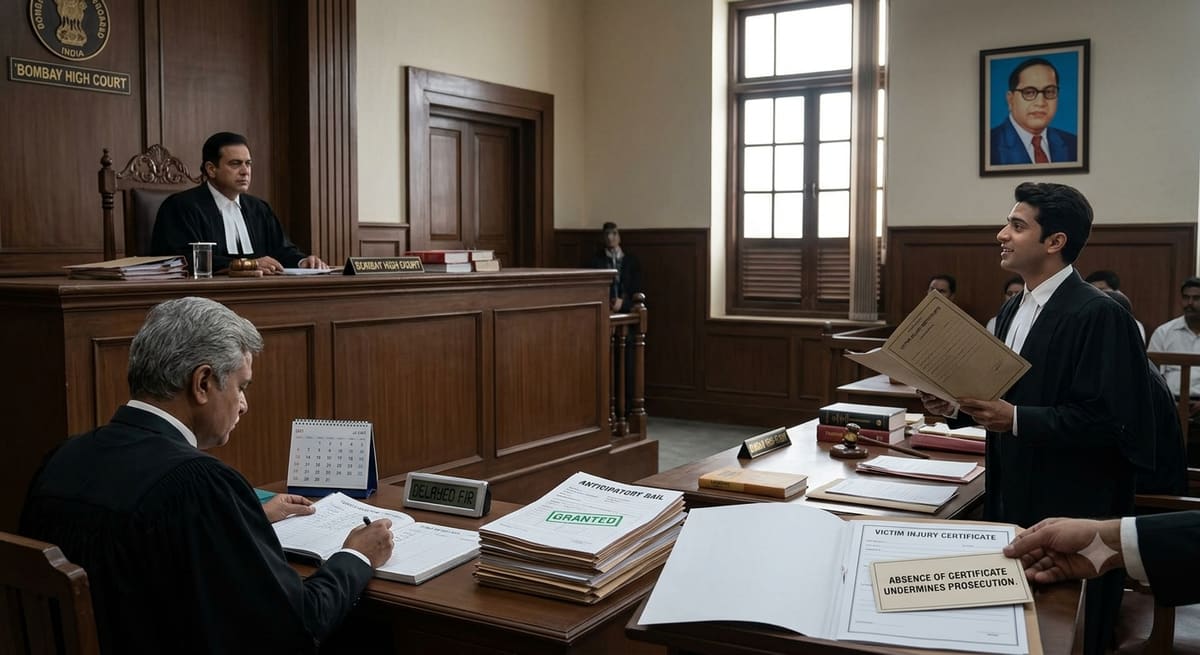
The Bombay High Court has reaffirmed that anticipatory bail must be granted where the allegations lack corroboration and procedural delays raise reasonable doubt about the veracity of the complaint. In this case, the absence of an injury certificate for the alleged victim’s son, coupled with a four-day delay in lodging the FIR, tipped the balance in favor of protecting personal liberty pending investigation.
Background & Facts
The Dispute
The applicants - Ravindra Nanasaheb Mote, Annasaheb Lahu @ Sunny Mote, and Sanket s/o Bajirao Mote - are sought to be prosecuted in connection with Crime No. 0055/2026 registered at Shanishingnapur Police Station, District Aihalyanagar. The case arises from an alleged nighttime intrusion into the premises of the informant, who operates a Kala Kendra. The prosecution alleges that the applicants and co-accused forcibly entered the property, committed theft of gold ornaments and cash, and assaulted the informant and his son, Satyajeet.
Key Facts
The incident is alleged to have occurred on 21.04.2026 at approximately 11:00 pm
The First Information Report (FIR) was lodged on 25.04.2026, four days after the alleged incident
The informant claims injuries to himself and his son, Satyajeet
An injury certificate was produced for the informant, indicating only simple injuries
No injury certificate or medical report exists for Satyajeet, the son
The applicants have no prior criminal record
The Kala Kendra operated by the informant was reportedly opposed by the applicants and others, suggesting a possible motive for false implication
Procedural History
21.04.2026: Alleged incident of forced entry, theft, and assault
25.04.2026: FIR registered at Shanishingnapur Police Station
02.07.2026: Anticipatory Bail Application No. 871 of 2026 filed before the Bombay High Court, Aurangabad Bench
02.07.2026: Hearing conducted before Justice R. M. Joshi
The Parties' Positions
For the Applicants
The applicants’ counsel, Mr. A. B. Jagtap, argued that:
Co-accused in the same case have already been granted anticipatory bail
The injury certificate does not substantiate the allegation of assault on Satyajeet, the informant’s son
The four-day delay in filing the FIR is unexplained and raises suspicion of fabrication
The applicants have no criminal antecedents
The dispute may stem from prior opposition to the Kala Kendra, indicating potential malice
For the Respondent/State
The Additional Public Prosecutor, Mr. N. R. Dayama, opposed the application on the grounds that:
The allegations involve serious offences under the Bharatiya Nyaya Sanhita, including robbery and assault
The nighttime intrusion and theft constitute grave violations of personal security
The nature of the offences warrants custodial interrogation
The applicants must be held accountable pending investigation
Relief Sought
The applicants sought pre-arrest bail in the event of arrest, with conditions to ensure cooperation with the investigation and protection of witnesses.
The Legal Issue
The central question was whether anticipatory bail can be granted under Section 438 of the Code of Criminal Procedure where the FIR is delayed, medical evidence fails to corroborate key allegations, and the accused have no prior criminal record.
Arguments Presented
For the Applicants
The counsel relied on the principle that personal liberty is the norm and custody the exception, as affirmed in Arnesh Kumar v. State of Bihar. He emphasized that the absence of an injury certificate for the son undermines the assault allegation, and the delay in lodging the FIR, without explanation, casts doubt on the prosecution’s version. He further cited Sushil Ansal v. State to argue that where allegations are general and lack specific corroboration, liberty should not be denied at the pre-arrest stage.
For the Respondent/State
The State contended that the offences under Sections 119(1), 332(c), 118(1), 189(1), 190, 191(1), 191(2), 191(3) of the Bharatiya Nyaya Sanhita are non-bailable and involve violence and theft, which necessitate custodial interrogation. It argued that the court should not interfere with the investigation process and that the gravity of the offences outweighs the procedural irregularities.
The Court's Analysis
The Court conducted a detailed review of the FIR and the injury certificate. It noted that while the FIR alleges assault on both the informant and his son, the injury certificate only confirms simple injuries to the informant. No medical record exists for Satyajeet, rendering the assault allegation against him unsubstantiated.
"Considering the delay caused in lodging of the First Information Report and also in view of the fact that Kala Kendra run by the informant was opposed by the Applicants and others, possibility of false implication/over implication is not ruled out."
The Court observed that the delay of four days in filing the FIR, without any plausible explanation, is a significant factor under State of Haryana v. Bhajan Lal, which permits courts to scrutinize the credibility of complaints in anticipatory bail matters. The Court further noted that co-accused have already been granted bail, indicating that the investigation has not yet reached a stage requiring custodial detention of all accused.
The Court emphasized that the stage of investigation is still early, and the applicants’ cooperation can be secured through conditions rather than arrest. The Court held that the liberty of the applicants must be protected pending further investigation, especially where the evidence is weak and the allegations are not fully corroborated.
The Verdict
The applicants succeeded. The Court granted anticipatory bail subject to the following conditions:
In the event of arrest, each applicant shall be released on furnishing a personal bond of Rs. 15,000/- with one surety of the like amount
They shall attend the concerned police station on 09.07.2026 and 13.07.2026 between 11:00 am to 1:00 pm, and thereafter as directed in writing by the Investigating Officer
They shall not contact any witness directly or indirectly
They shall not interfere with evidence in any manner
They shall fully cooperate with the investigating agency
The Additional Public Prosecutor shall communicate this order to the Investigating Officer
The Court clarified that its observations are confined to the anticipatory bail application and shall not influence the trial court.
What This Means For Similar Cases
Delay in FIR Can Undermine Prosecution Credibility
Practitioners must highlight unexplained delays in FIR registration as a ground for anticipatory bail
Courts are increasingly willing to question the veracity of complaints where delay is coupled with weak corroborative evidence
A delay of more than 72 hours without justification may trigger judicial scrutiny under Bhajan Lal
Medical Evidence Must Match Allegations
Assault allegations without supporting medical reports are vulnerable to challenge
In cases involving multiple victims, failure to produce injury certificates for all alleged victims weakens the prosecution’s case
Courts will not accept general allegations without specific, documented proof
Pre-Arrest Bail Is Not Denied Solely on Gravity of Offence
The Court reaffirmed that gravity of offence alone cannot override the presumption of innocence
The availability of bail to co-accused is a relevant factor in assessing the necessity of custodial detention
Conditions such as reporting to police and non-interference with witnesses are sufficient safeguards in early-stage investigations