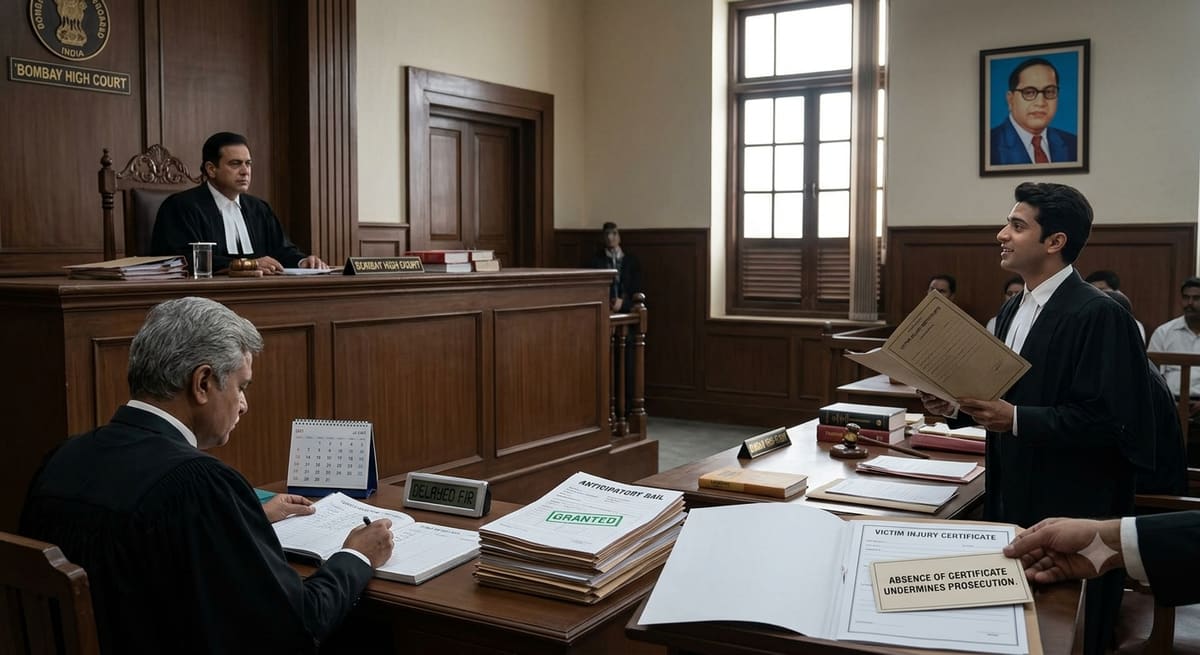
The Bombay High Court has reaffirmed that the absence of corroborative medical evidence in cases under the Bharatiya Nyaya Sanhita significantly impacts the assessment of seriousness in anticipatory bail applications. This order underscores the necessity of judicial scrutiny beyond mere allegations, particularly where the gravity of the offence hinges on physical harm.
Background & Facts
The Dispute
The applicants, Atul Subhash Jadhav and others, are accused in Crime No. 0082/2026 registered at Ambi Police Station, District Dharashiv, for alleged assault on an informant on 13.05.2026. The charges include offences under Sections 333, 118(1), 115(2), 352, 351(2), 351(3) read with Section 3(5) of the Bharatiya Nyaya Sanhita, and Sections 4 and 25 of the Arms Act. The applicants were denied anticipatory bail by the Additional Sessions Court, prompting this application before the Bombay High Court.
Key Facts
- The alleged incident occurred on 13.05.2026 at Ambi, District Dharashiv
- The complainant alleged physical assault resulting in injury
- No injury certificate or medical report was produced before the Additional Sessions Court at the time of rejecting anticipatory bail
- The applicants have not been arrested as of the date of this hearing
- The prosecution has not filed a charge sheet as of 19.06.2026
- The applicants are residents of Maharashtra and have no prior criminal record
Procedural History
- 13.05.2026: Alleged assault incident and FIR registration (Crime No. 0082/2026)
- 05.06.2026: Application for anticipatory bail filed before Additional Sessions Court
- 10.06.2026: Additional Sessions Court rejected anticipatory bail application without recording whether injury certificate was produced
- 15.06.2026: Anticipatory Bail Application No. 998 of 2026 filed before Bombay High Court, Aurangabad Bench
- 19.06.2026: Hearing before Justice R. M. Joshi
The Parties' Positions
For the Applicants: The learned Advocate, Mr. Rahul R. Karpe, submitted that the rejection of anticipatory bail by the lower court was based solely on the allegations without any evidentiary support, particularly the absence of an injury certificate. He argued that the offence under Section 118(1) of the Bharatiya Nyaya Sanhita requires proof of actual harm, and without medical corroboration, the seriousness of the charge is diminished.
For the Respondent/State: Ms. P. J. Bharad, Additional Public Prosecutor, opposed interim relief, contending that the allegations were serious and that granting bail at this stage would prejudice the investigation.
Relief Sought
The applicants sought interim protection from arrest pending final hearing of the anticipatory bail application, along with conditions to ensure cooperation with the investigation.
The Legal Issue
The central question was whether the absence of an injury certificate in a case under Section 118(1) of the Bharatiya Nyaya Sanhita renders the allegation of assault insufficient to justify denial of anticipatory bail, and whether the lower court’s failure to record evidence constitutes a procedural flaw warranting intervention.
Arguments Presented
For the Appellant/Petitioner
The applicants relied on the principle that anticipatory bail cannot be denied solely on the basis of the nature of the offence without evaluating the evidentiary foundation. They cited Arnesh Kumar v. State of Bihar to argue that courts must apply the triple test - gravity of offence, likelihood of flight, and possibility of tampering - before denying liberty. The absence of an injury certificate, they submitted, undermines the prosecution’s claim of serious physical harm, making the case more suitable for bail. They further emphasized that the lower court’s order was silent on whether any medical evidence was produced, rendering it non-compliant with procedural fairness.
For the Respondent/State
The State contended that the allegations under Sections 333 and 118(1) involve violence against a public servant and are inherently serious. It argued that the investigation was at an early stage and that granting bail might lead to witness intimidation or evidence destruction. The State did not dispute the absence of an injury certificate but maintained that the allegations themselves, if proven, warranted denial of bail.
The Court's Analysis
The Court examined the record and found that the Additional Sessions Court’s order failed to address whether an injury certificate was produced or even sought. Under Section 118(1) of the Bharatiya Nyaya Sanhita, which criminalizes causing hurt to a public servant in the discharge of duty, the prosecution must establish not only the act but also the resulting injury. The Court observed:
"Prima facie, a perusal of the record indicates that the offence alleged against the present applicants is punishable under Section 118(1) of the Bharatiya Nyaya Sanhita. It is pertinent to note that the order passed by the learned Additional Sessions Court does not record that any injury certificate was produced or obtained in respect of the injuries allegedly sustained by the informant."
The Court held that the lower court’s omission to consider or record the absence of medical evidence was a material flaw. It emphasized that procedural fairness demands that courts not rely on uncorroborated allegations when liberty is at stake. The Court further noted that the applicants had no prior criminal antecedents, were not attempting to evade investigation, and had offered to cooperate fully. The Court distinguished this case from those involving premeditated violence or organized crime, where denial of bail is more readily justified.
The Verdict
The applicants succeeded. The Court granted interim anticipatory bail with the following conditions: (i) If arrested, each applicant shall be released on furnishing a PR Bond of Rs. 15,000 with one solvent surety of like amount; (ii) They shall attend the police station upon written intimation; (iii) They shall not contact witnesses directly or indirectly; (iv) They shall not interfere with evidence; (v) They shall fully cooperate with the investigating agency. The order is effective until the next hearing on 15.07.2026.
What This Means For Similar Cases
Absence of Medical Evidence Weakens Prosecution’s Case
- Practitioners must insist on production of injury certificates in all cases under Sections 333, 118(1), and similar provisions of the Bharatiya Nyaya Sanhita
- Courts cannot presume injury from mere allegation; absence of medical proof must be recorded and weighed
- Applications for anticipatory bail in assault cases should be supported by affidavits or submissions highlighting lack of medical corroboration
Procedural Silence by Lower Courts Is Grounds for Intervention
- High Courts will intervene where lower courts fail to record evidentiary considerations
- Orders denying bail without addressing key evidence (e.g., injury certificates, forensic reports) are vulnerable to challenge
- Advocates should flag procedural omissions in bail orders as grounds for appellate relief
Proportionality in Bail Decisions Is Paramount
- The Court reaffirmed that gravity of offence alone cannot override liberty interests
- Applicants with clean records and willingness to cooperate are entitled to conditional bail even in serious cases
- Conditions such as PR Bond, non-contact with witnesses, and cooperation with investigation are sufficient safeguards