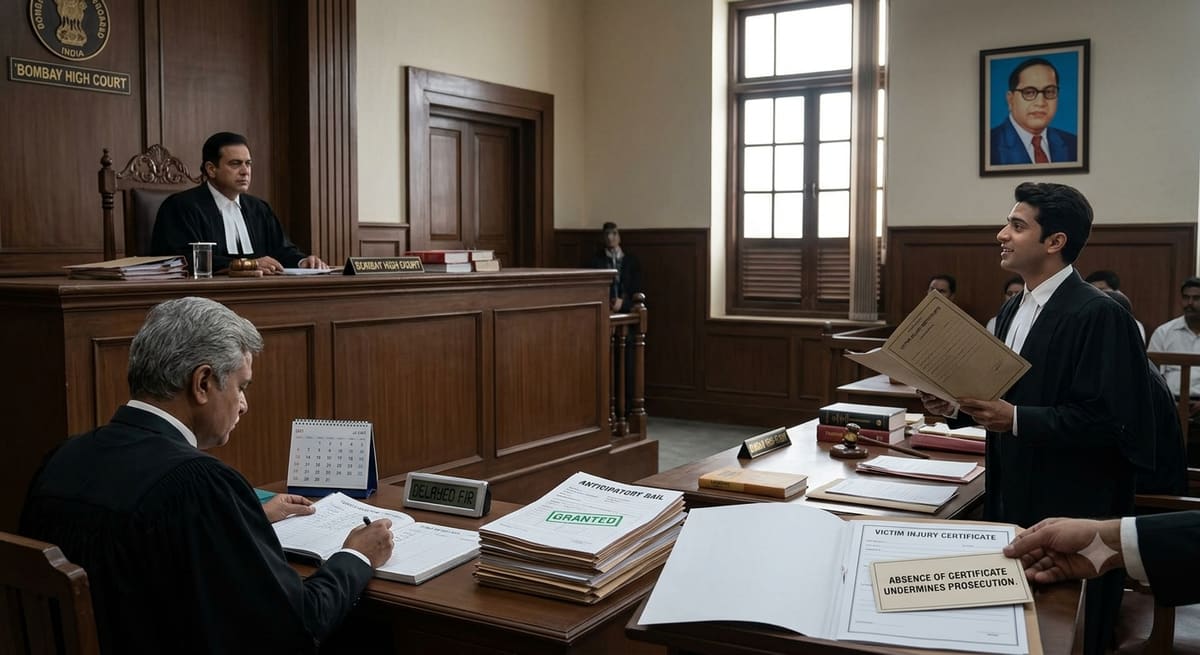
The Bombay High Court's recent order in Ibrahim Bana Shaikh v. State of Maharashtra underscores the judiciary's role in scrutinizing procedural lapses, such as delayed FIRs and unreliable medical evidence, to prevent potential miscarriages of justice. The Court granted interim anticipatory bail, emphasizing the need to protect liberty when false implication is suspected.
Background & Facts
The Dispute
The applicants - Ibrahim Bana Shaikh, Yusuf Bana Shaikh, and Sadiq Bana Shaikh - are accused in Crime No. 0422/2026, registered at Bidkin Police Station, District Chhatrapati Sambhajinagar, for offences under Sections 109, 118(1), 352, 351(2), 190, 191(2), and 191(3) of the Bharatiya Nyaya Sanhita. The First Information Report (FIR) was lodged 17 days after the alleged incident, raising concerns about the veracity of the accusations.
Key Facts
The incident occurred on an unspecified date, but the FIR was filed 17 days later, suggesting potential procedural irregularities.
A counter report exists at the instance of the applicant Sadiq, indicating a conflicting narrative.
The medical certificate from Lilasons Hospital certifies grievous injuries, including abrasions, without evidence of fractures, casting doubt on its accuracy.
The Sessions Court had previously rejected the applicants' pre-arrest bail application, but the High Court noted the absence of injury certificate scrutiny in the lower court's order.
Procedural History
Date of Incident: Not specified, but FIR lodged 17 days later (exact date not mentioned).
Crime No. 0422/2026: Registered at Bidkin Police Station for offences under the Bharatiya Nyaya Sanhita.
Pre-Arrest Bail Application: Rejected by the Sessions Court (order not dated).
13.07.2026: Anticipatory Bail Applications (Nos. 1210/2026 and 1212/2026) filed before the Bombay High Court.
13.07.2026: Criminal Applications (Nos. 2797/2026 and 2798/2026) allowed, permitting the informant's counsel to assist the prosecution.
13.07.2026: Interim anticipatory bail granted pending further hearing.
The Parties' Positions
For the Applicants
Argued that the delay of 17 days in lodging the FIR and the existence of a counter report suggest false implication.
Highlighted the lack of scrutiny of the medical certificate by the Sessions Court, which erroneously certified abrasions as grievous injuries.
Sought interim protection of liberty until the prosecution's arguments are heard.
For the Respondent/State and Informant
Opposed the grant of interim protection, citing three grievous injuries sustained by the victim.
Relied on the Sessions Court's observations (paragraph 5 of its order) to argue against bail.
Relief Sought
The applicants sought interim anticipatory bail pending further hearing, citing concerns of false implication and procedural lapses.
The Legal Issue
The central question was whether interim anticipatory bail could be granted where:
There is an inordinate delay of 17 days in lodging the FIR;
A counter report exists, suggesting a conflicting narrative;
The medical certificate appears unreliable, certifying grievous injuries without supporting evidence; and
The lower court failed to scrutinize the injury certificate while rejecting pre-arrest bail.
Arguments Presented
For the Applicants
Delay in FIR: Contended that the 17-day delay in lodging the FIR raises suspicions of false implication, as delays often indicate fabricated complaints.
Counter Report: Argued that the existence of a counter report at the instance of the applicant Sadiq further undermines the prosecution's case.
Medical Certificate Scrutiny: Emphasized that the injury certificate from Lilasons Hospital is prima facie unreliable, as it certifies grievous injuries (including abrasions) without evidence of fractures.
Lower Court's Oversight: Highlighted that the Sessions Court failed to scrutinize the medical certificate while rejecting the pre-arrest bail application.
For the Respondent/State and Informant
Grievous Injuries: Argued that the victim sustained three grievous injuries, justifying the rejection of bail.
Sessions Court's Observations: Relied on paragraph 5 of the Sessions Court's order, which presumably supported the prosecution's case.
The Court's Analysis
The Court conducted a prima facie assessment of the record and identified several procedural and evidentiary concerns that warranted interim protection for the applicants:
Delay in FIR: The 17-day delay in lodging the FIR was deemed inordinate, raising doubts about the genuineness of the complaint. The Court noted that such delays often indicate false implication, particularly in cases where the accused and complainant have prior disputes.
Counter Report: The existence of a counter report at the instance of the applicant Sadiq suggested a conflicting narrative, further casting doubt on the prosecution's version of events.
Medical Certificate Scrutiny: The Court critically examined the injury certificate issued by Lilasons Hospital and found it prima facie unreliable. Specifically:
The certificate certified abrasions as grievous injuries, which the Court found medically implausible.
There was no evidence of fractures or other supporting injuries to justify the classification of grievous hurt.
The Court observed that the lower court had not scrutinized the certificate, which was a significant oversight.
False Implication Concerns: Based on the delay in FIR, counter report, and unreliable medical certificate, the Court concluded that there was reason to suspect false implication. This warranted interim protection of the applicants' liberty until the prosecution's arguments could be heard.
"This Court, therefore, finds reason to accept the contention of learned Counsel for the Applicant that this could be a case of false implication. Hence, protection of the Applicants deserve to be protected till prosecution is heard."
The Verdict
The Bombay High Court granted interim anticipatory bail to the applicants with the following directions:
Interim Protection: In the event of arrest, the applicants - Ibrahim Bana Shaikh, Yusuf Bana Shaikh, and Sadiq Bana Shaikh - shall be released on bail on furnishing a Personal Recognizance (PR) Bond of Rs. 15,000 each, with one surety in the like amount.
Conditions of Bail:
The applicants shall attend the concerned police station as and when called.
They shall not contact the witnesses directly or indirectly.
They shall not interfere with the evidence in any manner.
They shall cooperate with the investigating agency for further investigation.
Notice to Hospital: The Court issued a notice to Lilasons Hospital to explain the injury certificate issued to the victim, returnable on 12.08.2026.
Next Hearing: The matter was adjourned to 12.08.2026 for further arguments.
What This Means For Similar Cases
Scrutiny of Medical Evidence Is Critical in Bail Proceedings
Courts must independently scrutinize medical certificates, particularly when they appear implausible or inconsistent with the alleged injuries.
Abrasions certified as grievous injuries without supporting evidence (e.g., fractures) should raise red flags and warrant closer examination.
Failure to scrutinize medical evidence at the pre-arrest bail stage can lead to erroneous rejections and potential miscarriages of justice.
Delay in FIR and Counter Reports Raise False Implication Concerns
Inordinate delays in lodging FIRs (e.g., 17 days) should be viewed with suspicion, especially in cases involving prior disputes between parties.
The existence of a counter report can undermine the prosecution's case and strengthen the accused's claim of false implication.
Practitioners should highlight procedural lapses (e.g., delayed FIRs, unreliable evidence) to argue for interim protection of liberty pending trial.
Interim Protection as a Safeguard Against Miscarriage of Justice
Anticipatory bail is not merely a procedural formality but a safeguard against false implication and wrongful arrests.
Courts should grant interim protection where prima facie doubts exist about the genuineness of the complaint, particularly when:
The FIR is delayed;
Conflicting narratives (e.g., counter reports) exist;
Medical or forensic evidence appears unreliable.
Practitioners must vigorously argue for interim protection in cases where liberty is at stake due to procedural irregularities.