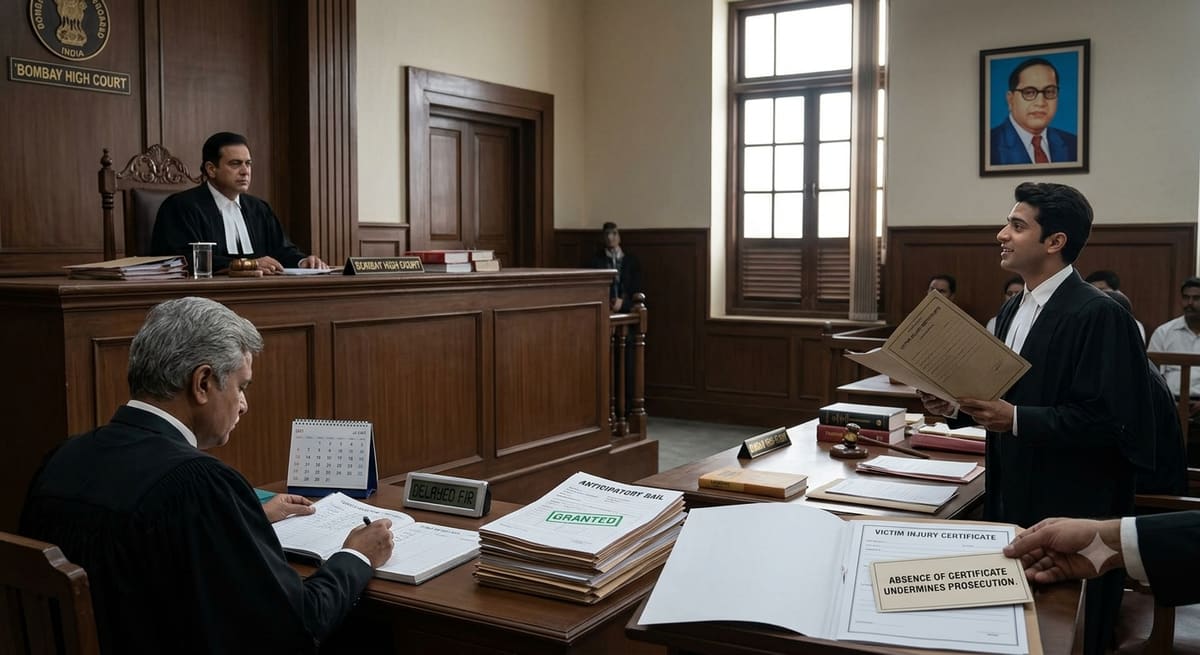
The Allahabad High Court recently granted anticipatory bail to an applicant accused under Sections 105 and 3(5) of the Bharatiya Nyaya Sanhita (BNS) and Sections 3/5 of the U.P. Prohibition of Unlawful Conversion of Religion Act, 2021, highlighting the significance of delayed FIR lodging, lack of medical corroboration, and the absence of direct allegations against the applicant. The judgment reaffirms the principles of personal liberty and the discretionary power of courts in granting bail, particularly when the prosecution fails to justify immediate arrest.
Background & Facts
The Dispute
The applicant, Roshan, sought anticipatory bail in connection with Case Crime No. 121 of 2026, registered under Sections 105, 3(5) of the Bharatiya Nyaya Sanhita (BNS) and Sections 3/5 of the U.P. Prohibition of Unlawful Conversion of Religion Act, 2021 at Police Station Bhognipur, District Kanpur Dehat. The FIR was lodged on 09.04.2026, alleging an incident that occurred on 18.01.2026, which resulted in the death of the deceased on 07.04.2026. The applicant contended that he was falsely implicated and that the prosecution’s version lacked corroboration.
Key Facts
- The alleged incident occurred on 18.01.2026, but the FIR was lodged on 09.04.2026, after the death of the deceased.
- The deceased was admitted to a private hospital on 31.03.2026 and discharged on 06.04.2026. He succumbed to his injuries on 07.04.2026.
- The post-mortem report revealed no external injury marks on the deceased’s body, and the cause of death was asphyxia due to aspiration.
- The deceased had been treated at a private hospital, but no medical records prior to 31.03.2026 were included in the case diary.
- The FIR alleged assault by co-accused Shahanshah Khan, Sartaj Khan @ Kallu, and Dilshad, but no direct allegation was made against the applicant under Sections 105 or 3(5) of the BNS.
- The applicant’s role, if any, was limited to Sections 3/4 of the U.P. Prohibition of Unlawful Conversion of Religion Act, 2021, based on the prosecution’s version.
- Co-accused Sartaj @ Kallu Khan, who was alleged to have caused injury to the deceased, was granted regular bail by a coordinate Bench of the Allahabad High Court on 02.07.2026 in Crl. Misc. Bail Application No. 21352 of 2026.
- The applicant had no criminal antecedents and undertook to cooperate with the investigation and trial.
Procedural History
- 09.04.2026: FIR lodged under Sections 105, 3(5) BNS and Sections 3/5 of the U.P. Prohibition of Unlawful Conversion of Religion Act, 2021.
- 07.04.2026: Death of the deceased.
- 02.07.2026: Co-accused Sartaj @ Kallu Khan granted regular bail by the Allahabad High Court.
- 2026: The applicant filed Criminal Misc. Anticipatory Bail Application U/S 482 BNSS No. 5974 of 2026 before the Allahabad High Court.
Relief Sought
The applicant sought anticipatory bail, contending that he was falsely implicated and that the prosecution’s case lacked corroboration. He undertook to cooperate with the investigation and trial and abide by any conditions imposed by the court.
The Legal Issue
The central question before the court was whether anticipatory bail should be granted to the applicant, considering:
- The delay in lodging the FIR and the lack of explanation for such delay.
- The absence of medical corroboration of the prosecution’s version.
- The lack of direct allegations against the applicant under the serious offences charged.
- The principles of personal liberty and the discretionary power of courts in granting bail under Section 482 of the Bharatiya Nagrik Suraksha Sanhita (BNSS).
Arguments Presented
For the Applicant
- The applicant was absolutely innocent and had been falsely implicated in the case.
- The FIR was lodged after the death of the deceased on 09.04.2026, with no explanation for the inordinate delay.
- The post-mortem report revealed no external injury marks on the deceased’s body, and the cause of death was asphyxia due to aspiration, which did not corroborate the prosecution’s version.
- No medical records of the deceased’s treatment prior to 31.03.2026 were included in the case diary, raising doubts about the prosecution’s case.
- The deceased died due to brain hemorrhage, which was unrelated to the alleged assault.
- Co-accused Sartaj @ Kallu Khan, who was alleged to have caused injury to the deceased, had already been granted regular bail by the High Court.
- The applicant had no criminal antecedents and undertook to cooperate with the investigation and trial.
- The applicant’s role, if any, was limited to Sections 3/4 of the U.P. Prohibition of Unlawful Conversion of Religion Act, 2021, and no allegation was made under Sections 105 or 3(5) of the BNS.
For the Respondent/State
- The Assistant Government Advocate (A.G.A.) opposed the application for anticipatory bail but did not dispute the factual aspects of the applicant’s contentions.
The Court's Analysis
The court relied on established precedents to guide its analysis of the anticipatory bail application. Key observations included:
-
Nature and Gravity of the Offence: The court noted that while the offences under Sections 105 and 3(5) of the BNS and Sections 3/5 of the U.P. Prohibition of Unlawful Conversion of Religion Act, 2021 were serious, the lack of direct allegations against the applicant and the absence of medical corroboration weakened the prosecution’s case.
-
Delayed FIR: The court emphasized the inordinate delay in lodging the FIR, which was filed on 09.04.2026 for an incident alleged to have occurred on 18.01.2026. The prosecution failed to provide a satisfactory explanation for this delay, which raised doubts about the veracity of the allegations.
-
Medical Evidence: The post-mortem report revealed no external injury marks on the deceased’s body, and the cause of death was asphyxia due to aspiration. The court observed that the prosecution’s version was not corroborated by medical evidence, further undermining its credibility.
-
Role of the Applicant: The court noted that no direct allegation was made against the applicant under Sections 105 or 3(5) of the BNS. The applicant’s role, if any, was limited to Sections 3/4 of the U.P. Prohibition of Unlawful Conversion of Religion Act, 2021, which was less severe compared to the other charges.
-
Principles of Personal Liberty: The court relied on the Supreme Court’s decisions in Sushila Aggarwal and others vs. State (NCT of Delhi) and another and Siddharth Vs. State of Uttar Pradesh & Another to emphasize that personal liberty is a constitutional mandate and that arrest should not be routine. The court held that if the investigating officer has no reason to believe that the accused will abscond or tamper with evidence, and the accused has cooperated with the investigation, there is no compulsion to arrest.
"Courts ought to be generally guided by considerations such as the nature and gravity of the offences, the role attributed to the applicant, and the facts of the case, while considering whether to grant anticipatory bail, or refuse it. Whether to grant or not is a matter of discretion."
"Merely because an arrest can be made because it is lawful does not mandate that arrest must be made. A distinction must be made between the existence of the power to arrest and the justification for exercise of it. If arrest is made routine, it can cause incalculable harm to the reputation and self-esteem of a person."
The court concluded that, considering the nature of the accusation, the role of the applicant, and the attending facts and circumstances, a case for anticipatory bail was made out. The court granted bail without expressing any opinion on the merits of the case.
The Verdict
The Allahabad High Court allowed the anticipatory bail application with the following directions:
- The applicant, Roshan, shall be released on anticipatory bail in the event of his arrest, till the conclusion of the trial, upon furnishing a personal bond of Rs. 50,000 with two sureties of the like amount to the satisfaction of the Station House Officer or the concerned court.
- The applicant shall cooperate with the Investigating Officer during the investigation and shall report as and when required.
- The applicant shall not directly or indirectly make any inducement, threat, or promise to any person acquainted with the facts of the case to dissuade them from disclosing such facts to the court or the police.
- The applicant shall not leave India without the previous permission of the court.
- In case of default or misuse of the bail conditions, the Public Prosecutor, Investigating Officer, or first informant-complainant is at liberty to file an application for cancellation of anticipatory bail before the concerned court.
What This Means For Similar Cases
Delayed FIR and Lack of Corroboration Can Justify Anticipatory Bail
- Practitioners should emphasize delays in lodging FIRs and the absence of corroborative evidence, such as medical reports or witness statements, to argue for anticipatory bail.
- Courts are likely to view inordinate delays as a factor weakening the prosecution’s case, especially when no satisfactory explanation is provided.
- The judgment reinforces that anticipatory bail can be granted even in serious offences if the prosecution fails to establish a prima facie case against the accused.
Personal Liberty and Discretion in Granting Bail
- The judgment reaffirms the constitutional mandate of personal liberty and the discretionary power of courts in granting bail.
- Arrest should not be routine and must be justified by the investigating officer based on specific grounds, such as the likelihood of the accused absconding, tampering with evidence, or influencing witnesses.
- Practitioners can cite this judgment to argue that cooperation with the investigation and lack of criminal antecedents are strong grounds for granting anticipatory bail.
Role of Medical and Documentary Evidence
- The absence of medical or documentary evidence to corroborate the prosecution’s version can be a decisive factor in granting anticipatory bail.
- Courts are likely to scrutinize post-mortem reports, medical records, and case diaries to assess the credibility of the prosecution’s case.
- Practitioners should highlight gaps in the prosecution’s evidence, such as missing medical records or inconsistencies in witness statements, to strengthen bail applications.