The Income Tax Appellate Tribunal Delhi has affirmed a critical principle in corporate taxation: warranty provisions made in accordance with established accounting practices constitute deductible accrued liabilities, even if the exact quantum of future expenditure is uncertain. This ruling reinforces the legitimacy of commercial accounting methods under the Income Tax Act and sets a precedent for consistent treatment of similar provisions across assessment years.
Background & Facts
The Dispute
The dispute centered on three key tax adjustments made by the Assessing Officer for Assessment Year 2011-12 against TK Elevator Private Limited: disallowance of a Rs. 91.15 lakh warranty provision, a Rs. 2.20 crore transfer pricing adjustment on Corporate Mark Fee payments to its foreign associated enterprise, and an addition of Rs. 12.00 crore on account of advances received from customers.
Procedural History
- The Assessing Officer passed a final order under Section 143(3) read with Section 144C(3) on 18/05/2015, making all three additions.
- The assessee appealed to the Commissioner of Income Tax (Appeals), who:
- Deleted the Rs. 12.00 crore addition on advances from customers
- Upheld the Rs. 91.15 lakh warranty provision disallowance
- Upheld the Rs. 2.20 crore transfer pricing adjustment
- Both parties appealed to the Income Tax Appellate Tribunal: the assessee against the warranty and transfer pricing disallowances, and the Revenue against the deletion of the advance addition.
Relief Sought
The assessee sought deletion of the warranty provision disallowance and transfer pricing adjustment, relying on prior favorable tribunal and high court rulings. The Revenue sought restoration of the Rs. 12.00 crore addition on advances received, arguing it violated the accrual system of accounting.
The Legal Issue
The central questions were: (1) Whether a warranty provision, calculated on a scientific basis and consistently applied, qualifies as a deductible accrued liability under the accrual system of accounting? (2) Whether the transfer pricing adjustment on Corporate Mark Fee can be sustained when identical arrangements have been treated favorably in prior cases? (3) Whether advances received from customers, shown as liabilities in the balance sheet, must be included in income under the accrual method?
Arguments Presented
For the Appellant/Petitioner
The assessee relied on Rotork Controls India Pvt. Ltd. v. CIT (2009) 314 ITR 62 (SC), which held that warranty obligations arising from past sales constitute measurable liabilities eligible for deduction. It cited its own prior tribunal decisions for A.Y. 2005-06 and 2006-07, affirmed by the Delhi High Court, which allowed similar warranty provisions. For the transfer pricing issue, it pointed to the Pune Bench’s decision in ThyssenKrupp Electrical Steel India Pvt. Ltd. v. DCIT (ITA No. 297/Pun/2017), which recognized the right of a parent to monetize previously free intellectual property if the fee is arm’s length. For advances, it relied on Taparia Tools Ltd. v. CIT (2015) 55 Taxmann.com 361 (SC), which held that advances shown as liabilities need not be included in income if they represent contractual obligations.
For the Respondent/State
The Revenue contended that warranty provisions are contingent liabilities and cannot be deducted until actual expenditure is incurred. It argued that advances received from customers must be recognized as income under the accrual system, regardless of balance sheet classification. On transfer pricing, it maintained that the absence of direct benefit from the Corporate Mark Fee justified full disallowance, and that prior tribunal decisions were not binding.
The Court's Analysis
The Tribunal examined the nature of warranty obligations under accounting principles and tax law. It noted that the assessee had consistently applied a 3% provision based on material cost, with actual expenditures charged to P&L and provisions written back monthly. The Court emphasized that Rotork Controls established that warranty obligations are not mere contingencies but measurable liabilities arising from completed sales. The Tribunal held that the provision was not speculative but based on historical data and contractual obligations.
"The Assessee provides 3% of material for product warranty. The amount actually incurred is separately charged to profit and loss account and provision is written back on monthly basis. The Assessee regularly follows this method of accounting."
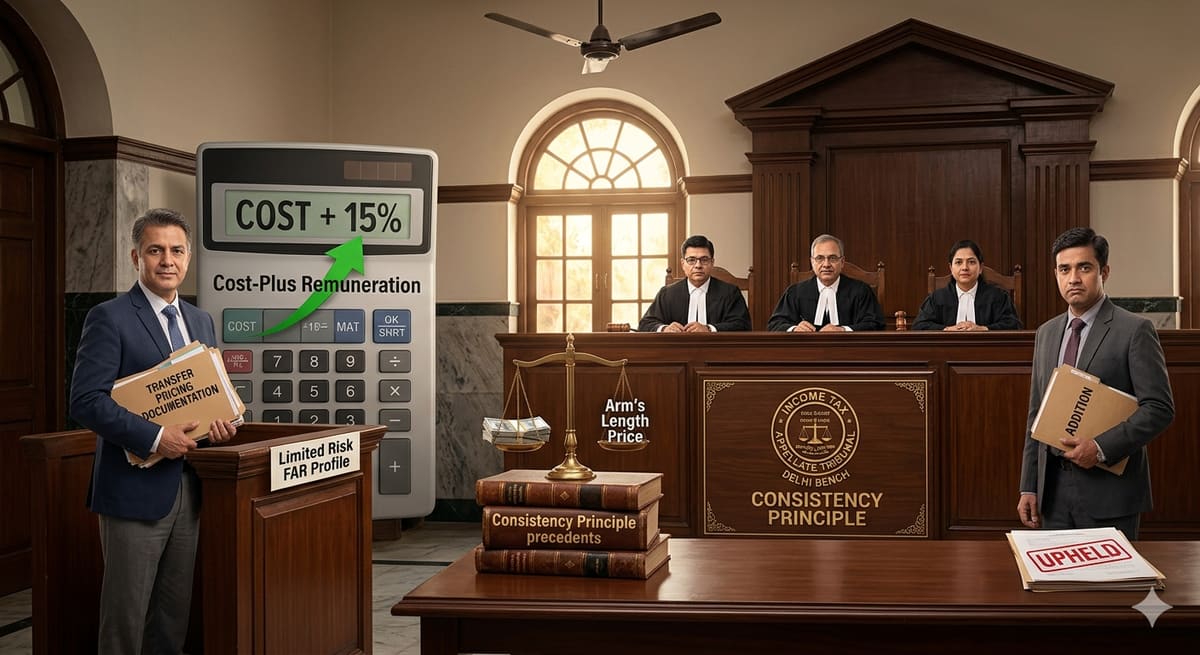
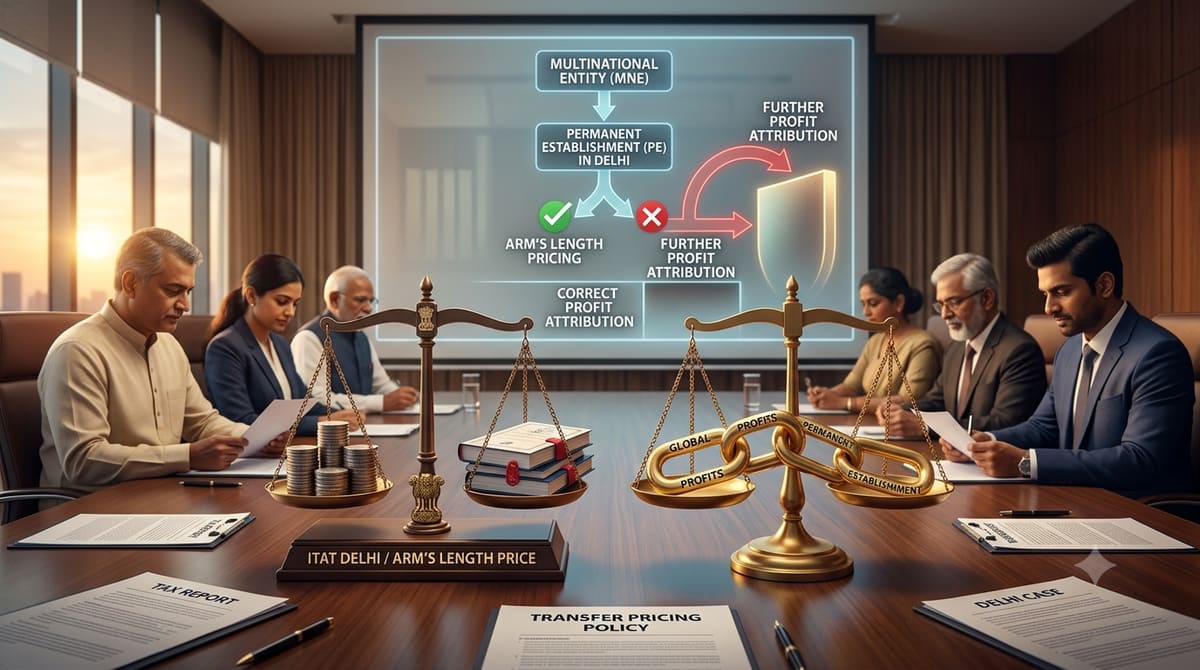
Regarding the transfer pricing adjustment, the Tribunal declined to substitute its own view on the arm’s length price. Instead, it recognized the principle of consistency and administrative efficiency. Where an identical agreement had been upheld by a coordinate bench, the Tribunal directed the Assessing Officer to re-examine the matter by comparing both agreements and applying the Pune Bench’s reasoning if facts were identical.
On advances from customers, the Tribunal noted that the issue had been settled in the assessee’s favor across multiple assessment years, including by the Delhi High Court. It held that the Revenue’s argument ignored the settled principle that income is recognized when earned, not when received, and that advances shown as liabilities reflect contractual obligations, not income.
The Verdict
The assessee won on the warranty provision and advances issues. The Tribunal deleted the disallowance of Rs. 91.15 lakh and dismissed the Revenue’s appeal against the deletion of Rs. 12.00 crore. On the transfer pricing issue, the Tribunal partly allowed the appeal by remanding the matter to the Assessing Officer for reconsideration in light of the Pune Bench’s decision, keeping all contentions open.
What This Means For Similar Cases
Warranty Provisions Are Deductible Accrued Liabilities
- Practitioners can now confidently argue that warranty provisions based on historical data and contractual terms qualify as deductible liabilities under Section 36(1)(vii)
- The burden shifts to the Revenue to prove the provision is arbitrary or not based on reasonable estimation
- Companies must maintain consistent accounting policies and document the methodology used
Transfer Pricing Decisions Must Be Consistent Across Group Entities
- Tax authorities cannot treat identical intercompany agreements differently without objective justification
- Practitioners should compile and submit comparable agreements from group entities to support arm’s length pricing
- Coordinate bench rulings are binding in spirit, even if not technically precedential
Advances as Liabilities Are Not Automatically Taxable
- Advances received for future delivery of goods or services, if shown as liabilities, need not be included in income
- The accrual system recognizes income when earned, not when received
- Taxpayers must ensure balance sheet classification aligns with accounting standards and contractual terms