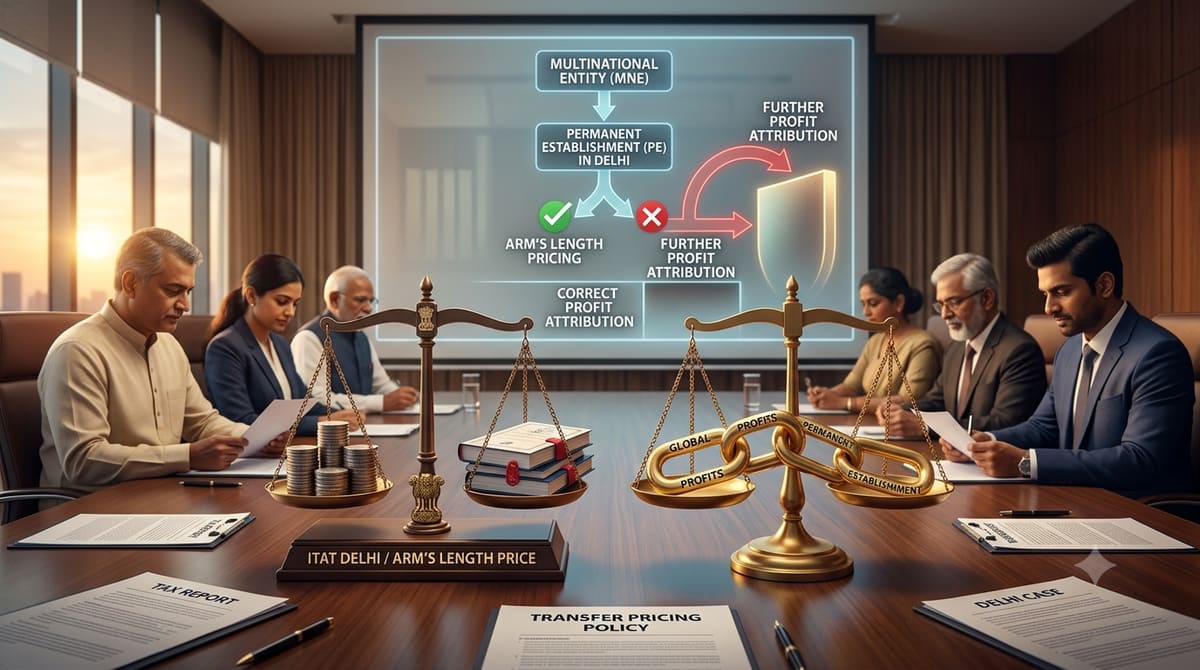
The Delhi Bench of the Income Tax Appellate Tribunal set aside a Rs 9,70,73,612 transfer-pricing adjustment on intra-group services, holding that the NIL arm's length price was illegal and that the Assessing Officer, Transfer Pricing Officer and Dispute Resolution Panel had acted beyond their jurisdiction.
Background & Facts
The Dispute
The appellant, Munters India Humidity Control Pvt. Ltd., engaged in the business of humidification and de-humidification equipment, availed management, sales and support services from its associated enterprises (AEs) abroad. The Assessing Officer (AO) and the Transfer Pricing Officer (TPO) treated the payments for these services as intra-group services (IGS) and, applying the Comparable Uncontrolled Price (CUP) method, arrived at a NIL arm's length price (ALP). Consequently, a transfer-pricing adjustment of Rs 9,70,73,612 was made in the assessment year 2022-23.
Key Facts
- Business scope: Design, manufacture and sale of towers, trays, random packing, mist eliminators, etc.
- Intra-group services claimed: Management services, sales-support services, IT services, HR, finance, procurement, etc.
- Amounts involved: Transfer-pricing adjustment of Rs 9,70,73,612; interest and penalties under sections 234A, 234B, 234C, 270A, 271AA, 271G were also raised.
- Statutory provisions invoked: Sections 92C, 143(2), 143(3), 144 of the Income Tax Act, 1961 and Rule 10D of the Income Tax Rules, 1962.
- Documentation: The appellant submitted detailed cost allocation keys, emails, service agreements and a cost-benefit analysis to prove receipt of services.
Procedural History
- 02 June 2023: Notice u/s 143(2) issued to appellant.
- 09 Nov 2023, 13 Nov 2024, 28 Nov 2024: Notices u/s 142(1) issued.
- 22 Jan 2025: TPO order proposing adjustment of Rs 9,70,73,612 and a protective adjustment of Rs 1,49,915.
- 04 Feb 2025: Draft assessment order issued by AO.
- 26 Nov 2025: Dispute Resolution Panel (DRP) directions issued.
- 17 Dec 2025: Final assessment order passed by AO.
- 04 Jun 2026: Hearing of IT(TP)A No. 83/Del/2026 before the Tribunal.
- 25 Aug 2026: Judgment pronounced.
Parties' Positions
- Appellant: Contended that the NIL ALP was illegal, the CUP method was misapplied, the TNMM method was appropriate, and that the services rendered were genuine, provided direct benefit, and therefore should be taxed at the actual cost.
- Respondent (DCIT): Asserted that the services were not at arm's length, the CUP method correctly yielded NIL, and that the adjustments were within statutory authority.
Relief Sought
The appellant sought deletion of the transfer-pricing adjustment, reversal of interest and penalties, and a declaration that the intra-group services were taxable at the actual cost incurred.
The Legal Issue
Whether the Transfer Pricing Officer, acting under Section 92C of the Income Tax Act and Rule 10D, could lawfully determine a NIL arm's length price for the appellant's intra-group services using the CUP method without concrete evidence of benefit, and whether the AO's assessment and the DRP's directions were within jurisdiction.
Arguments Presented
For the Appellant
- The appellant relied on M/S NHAVA SHEVA INTERNATIONAL CONTAINER TERMINAL PVT LTD. v. CIT(A) and M/S GAMPLUS INDIA PVT LTD. v. CIT(A) to argue that CUP cannot be applied where the service benefit is not demonstrable.
- Cited Corteva Agriscience India Pvt. Ltd. v. DCIT (ITAT) to show that proper cost-benefit analysis and documentation can establish ALP above NIL.
- Emphasised that the TPO failed to consider the TNMM method, which is permissible under Rule 10D, and that the CUP method was applied on presumptions.
- Asserted that the DRP exceeded its jurisdiction by questioning commercial rationale, a matter reserved for the Tribunal.
For the Respondent
- Relied on M/S DRESSER RAND INDIA PVT LTD. v. CIT(A) to maintain that NIL ALP is appropriate where services are not demonstrably needed.
- Argued that the appellant could not prove that the payments were commensurate with any tangible benefit, invoking the OECD guideline that intra-group services must be justified by benefit.
- Contended that the CUP method is the default under Section 92C and that the TPO’s determination was therefore lawful.
The Court's Analysis
The Tribunal began by reiterating the statutory framework governing international transactions. Section 92C mandates that the arm's length price be determined using one of the prescribed methods - CUP, TNMM, or cost-plus - subject to the facts of the case. The Court observed that the choice of method must be justified on the basis of the nature of the transaction and the availability of reliable comparables.
"In our considered opinion, the services rendered by Nalco, USA and Nalco Pacific Pte Ltd., Singapore were in the nature of intra-group services and not stewardship activity."
The Tribunal noted that the appellant had supplied extensive documentary evidence, including cost allocation keys, service agreements, and email correspondence, establishing that the services were actually rendered and that the payments were not merely a façade. The Court distinguished the Dresser Rand precedent, observing that in that case the taxpayer could not demonstrate any benefit, whereas here the appellant had produced a detailed cost-benefit analysis.
The Court further examined the applicability of the CUP method. It held that CUP requires reliable external comparables; in the absence of such data, the method cannot be mechanically applied to arrive at NIL. The Tribunal found that the TPO had not furnished any comparables and had based the NIL determination on presumptions, violating the principle that the arm's length price must reflect what an independent enterprise would have paid.
Turning to the TNMM, the Court emphasized that Rule 10D permits its use where CUP is not feasible. The appellant’s submission of a TNMM analysis, supported by functional and risk profiles, was deemed credible. Consequently, the Tribunal concluded that the TPO erred in both method selection and in failing to consider the appellant’s evidence.
Regarding jurisdiction, the Tribunal held that the DRP’s direction to the AO was ultra vires because the DRP is limited to facilitating dispute resolution, not to substitute for the Tribunal’s substantive assessment of arm's length pricing.
In light of the above, the Tribunal held that the transfer-pricing adjustment of Rs 9,70,73,612 was illegal, bad in law and without jurisdiction. The interest and penalty provisions under sections 234A, 234B, 234C, 270A, 271AA, 271G were not sustained as the underlying adjustment itself was set aside.
The Verdict
The Tribunal allowed the appellant’s grounds 2 to 5, deleted the transfer-pricing adjustment of Rs 9,70,73,612, dismissed the revenue’s ground 1, and left grounds 9 to 12 open. No interest or penalty under sections 234A-C, 270A, 271AA-271G was upheld. The order was pronounced on 25 August 2026.
What This Means For Similar Cases
Method Selection Must Be Evidence-Based
- Practitioners must be prepared to justify the choice of CUP, TNMM or cost-plus with concrete data; a presumption of NIL ALP is insufficient.
- When reliable external comparables are unavailable, TNMM should be considered, and the rationale must be recorded in the transfer-pricing report.
Benefit and Need Tests Are Non-Negotiable
- The Tribunal reiterated that an intra-group service must provide a direct or tangible benefit to the recipient; mere contractual existence does not suffice.
- Documentation such as cost-allocation keys, service logs, and benefit analysis should be maintained contemporaneously.
DRP Powers Are Limited
- The Dispute Resolution Panel cannot overstep into substantive arm’s length determinations; its role is confined to procedural facilitation.
- Appeals against DRP directions should focus on procedural irregularities rather than substantive pricing disputes.
Practical Takeaways
- Compile detailed functional and risk analyses for each intra-group service.
- Retain contemporaneous evidence of service receipt (emails, work orders, performance reports).
- Prepare a fallback method (TNMM) in case CUP comparables are lacking.
- Anticipate DRP scrutiny and ensure that any directions are within its statutory remit.