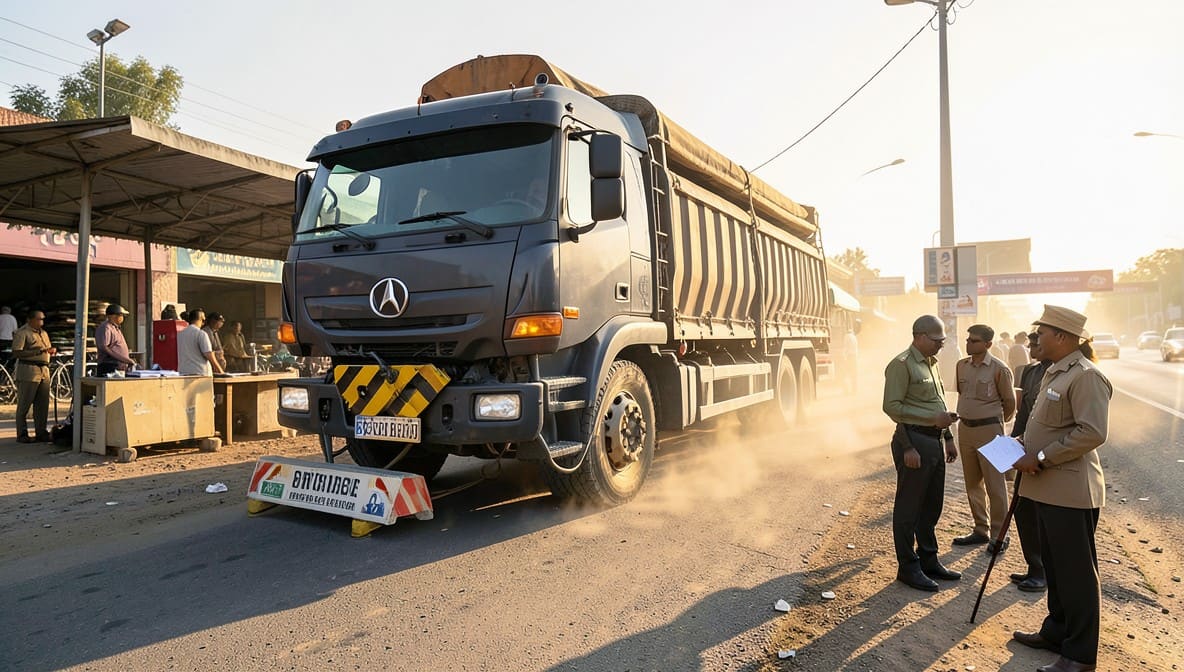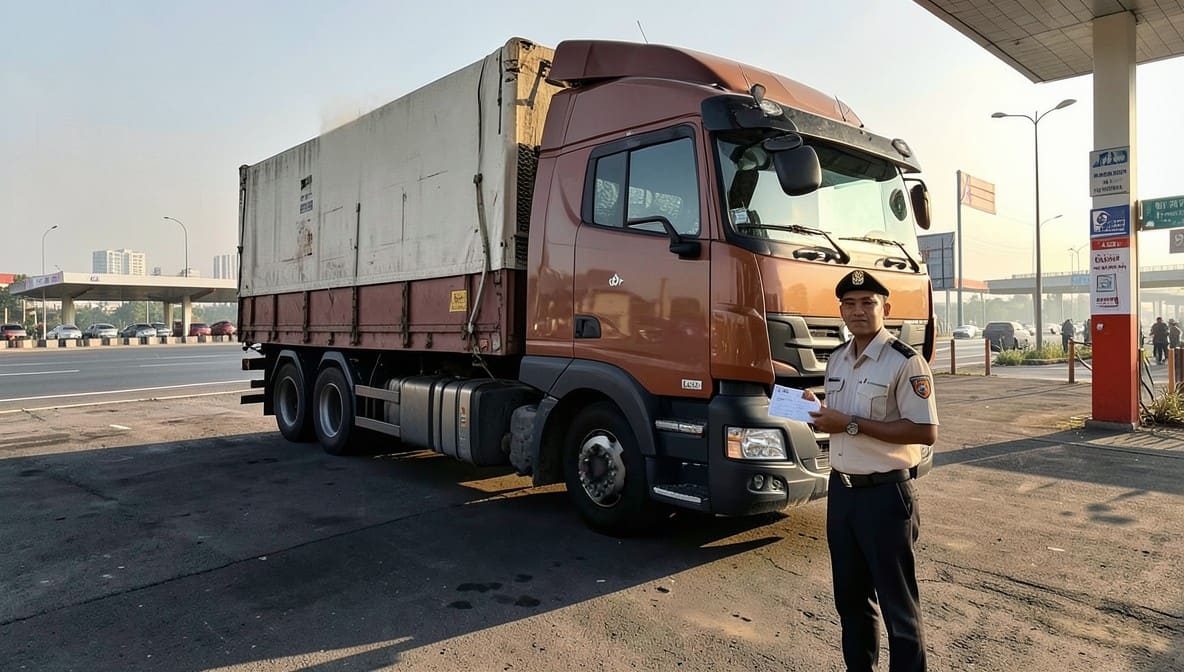
The Rajasthan High Court has reaffirmed that suspension of vehicle registration on allegations of overloading is unlawful without physical verification and weighing. This judgment establishes a mandatory procedural safeguard against arbitrary administrative action by transport authorities, ensuring due process for vehicle owners.
Background & Facts
The Dispute
The petitioner, Mumtaj S/o Phaiju Khan, is the owner of Truck No. RJ-07-GD-0889. The respondents, including the State of Rajasthan, Transport Department, and Regional Transport Officer (RTO) Bikaner, suspended the vehicle’s registration on the basis of alleged overloading, as reported by the Department of Mining and Geology. The petitioner challenged this suspension as violative of natural justice and lacking in statutory compliance.
Key Facts
- The vehicle’s registration was suspended without physical weighing or inspection.
- The suspension order was issued solely on the basis of data received from the Department of Mining and Geology.
- The petitioner contested service of notice, asserting that no valid notice was received prior to suspension.
- No physical verification of the vehicle’s weight, dimensions, or structural alterations was conducted before the suspension order.
- The petitioner’s vehicle was impounded and rendered non-operational, causing significant commercial loss.
Procedural History
- Date of Suspension: Not explicitly stated in judgment, but occurred prior to filing of writ petition.
- Date of Filing: Civil Writ Petition No. 7891/2026 filed before the High Court of Judicature for Rajasthan at Jodhpur.
- Date of Hearing: 10.04.2026.
- Date of Judgment: 10.04.2026.
The Parties' Positions
For the Petitioner:
- Argued that suspension was arbitrary and violative of Article 14 and Article 21 of the Constitution.
- Contended that no notice was received, and no opportunity of hearing was granted.
- Relied on the precedent set in Kanwar Singh and Ors. v. State of Rajasthan and Ors. (S.B. Civil Writ Petition No. 9721/2025, decided on 28.07.2025), which laid down the same legal principles.
For the Respondents:
- Did not dispute the factual similarity with Kanwar Singh.
- Did not produce evidence of physical verification, notice service, or inspection.
- Relied on data from the Department of Mining and Geology to justify suspension.
Relief Sought
The petitioner sought quashing of the suspension order, release of the vehicle, and directions to the authorities to follow due process before any future suspension.
The Legal Issue
The central question was whether the suspension of a vehicle’s registration under transport regulations can be lawfully effected solely on the basis of alleged overloading data from a third department, without physical weighing or inspection of the vehicle.
Arguments Presented
For the Petitioner
The petitioner’s counsel relied on the binding precedent of Kanwar Singh v. State of Rajasthan, wherein the same Bench held that suspension of registration cannot be ordered unless overloading is established by physically weighing the vehicle. It was argued that reliance on unverified digital or third-party data violates the principles of natural justice and procedural fairness. The petitioner emphasized that the absence of notice and opportunity of hearing rendered the order void ab initio.
For the Respondent
The respondents did not contest the applicability of Kanwar Singh. They conceded that the issue was identical and offered no legal counter-argument to refute the precedent. Their opposition was procedural, not substantive, and they failed to demonstrate compliance with mandatory verification requirements.
The Court's Analysis
The Court explicitly recognized that the present case was identical in facts and legal issues to Kanwar Singh v. State of Rajasthan. It affirmed the reasoning in that judgment, which held that administrative action must be grounded in tangible evidence, not speculative or unverified reports.
"Unless and until the allegation of overloading is established by physically weighing the vehicles, the registration of subject vehicles cannot be suspended. Therefore, the impugned orders are not sustainable in the eyes of law."
The Court further emphasized that if there is an allegation of mechanical alteration, the authorities must first direct the owner to produce the vehicle for inspection. The mere receipt of data from the Department of Mining and Geology does not constitute lawful grounds for suspension.
The Court also addressed the issue of notice, noting that the petitioner disputed service, and in the absence of conclusive proof, the burden could not be shifted to the petitioner. The Court therefore declined to uphold the suspension on procedural grounds alone.
The Court reiterated that interim permission must be granted for the sole purpose of transporting the vehicle for inspection, and that such permission must not be construed as authorization for commercial operation.
The Verdict
The writ petition was disposed of in the same terms as Kanwar Singh v. State of Rajasthan. The suspension order was set aside. The petitioner is directed to produce the vehicle before the concerned RTO/Bikaner DTO on or before 30.04.2026 for physical verification, including weighing and inspection for mechanical alteration. If no alteration or overloading is found, the vehicle shall be released forthwith. The respondents are directed to grant interim permission for the limited purpose of transporting the vehicle to the DTO office. All pending applications are dismissed.
What This Means For Similar Cases
Physical Verification Is Mandatory
- Transport authorities cannot suspend registration based on digital alerts, third-party reports, or alleged overloading without physically weighing the vehicle.
- Any suspension order based solely on data from mining or revenue departments is legally invalid.
Notice and Hearing Are Non-Negotiable
- If service of notice is disputed, the burden lies on the authority to prove it.
- Absence of a hearing renders the order void under principles of natural justice.
Interim Permission Must Be Granted
- Vehicle owners must be allowed to move their vehicles to inspection centers without fear of penalty.
- Such permission must be strictly limited to transit and must not authorize road use for commercial purposes.
Precedent Binding Across Coordinate Benches
- Orders from coordinate benches on identical issues are binding unless overruled by a larger bench.
- Practitioners may cite Kanwar Singh as authoritative precedent in all similar cases in Rajasthan.