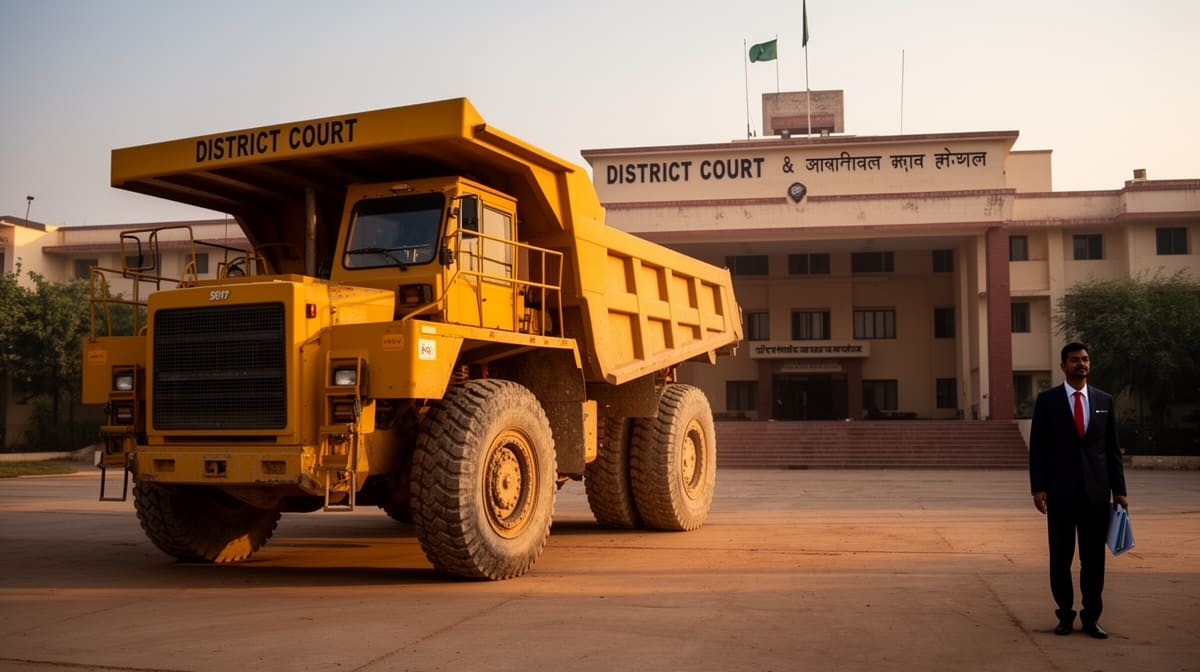
The Rajasthan High Court has clarified the legal position on interim release of vehicles seized under mining laws, establishing a clear distinction between cases where confiscation proceedings have been initiated and those where they have not. This ruling resolves a recurring procedural conflict faced by practitioners representing accused persons in mining-related offences.
Background & Facts
The Dispute
The petitioner, Radheshyam Jat, sought the release of his vehicle bearing registration number RJ-06-RE-2093, which was seized by the Mines and Geology Department, Bhilwara, for alleged violation of mining regulations. The vehicle was impounded pending adjudication of the alleged offence under the Rajasthan Minor Minerals Concession Rules, 2010. The petitioner filed a Criminal Miscellaneous Petition under Section 439 CrPC seeking interim release on the basis of a supurdaginama (undertaking of custody).
Key Facts
- The vehicle was seized on or about 10.03.2026 during a raid conducted by the Mining Engineer’s office, Bhilwara
- No formal confiscation order under Rule 24 of the Rajasthan Minor Minerals Concession Rules, 2010, had been passed as of the date of filing the petition
- The petitioner submitted a supurdaginama on 18.04.2026, offering to keep the vehicle in safe custody and produce it before the court as required
- On 21.04.2026, the learned Magistrate rejected the application for release, relying on prior judicial precedents that barred release on supurdaginama once seizure occurred
- The petitioner challenged this order before the High Court on 22.04.2026
Procedural History
- 10.03.2026: Vehicle seized by Mining Department during enforcement action
- 18.04.2026: Petitioner filed application for release on supurdaginama before Magistrate
- 21.04.2026: Magistrate dismissed application, citing binding precedent
- 22.04.2026: Criminal Miscellaneous Petition No. 3330/2026 filed before Rajasthan High Court
- 24.04.2026: Hearing before Hon’ble Mr. Justice Baljinder Singh Sandhu
The Parties' Positions
For the Petitioner
The petitioner’s counsel, Mr. Suresh Kumar Bishnoi, argued that since no confiscation proceedings had been formally initiated under Rule 24, the criminal court retained inherent power under Section 439 CrPC to grant interim custody to the owner. He relied on principles of natural justice and proportionality, asserting that prolonged detention of a vehicle without a confiscation order amounted to arbitrary deprivation of property.
For the Respondents
The Additional Advocate General, Mr. Anurag Jyani, contended that once a vehicle is seized under mining laws, it becomes subject to the exclusive jurisdiction of the mining authorities for confiscation. He argued that allowing criminal courts to release vehicles on supurdaginama would undermine the statutory scheme and create procedural chaos.
Relief Sought
The petitioner sought quashing of the order dated 21.04.2026 and direction to release the vehicle RJ-06-RE-2093 on supurdaginama, pending conclusion of any confiscation proceedings.
The Legal Issue
The central question was whether a criminal court may grant interim custody of a vehicle seized under mining laws on the basis of a supurdaginama when no formal confiscation proceedings have yet been initiated by the mining department.
Arguments Presented
For the Petitioner
The petitioner’s counsel relied on the principle that criminal courts retain inherent jurisdiction under Section 439 CrPC to ensure that no person is deprived of property without due process. He argued that until the mining department initiates formal confiscation proceedings under Rule 24, the vehicle remains subject to the criminal court’s control. He cited State of Rajasthan v. Ram Singh (2020) to support the proposition that interim custody is permissible where statutory proceedings are not yet triggered.
For the Respondent
The State contended that the mining laws create a comprehensive statutory regime for seizure and confiscation, and that any interference by criminal courts prior to initiation of confiscation proceedings would defeat legislative intent. The AAG relied on Chaina Ram v. State of Rajasthan (2025) and other coordinate bench judgments to argue that the only lawful mode of release is through payment of penalty or compounding fees after initiation of proceedings.
The Court's Analysis
The Court observed that the issue had been authoritatively settled by a coordinate bench in Chaina Ram v. State of Rajasthan (S.B. Criminal Misc. Petition No. 597/2024, decided on 19.05.2025), which had examined the interplay between the powers of criminal courts and mining authorities under the Rajasthan Minor Minerals Concession Rules.
"It is held that under the mining laws, the state authorities have the powers for initiating confiscation proceedings in relation to the vehicles seized for violation of the mining laws. It is once the confiscation proceedings are initiated, the vehicle cannot be released on supurdaginama as prayed by few of the petitioners. However, the said vehicles can only be released on payment of penalty and compounding fees. Whereas, the vehicles qua which no confiscation proceedings have yet been commenced, the competent criminal Court can handover interim custody of the vehicles to its true owner as a criminal Court is not supposed to keep a vehicle detained until the confiscation proceedings are commenced and concluded by the mining department."
The Court emphasized that the distinction between initiated and uninitiated proceedings is not procedural but substantive. Where no order under Rule 24 has been passed, the vehicle remains under the custody of the criminal court, which may, in its discretion, release it on a supurdaginama. This preserves the balance between the state’s regulatory interest and the owner’s right to possession pending adjudication.
The Court further clarified that even if a vehicle is released on supurdaginama, the mining department retains the right to initiate confiscation proceedings at any time and reclaim the vehicle lawfully. This ensures that the statutory scheme is not circumvented.
The Verdict
The petition was allowed. The order dated 21.04.2026 was set aside. The petitioner is directed to file a fresh application before the competent criminal court for release of vehicle RJ-06-RE-2093 on supurdaginama. The criminal court shall decide the application in accordance with the observations in Para 8 of the judgment in Chaina Ram v. State of Rajasthan dated 19.05.2025. All pending applications are disposed of.
What This Means For Similar Cases
Criminal Courts May Grant Interim Custody Before Confiscation Proceedings
- Practitioners may now file applications under Section 439 CrPC for release of seized mining vehicles if no confiscation order under Rule 24 has been passed
- The burden shifts to the State to prove that confiscation proceedings have been formally initiated
- Courts must examine the record to determine whether a Rule 24 notice or order exists before denying release
Supurdaginama Does Not Preclude Future Confiscation
- Release on supurdaginama is temporary and conditional
- The mining department retains full right to initiate confiscation proceedings at any stage
- Petitioners must be advised that release does not equate to immunity from future seizure or penalty
Procedural Clarity Reduces Judicial Overload
- This ruling prevents duplication of efforts between criminal courts and mining authorities
- Reduces unnecessary detention of vehicles pending administrative action
- Encourages timely initiation of confiscation proceedings by the State