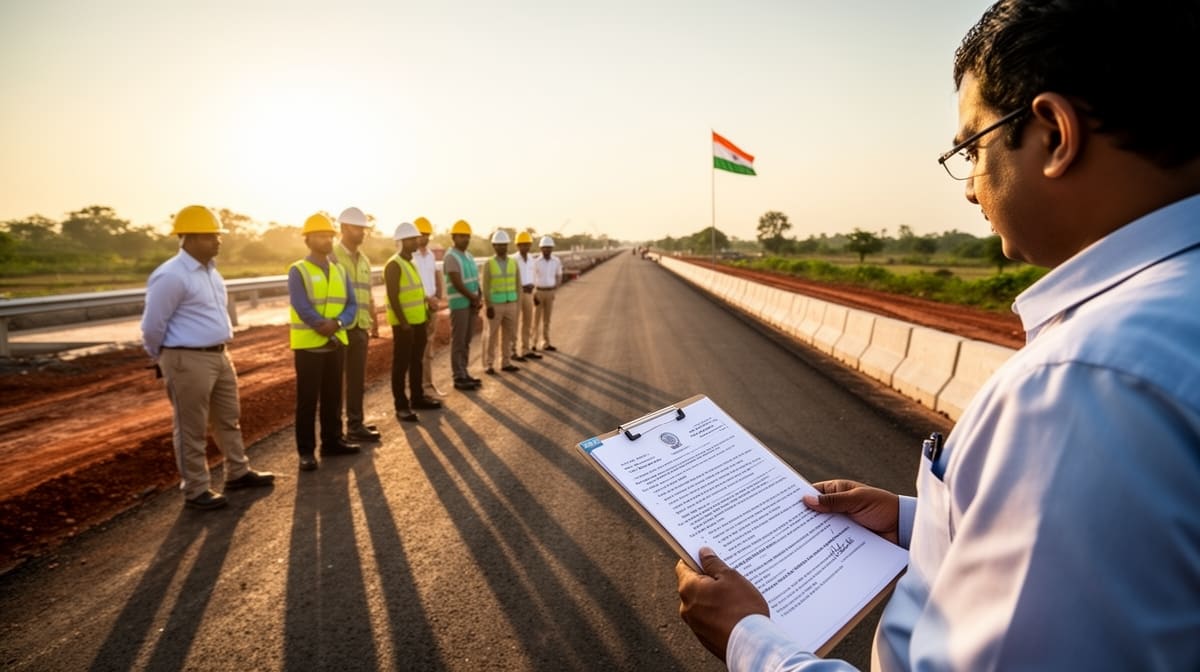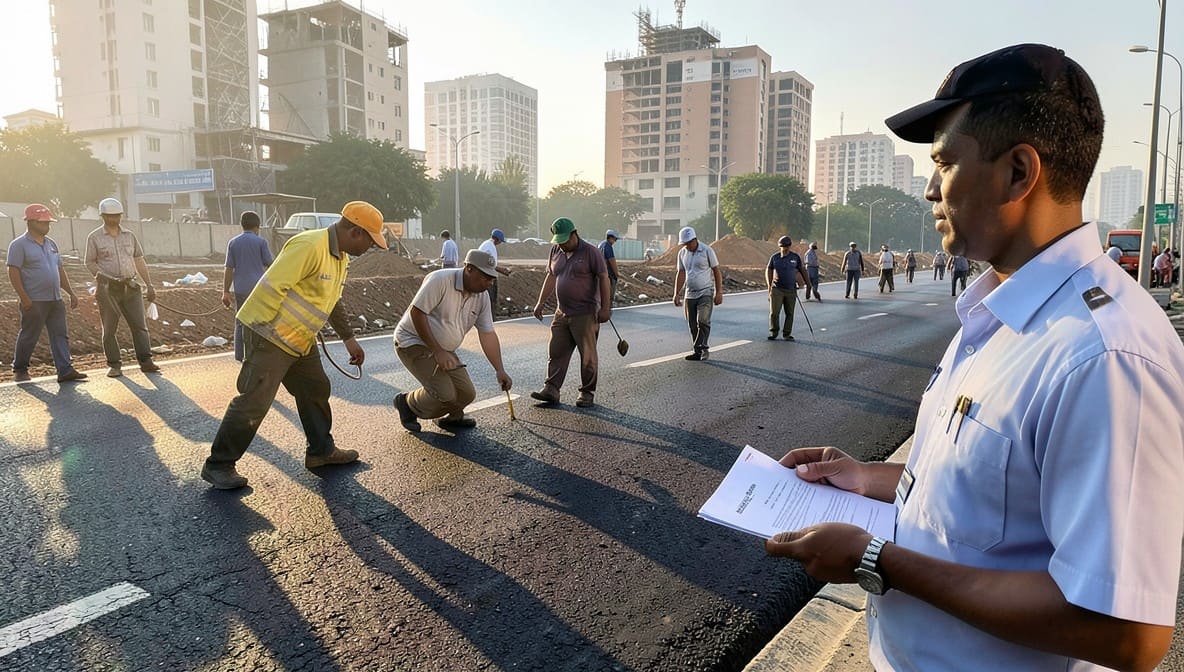
The Punjab and Haryana High Court has affirmed that public authorities cannot evade payment obligations merely because work was executed on oral instructions rather than written contracts. Where a duly constituted committee verifies the execution of work and recommends payment, the state is bound by its findings, regardless of procedural irregularities.
Background & Facts
The Dispute
The petitioner, M/s Mukesh & Brothers Infrastructure, a registered government contractor, undertook road repair work in Sector-37 II, Pace City (Industrial Area), Gurugram, on the oral directive of the then Executive Engineer of the Municipal Corporation, Gurugram. The work involved laying M-40 grade RMC over a pipeline crossing area. Although no formal work order was issued, the petitioner commenced work based on assurances from the respondent’s officials that approval would be granted post-facto.
Key Facts
- The petitioner had previously executed work under Work Order No. EE-I/MCG/2017/55755 dated 17.10.2017 for Rs. 31.28 lakhs, for which a running bill of Rs. 15,97,375 had been paid.
- On verbal instructions from the Executive Engineer, the petitioner carried out additional work beyond the scope of the original order.
- The petitioner raised a grievance regarding non-payment, leading to the constitution of a committee by higher authorities.
- The committee, comprising officers Hari Parkash (AE), Naim Hussain (AE), Subham (JE), and Sarjeet (JE), inspected the site on 07.05.2024 and confirmed that the work had been fully executed.
- The committee prepared a final bill of Rs. 32,48,814 (including the prior payment), with a net outstanding liability of Rs. 14,97,266.
- The bill was duly documented in Measurement Book No. 1934, Pages 50 - 58, with measurements verified and signed by the AE and JE.
- The respondent conceded the authenticity of the committee’s report but refused payment on two grounds: absence of a written work order and the work being executed in an unauthorized area.
Procedural History
- 17.10.2017: Original work order issued for Rs. 31.28 lakhs.
- Mid-2018 - 2023: Work executed on verbal directions; no formal documentation issued.
- 2023: Petitioner raised grievance regarding non-payment.
- 07.05.2024: Committee submitted report confirming work execution and recommending payment of Rs. 14,97,266.
- 17.04.2026: Writ petition filed under Article 226 of the Constitution.
Relief Sought
The petitioner sought a direction to the Municipal Corporation, Gurugram, to release the admitted liability of Rs. 14,97,266 with interest at 12% per annum from the date of completion of work.
The Legal Issue
The central question was whether a public authority can refuse payment for work executed on its oral directions, when a duly constituted internal committee has verified the execution and quantified the liability, despite the absence of a formal written contract.
Arguments Presented
For the Petitioner
The petitioner’s counsel argued that the doctrine of promissory estoppel and the principle of fairness under Article 14 of the Constitution bind public authorities to honor commitments made in the course of official duty. Reliance was placed on the committee’s report, which was prepared by senior officials of the Corporation and confirmed both the completion of work and the quantum of payment due. The absence of a written order was attributed to administrative lapse, not the petitioner’s fault. The petitioner acted in good faith, relying on assurances from authorized officers.
For the Respondent
The Municipal Corporation contended that no enforceable contractual obligation arose due to the absence of a written work order under the Government Financial Rules. It further argued that the work was executed in an unauthorized area, rendering it illegal and non-recoverable. The Corporation claimed that payments cannot be made without compliance with procedural norms, and that the committee’s report was merely recommendatory and not binding.
The Court's Analysis
The Court rejected the respondent’s argument that absence of a written contract absolves it of liability. It emphasized that public bodies are not entitled to take advantage of their own administrative failures. The Court noted that the committee’s report was not a mere internal memorandum but a formal, documented assessment prepared by multiple officers with firsthand knowledge of the work.
"The respondent is bound to consider its report dated 07.05.2024 and release the payment."
The Court observed that the committee had not only verified the physical execution of the work but also documented the measurements, signed off by the AE and JE, and prepared the bill in accordance with standard procedure. The fact that the work was carried out in an unapproved area did not negate the benefit conferred upon the Corporation, nor did it render the petitioner’s conduct unlawful if done at the behest of its officers.
The Court held that the principle of unjust enrichment applies: the Corporation received the benefit of completed infrastructure, and denying payment would amount to wrongful enrichment. The Court further clarified that while written contracts are preferred, they are not an absolute prerequisite for liability where work has been performed on the authority’s direction and verified by its own officials.
The Verdict
The petitioner succeeded. The Court directed the Municipal Corporation, Gurugram, to release the admitted liability of Rs. 14,97,266 within three months from the date of judgment. In the event of delay beyond this period, the Corporation shall pay interest at 9% per annum from the expiry of the three-month period until actual payment. All pending applications were disposed of.
What This Means For Similar Cases
Oral Directions Can Create Enforceable Obligations
- Public authorities cannot disown liability for work performed on their verbal instructions if the work is verified by their own officials.
- Contractors may rely on oral assurances from authorized officers, especially where prior dealings establish a pattern of conduct.
- Administrative non-compliance with procedural norms cannot be used to defeat legitimate claims.
Committee Reports Carry Weight in Administrative Law
- Internal committee reports prepared by senior officers, with site verification and documentation, constitute prima facie evidence of liability.
- Such reports cannot be dismissed as "recommendatory" when they form the basis of a claim and are not challenged on grounds of fraud or error.
- Courts will uphold these findings unless there is clear evidence of mala fides or procedural illegality.
Unapproved Locations Do Not Automatically Nullify Payment Claims
- If work is carried out at the direction of public officials, the illegality of the location does not automatically extinguish the right to payment.
- The state may pursue separate action for unauthorized use, but cannot withhold payment for services rendered and accepted.
- The remedy lies in penalizing the official who authorized the work, not in denying compensation to the contractor.