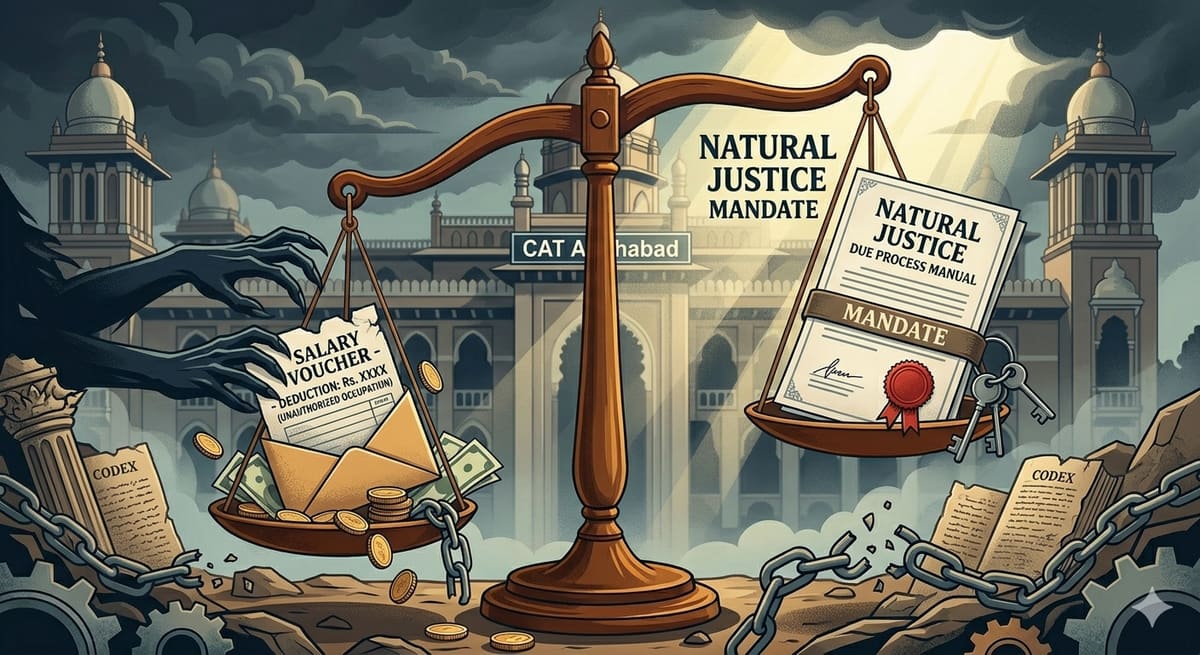
The Central Administrative Tribunal’s ruling in this case establishes a critical safeguard against arbitrary financial penalties imposed on government employees for retaining quarters during administrative transitions, particularly amid public emergencies. The judgment underscores that mere non-vacation of accommodation does not equate to unauthorized occupation without clear, timely, and unambiguous notice from the employer.
Background & Facts
The Dispute
The applicant, Shri Satyendra Kumar, a Sorting Assistant with the Railway Mail Service, was allotted a Type-I quarter (No. 25) in Muzaffarpur in 2003. In 2019, the Department initiated a project to upgrade several Type-I quarters to Type-III to address accommodation shortages. The applicant’s quarter was among those slated for conversion. Despite repeated reminders to vacate, he remained in the quarter, citing the unavailability of habitable alternative accommodation.
Procedural History
- 2019: Department notified occupants, including the applicant, to vacate Type-I quarters for renovation.
- 07.10.2021: Applicant was allotted a new quarter (Type-II, No. P-II/01), but it was in severely damaged condition.
- 21.10.2021 to 11.04.2022: Applicant submitted multiple representations requesting repairs to the new quarter.
- 25.05.2022: Assistant Director issued an order declaring the applicant’s continued occupation of the old quarter as "unauthorized" and imposed a damage rent of Rs. 14,52,400/- from October 2020 to May 2022.
- 02.09.2022 & 19.09.2022: Subsequent orders upheld the recovery.
- 21.06.2022: Applicant finally vacated the old quarter and took possession of the repaired new quarter.
Relief Sought
The applicant sought quashing of the recovery orders, declaration that his occupation was lawful, and refund of all amounts deducted from his salary with statutory interest.
The Legal Issue
The central question was whether continued occupation of a government quarter during a transition period, without explicit notice of unauthorized status, can be treated as "unauthorized occupation" warranting punitive damage rent under administrative rules.
Arguments Presented
For the Petitioner
The applicant’s counsel argued that:
- The Department never issued any notice declaring his occupation as "unauthorized" prior to May 2022.
- The allotment of the new quarter on 07.10.2021 was conditional upon its habitability, which was never fulfilled.
- The applicant had no alternative accommodation due to the COVID-19 pandemic, which paralyzed rental markets nationwide.
- The Department’s own correspondence acknowledged the poor condition of the new quarter, and no disciplinary proceedings were initiated under the Public Premises Act or service rules.
- The applicant never received House Rent Allowance (HRA), negating any claim of dual benefit.
For the Respondent
The Department contended that:
- The applicant was duly notified to vacate the Type-I quarter multiple times between 2019 and 2021.
- The allotment of the new quarter on 07.10.2021 created a legal obligation to vacate the old one within 15 days.
- The prolonged retention constituted unauthorized occupation, entitling the Department to recover damage rent under prevailing rules.
- The pandemic, while unfortunate, did not absolve the applicant of his duty to comply with administrative directives.
The Court's Analysis
The Tribunal conducted a meticulous review of the correspondence, timelines, and administrative conduct. It emphasized that unauthorized occupation under administrative law requires clear, unequivocal communication that the occupant’s continued stay is unlawful. The Department’s notices from 2019 to 2021 consistently framed the request as a "direction to vacate for renovation" and offered an alternative allotment - not a declaration of illegality.
"Allotment letter dated 07.10.2021... in remark column the reason for allotment... the word 'request of change quarter' has been mentioned which shows that the authorities... have never treated his occupation over quarter No. 25 type-I as unauthorized occupant."
The Court noted that the Department’s own actions - delaying repairs to the new quarter, accepting the applicant’s representations without rebuttal, and failing to initiate proceedings under the Public Premises (Eviction of Unauthorized Occupants) Act, 1971 - demonstrated an implicit recognition of the applicant’s lawful possession. The Tribunal further held that the pandemic context, coupled with the Department’s failure to provide viable alternatives, rendered the imposition of punitive damages manifestly unreasonable and disproportionate.
The Court rejected the notion that mere non-compliance with a request to vacate equates to criminal or quasi-criminal unauthorized occupation. It affirmed that administrative discipline must be exercised with procedural fairness and substantive reasonableness, especially when fundamental living rights are at stake.
The Verdict
The applicant prevailed. The Tribunal quashed all recovery orders and held that continued occupation of a government quarter during a transition, without explicit notice of unauthorized status, cannot be treated as unauthorized occupation warranting punitive damage rent. The Department was directed to refund all deducted amounts with 8% simple interest within 60 days.
What This Means For Similar Cases
Notice Must Be Explicit, Not Implied
- Practitioners must challenge any recovery order based on "unauthorized occupation" if no formal notice explicitly declares the occupation unlawful.
- Administrative notices requesting vacating for renovation or offering alternative accommodation do not, by themselves, convert lawful possession into unauthorized occupation.
Pandemic as a Valid Consideration in Administrative Discretion
- Courts and tribunals will now recognize public health emergencies as legitimate factors in assessing reasonableness of compliance timelines.
- Failure to provide habitable alternative accommodation during crises may negate claims of wilful default.
No Penalty Without Disciplinary or Eviction Proceedings
-
Departments cannot bypass statutory remedies (e.g., Public Premises Act, service rules) by imposing unilateral financial penalties.
-
If retention is treated as indiscipline, formal disciplinary proceedings must be initiated - silent recovery from salary is procedurally invalid.
-
Always demand written clarification on the legal basis for declaring occupation "unauthorized"
-
Document all representations regarding habitability of alternate accommodation
-
Challenge recovery orders that lack procedural grounding under the Public Premises Act or service rules