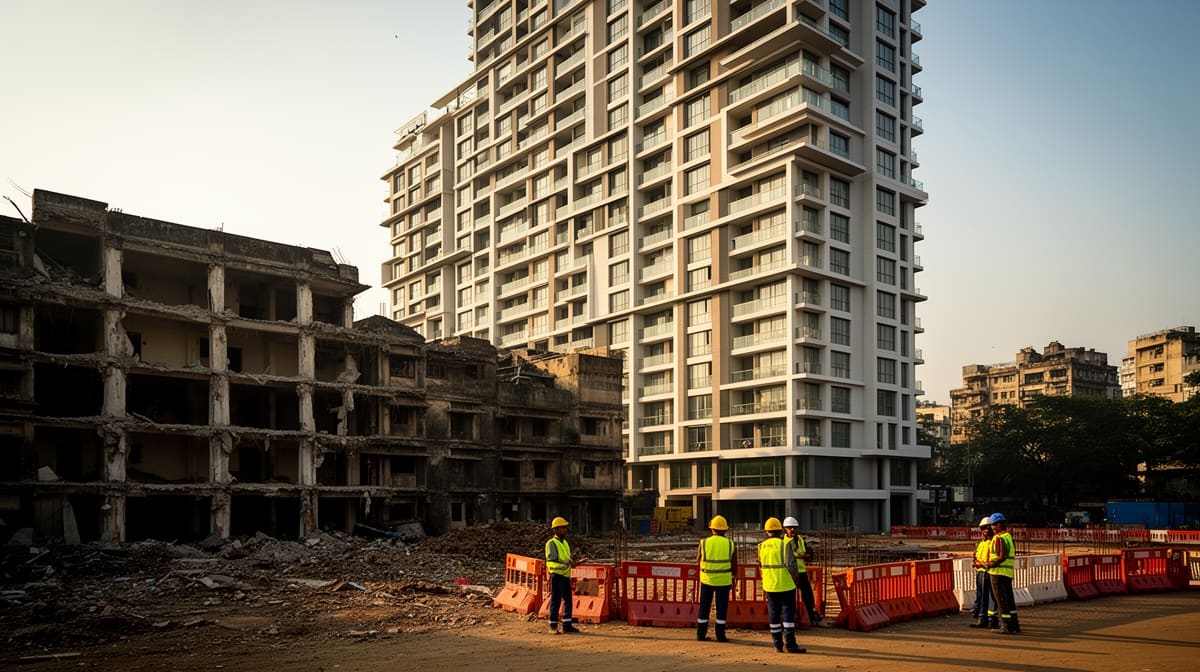
The Bombay High Court has clarified that the mere long-term occupation of railway land does not entitle unauthorised occupants to rehabilitation benefits under government policy. The Court emphasized that statutory eviction procedures under the Public Premises Act are not contingent upon social welfare considerations unless eligibility criteria are demonstrably met.
Background & Facts
The Dispute
The 25 connected writ petitions involve residents of informal settlements on Western Railway land in Malad (East), Mumbai. The petitioners, mostly homesteaders and low-income workers, have occupied unauthorised structures on railway property since as early as 1980. These structures, ranging from 5.95 to 16.32 square metres, were erected without any legal sanction and are situated on land classified as public premises under the Public Premises (Eviction of Unauthorised Occupants) Act, 1971.
Procedural History
- 29 August 2022: Estate Officer issued Show Cause Notices under Section 5A(2) of the Public Premises Act, demanding removal of unauthorised constructions.
- 13 October 2023: Petitioners submitted written responses, citing Government Resolution dated 12 December 2000 and Utran Se Besthan Railway Jhopadpatti Vikas Mandal v. Government of India.
- 23 January 2025: Estate Officer passed eviction orders, directing vacating within 15 days.
- 6 May 2025: City Civil Court dismissed appeals, holding them non-maintainable.
- 26 February 2026: Bombay High Court heard the writ petitions collectively.
Relief Sought
The petitioners sought quashing of the eviction orders and directed rehabilitation under the Mumbai Urban Transport Project (MUTP) Resettlement and Rehabilitation (R&R) Policy. They claimed eligibility as Project Affected Persons (PAPs) due to prolonged occupation and alleged failure of authorities to conduct baseline surveys.
The Legal Issue
The central question was whether Section 5A of the Public Premises Act, 1971 requires railway authorities to provide rehabilitation benefits to unauthorised occupants merely because of long-term occupation, or whether such benefits are conditional upon demonstrable eligibility under a specific government policy.
Arguments Presented
For the Petitioner
The petitioners contended that their occupation since 1980 qualifies them as Project Affected Persons under Clause 5 of the Government Resolution dated 12 December 2000. They relied on Utran Se Besthan Railway Jhopadpatti Vikas Mandal to argue that railway authorities, having tolerated occupation for decades, bear a moral and legal obligation to provide resettlement. They asserted that the Estate Officer failed to consider the R&R policy’s cut-off date mechanism and ignored the Supreme Court’s directive to balance eviction with humane resettlement.
For the Respondent
The respondents countered that the petitioners failed to produce any documentary evidence proving eligibility under the R&R policy. They emphasized that the structures lie beyond the 10-metre corridor of the 6th Railway Line, excluding them from MUTP coverage. The Railway Authorities had followed due process under Section 5A by issuing notices, permitting replies, and passing reasoned orders. The Utran judgment was distinguished as involving complete inaction by authorities, unlike the present case where statutory procedures were fully complied with.
The Court's Analysis
The Court undertook a rigorous statutory interpretation of Section 2(g) and Section 5A of the Public Premises Act, 1971. It held that the Act is a special, summary enactment designed for the swift removal of unauthorised occupation from public premises. The Court observed that the Act does not mandate rehabilitation, nor does it incorporate social welfare obligations unless explicitly linked by policy.
"The expression 'unauthorised occupation' under Section 2(g) is clear: it includes continuance in occupation after authority has expired. The Act does not create a right to remain, nor does it impose a duty to rehabilitate."
The Court examined the Government Resolution dated 12 December 2000 and found that eligibility for R&R benefits is strictly conditioned upon enumeration during a baseline survey and adherence to a cut-off date. The petitioners failed to prove they were enumerated or that their structures existed prior to the cut-off. Their reliance on Utran Se Besthan was rejected as inapposite: in that case, authorities had remained passive for years; here, they acted promptly under statutory mandate.
The Court further noted that the petitioners themselves admitted in their joint representation that their structures were located beyond the 10-metre zone of the railway line, disqualifying them from MUTP coverage. The Court concluded that the Estate Officer’s order was legally sound, procedurally correct, and not arbitrary.
The Verdict
The petitioners’ writ petitions were dismissed. The Court held that Section 5A of the Public Premises Act permits eviction of unauthorised occupants without obligation to provide rehabilitation unless eligibility under a specific policy is proven. However, the Court directed the State and Railways to record occupant details for potential future rehabilitation under any applicable scheme.
What This Means For Similar Cases
Rehabilitation Is Not Automatic for Long-Term Occupants
- Practitioners must now establish that occupants were enumerated in a baseline survey before invoking R&R policies.
- Mere duration of occupation, even exceeding 40 years, does not create a legal entitlement to resettlement.
- Courts will not infer policy applicability absent documentary proof of eligibility.
Due Process Under Public Premises Act Is Sufficient
- Issuing a Section 5A notice, allowing a reply, and passing a reasoned order satisfies statutory due process.
- The Utran precedent does not apply where authorities act within statutory timelines.
- Eviction orders under the Act are not invalid merely because occupants are economically vulnerable.
Documentation Is Critical for Future Rehabilitation Claims
- The Court mandated that the Collector record identity and profile details of evicted occupants.
- This creates a paper trail for potential future claims under state or central rehabilitation schemes.
- Practitioners should advise clients to preserve any proof of residence, income, or family composition for submission to rehabilitation authorities.