The Chhattisgarh High Court has clarified that when a government employee is transferred but not allotted alternate official accommodation, and House Rent Allowance (HRA) is consistently deducted from salary for the retained quarter, any subsequent recovery of penal rent constitutes a legal error. This judgment reinforces the principle that implied administrative consent, evidenced by financial deductions, cannot be overridden by retrospective penal action.
Background & Facts
The Dispute
The petitioner, Ram Avatar Sharma, a retired government employee, was transferred from the Industrial Training Institute (ITI), Bhilai, to ITI Mohla in June 2009. Despite the transfer, no official quarter was allotted to him at ITI Mohla. He continued to reside in the government quarter at ITI Bhilai. From June 2009 until June 2017, House Rent Allowance (HRA) of ₹95 per month was deducted from his salary in respect of the Bhilai quarter. On 04.07.2017, the authorities issued an order directing recovery of ₹4,97,600 as "penal rent" from his gratuity, alleging unauthorized occupation of the Bhilai quarter after transfer.
Key Facts
- Petitioner was posted at ITI Bhilai prior to June 2009
- Transfer order issued in June 2009 to ITI Mohla
- No official quarter allotted at ITI Mohla at any point
- HRA of ₹95/month deducted from salary from June 2009 to June 2017 (as per Annexure P/6)
- Petitioner remained in the Bhilai quarter throughout this period
- No formal written permission was granted to retain the Bhilai quarter
- Recovery order dated 04.07.2017 (Annexure P/11) demanded ₹4,97,600 as penal rent
- Amount recovered from petitioner’s gratuity prior to filing of writ petition
- Petitioner filed writ petition on 20.03.2019
Procedural History
- June 2009: Transfer from ITI Bhilai to ITI Mohla
- June 2009 - June 2017: HRA of ₹95/month deducted from salary for Bhilai quarter
- 04.07.2017: Recovery order issued for ₹4,97,600 as penal rent
- Prior to 20.03.2019: ₹4,97,600 recovered from petitioner’s gratuity
- 20.03.2019: Writ Petition No. 6099 of 2019 filed before the Chhattisgarh High Court
- 27.03.2026: Judgment delivered by Justice Sanjay K. Agrawal
The Parties' Positions
Petitioner’s Position: The deduction of HRA over eight years constituted implied permission to retain the Bhilai quarter. No notice of eviction was issued before the recovery order. Recovery from gratuity is arbitrary and violates principles of natural justice.
Respondents’ Position: The petitioner failed to vacate the Bhilai quarter after transfer. Show cause notices were issued. Retention of quarter without allotment constitutes unauthorized occupation. Penal rent recovery is lawful under service rules.
Relief Sought
The petitioner sought quashing of the recovery order dated 04.07.2017, refund of ₹4,97,600 recovered from his gratuity, and directions to prevent future similar recoveries.
The Legal Issue
The central question was whether the deduction of House Rent Allowance (HRA) over a prolonged period, in the absence of alternate accommodation, constitutes implied permission by the competent authority, thereby negating the legal basis for recovery of penal rent.
Arguments Presented
For the Petitioner
Mr. B.P. Singh, Advocate, argued that the consistent deduction of HRA from June 2009 to June 2017 amounted to administrative acquiescence. The State, by accepting rent through salary deductions, effectively authorized the petitioner’s continued occupation. Recovery of penal rent after eight years, especially from gratuity, is punitive, retrospective, and violates the doctrine of promissory estoppel. No formal order permitting retention was required, as the conduct of the authorities spoke louder than words.
For the Respondent
Mr. Sharad Mishra and Mr. H.A.P.S. Bhatia contended that the petitioner was under a statutory obligation to vacate the Bhilai quarter upon transfer. The issuance of show cause notices demonstrated due diligence. The deduction of HRA was merely a procedural formality and did not imply permission to retain the quarter. Penal rent recovery under service rules is mandatory for unauthorized occupation, regardless of HRA deductions.
The Court's Analysis
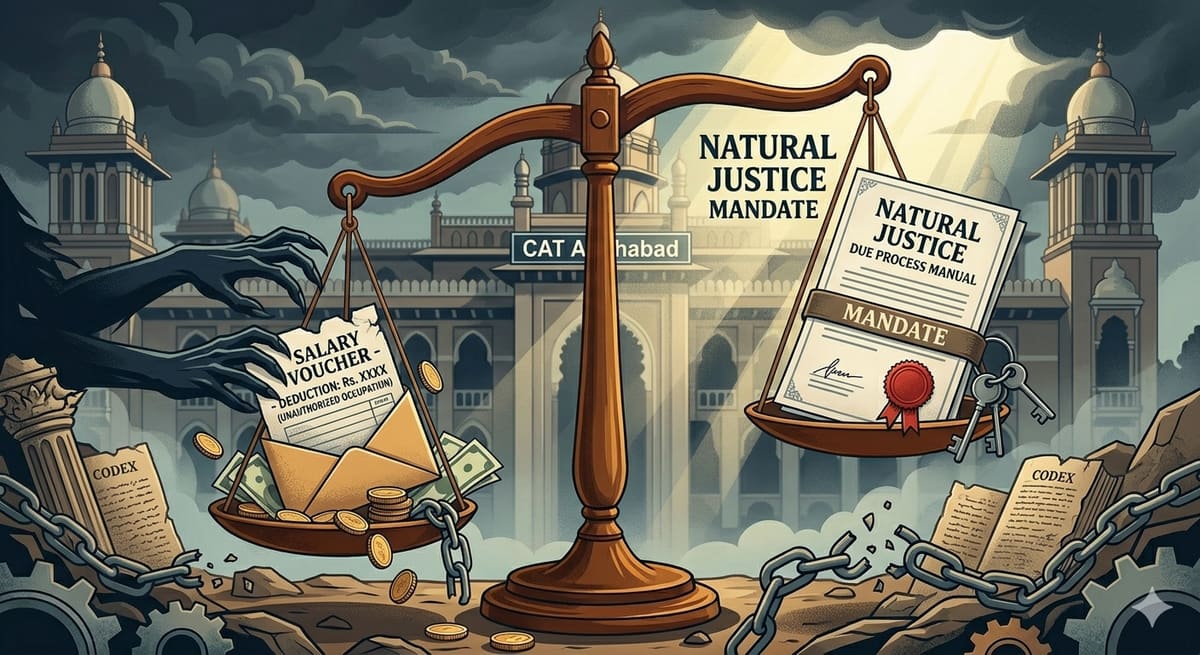
The Court examined the conduct of the State over a period of eight years and found that the deduction of HRA was not a mere clerical oversight but a deliberate administrative practice. The State, through its financial records, acknowledged the petitioner’s occupation of the Bhilai quarter and received rent in the form of HRA deductions. The Court held that such conduct cannot be ignored or later reversed to impose a retrospective penalty.
"Once the Competent Authority permitted him to stay in the quarter at ITI Bhilai and the HRA were deducted, in my considered opinion, penal rent could not have been recovered as the petitioner stayed with an implied permission of the Competent Authority for which the Competent Authority deducted the usual rent from the salary of the petitioner for the entire period."
The Court distinguished between mere non-objection and active financial recognition. The State’s acceptance of rent through salary deductions created a de facto license. To later treat the same occupation as unauthorized and impose a penalty of nearly ₹5 lakh was arbitrary and violative of Article 14 of the Constitution. The Court also noted that show cause notices issued after years of acquiescence lacked legal efficacy.
The Verdict
The writ petition was allowed. The recovery order dated 04.07.2017 and the impugned order were quashed. The State was directed to refund ₹4,97,600 recovered from the petitioner’s gratuity within 30 days from the date of judgment. No costs were awarded.
What This Means For Similar Cases
HRA Deduction Equals Implied Permission
- Practitioners representing government employees can now argue that consistent HRA deductions for a retained quarter constitute administrative consent
- Recovery of penal rent after years of such deductions is legally unsustainable
- The burden shifts to the State to prove that HRA deductions were made in error or without authority
Retrospective Penalties Are Unlawful
- Administrative actions cannot be weaponized retroactively to impose financial penalties
- Gratuity, being a statutory benefit, cannot be used as a recovery instrument for disputed rent claims without due process
- Any recovery must be preceded by a clear, contemporaneous order of eviction and opportunity to be heard
Documentation Trumps Oral Assertions
- Salary slips and financial records are conclusive evidence of administrative conduct
- Oral claims of "show cause notices" without proof of service or acknowledgment are insufficient to override documented financial recognition
- Practitioners must insist on production of all salary records and official correspondence before any recovery is contested