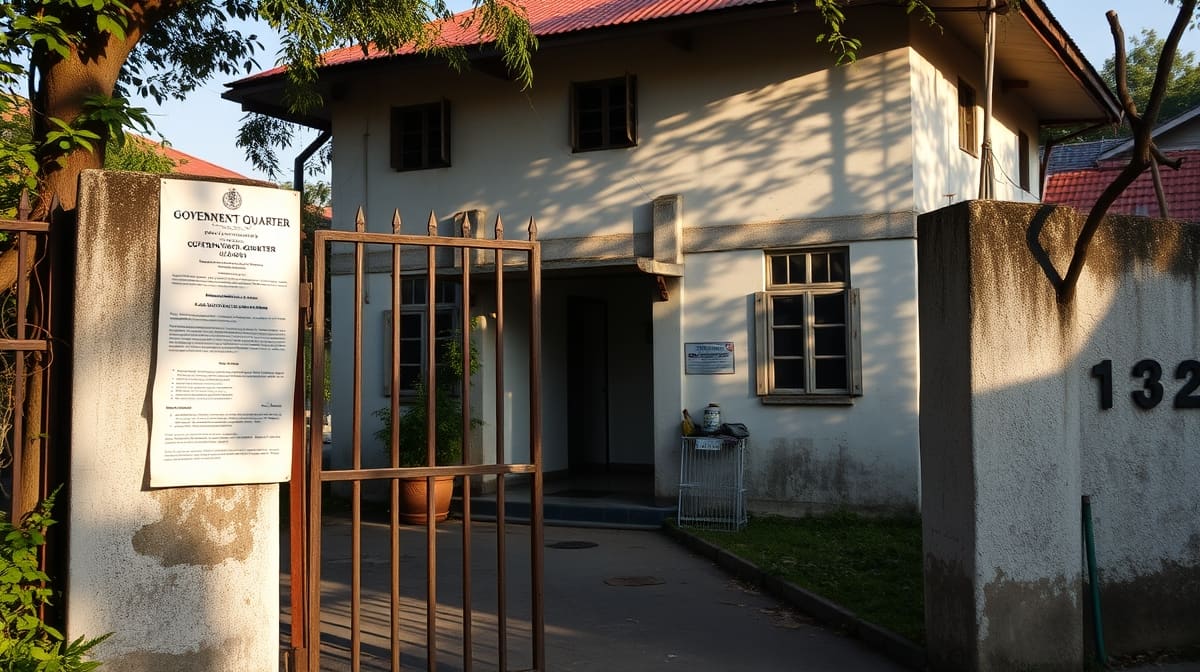
The Gauhati High Court has reaffirmed that possession of a government quarter post-retirement, without lawful authority, cannot be defended by an unregistered sale deed - even where the occupant claims to have invested in repairs and utilities. The judgment underscores the primacy of statutory allotment over private claims in public housing matters.
Background & Facts
The Dispute
The petitioners are the legal representatives of Late Toshimanen Ozukum, a retired Town Planner in the Urban Development Department of Nagaland. He was allotted Government Quarter No.CH/TP-1, Type VI, at Lower Chandmari, Kohima, vide Order No.TPO/G-76/91-92 dated 27.05.1998. After his retirement on superannuation, he refused to vacate the quarter. Despite multiple notices and a prior apology for non-compliance, he continued to occupy the premises. The Department issued eviction notices under the Nagaland Eviction of Persons in Unauthorized Occupation of Public Land Act, 1971, culminating in two notices dated 17.03.2021 and 19.10.2022, and an order dated 08.07.2022 directing eviction after survey.
Key Facts
- Late Toshimanen Ozukum was appointed as Town Planner and served until superannuation.
- On 27.02.1998, he applied for Government Quarter No.CH/TP-1, Type VI, at Chandmari, Kohima.
- On 27.05.1998, he was formally allotted the quarter by the Chief Town Planner.
- He was transferred to Dimapur on 21.02.2007 and ordered to vacate the quarter by Order No. UD/T-76/2001/583.
- On 20.09.2007, he submitted a letter apologizing for not vacating the quarter and requesting humanitarian consideration.
- On 04.09.2019, the Department issued an eviction notice under Government Notification No.UDD/2/ESTT/10/MISC/2015, demanding vacating within one month and imposing a penalty of Rs. 1,54,000 for overstay.
- He failed to vacate; on 16.03.2020, the Department directed the Deputy Commissioner to initiate action.
- On 18.09.2020, a vacation notice was issued under Section 5 of the Nagaland Eviction Act, 1971.
- On 17.03.2021, an eviction notice was issued, followed by an appeal under Section 12 of the Act.
- On 26.03.2021, RTI applications were filed seeking information on Quarter No.CH/TP-1, Type V and Type VII.
- RTI replies dated 11.06.2018 and 2021 indicated the quarter was recorded as Type V, not Type VI, and that no land acquisition records existed for Lower Chandmari.
- The petitioner claimed ownership via an unregistered sale deed dated 16.03.1998 for Rs. 80,000, covering two plots adjacent to the quarter.
- He claimed to have renovated the quarter, installed water and electricity, and built a boundary wall at his own cost.
- The Department maintained that the land was acquired by the British in 1935 and inherited by the State, and was covered under the 1934-35 Kohima settlement map.
Procedural History
- 27.05.1998: Quarter No.CH/TP-1, Type VI, allotted to Late Toshimanen Ozukum.
- 21.02.2007: Transfer order issued directing vacating of quarter.
- 20.09.2007: Petitioner tendered apology for non-vacation.
- 04.09.2019: First formal eviction notice issued under Government Notification.
- 16.03.2020: Department directed Deputy Commissioner to initiate action.
- 18.09.2020: Vacation notice issued under Section 5 of the Nagaland Eviction Act.
- 17.03.2021: Eviction notice issued under the Act.
- 26.03.2021: RTI applications filed by petitioner and landowner.
- 08.07.2022: Order passed by Commissioner directing survey before eviction.
- 19.10.2022: Second eviction notice issued.
- 27.01.2026: Hearing concluded.
- 06.04.2026: Judgment pronounced.
The Parties' Positions
Petitioners: Argued that the quarter was not government property, citing RTI replies showing no record of Quarter CH/TP-1 in the Department’s inventory. Claimed ownership via unregistered sale deed and asserted that renovations and utility connections established their right. Contended that eviction notices were issued without proper survey or evidence of unauthorized occupation.
Respondents: Maintained that the quarter was lawfully allotted to the deceased during service and that his continued occupation post-retirement was unauthorized. Highlighted his 2007 apology admitting fault. Emphasized that the unregistered sale deed was legally void under Section 17 of the Registration Act, 1908, as the property value exceeded Rs. 100. Asserted that the land was state property since 1935 and that the petitioner’s claim was fraudulent.
Relief Sought
The petitioners sought quashing of the eviction notices dated 17.03.2021 and 19.10.2022, and the order dated 08.07.2022. Alternatively, they sought a direction to conduct a proper survey and verification of the land as directed in the 08.07.2022 order.
The Legal Issue
The central question was whether an unregistered sale deed, for land on which a government quarter stands, can override a lawful government allotment and justify continued occupation post-retirement under the Nagaland Eviction of Persons in Unauthorized Occupation of Public Land Act, 1971.
Arguments Presented
For the Petitioner
Mr. L. Iralu argued that the RTI replies proved the quarter was not recorded in the Department’s inventory, suggesting the land was not government property. He contended that the petitioner’s long-term possession, coupled with personal investment in renovation and utilities, created a de facto right. He cited M. Jongshi & Ors. v. State of Nagaland, State of Madhya Pradesh v. Shiv Kunwarbai, and Sulochana Chandrakant Galande to argue that eviction without due process and survey was arbitrary. He emphasized that the Department’s own order dated 08.07.2022 acknowledged the need for survey, implying the prior notices were premature.
For the Respondent
Mr. I. Imsong, Additional Advocate General, countered that the allotment order dated 27.05.1998 was conclusive proof of lawful possession during service. He stressed that the unregistered sale deed was legally invalid under Section 17 of the Registration Act, 1908, which mandates registration for immovable property exceeding Rs. 100 in value. He cited the petitioner’s 2007 apology as admission of wrongful occupation. He argued that the RTI replies pertained to Type V and Type VII quarters, not Type VI, and were irrelevant. He maintained that the eviction notices followed statutory procedure and that the petitioner’s conduct amounted to abuse of process.
The Court's Analysis
The Court examined the legal status of the unregistered sale deed under Section 17 of the Registration Act, 1908, which mandates compulsory registration of instruments relating to immovable property of value exceeding Rs. 100. The Court noted that the petitioner claimed to have purchased land worth Rs. 3,00,000, yet produced no registered document. The Court held that an unregistered sale deed has no legal sanctity and cannot confer ownership or override a government allotment.
"The unregistered sale deed, by which he allegedly claimed having purchased the land, cannot be relied upon as the same had no legal sanctity."
The Court further observed that the petitioner’s own conduct undermined his claim. His 2007 apology, wherein he admitted to occupying the quarter unlawfully and requested humanitarian consideration, was a clear admission of unauthorized possession. The Court held that such conduct barred him from invoking the equitable jurisdiction of the Court under Article 226.
The Court also rejected the petitioner’s reliance on RTI replies, noting that the queries pertained to Type V and Type VII quarters, while the quarter in question was Type VI. The Court found the RTI responses irrelevant and the attempt to use them as evidence misleading.
The Court applied the principles from W.B. Central School Service Commission v. Abdul Halim and Municipal Council, Neemuch v. Mahadeo Real Estate, holding that judicial review under Article 226 is limited to cases of apparent legal error, irrationality, or procedural impropriety. The Court found no such infirmity in the eviction notices or the order dated 08.07.2022. The Department had acted within its statutory authority, and the petitioner’s claim was not bona fide.
The Court emphasized that the petitioner’s conduct - continuing occupation after retirement, refusal to vacate despite notices, and reliance on an invalid document - constituted a clear abuse of the judicial process.
The Verdict
The petition was dismissed with costs of Rs. 10,000. The Court held that the eviction notices dated 17.03.2021 and 19.10.2022, and the order dated 08.07.2022, were valid and lawful. The petitioners were directed to vacate the quarter as per the notice dated 04.09.2019 and pay monthly rent as quantified in Annexure-3. The costs of Rs. 10,000 were to be deposited with the Gauhati High Court Legal Services Authority, Kohima Bench, within four weeks.
What This Means For Similar Cases
Unregistered Documents Cannot Override Government Allotments
- Practitioners must advise clients that unregistered sale deeds for government quarter land are legally void under Section 17 of the Registration Act, 1908.
- Even substantial personal investment in repairs or utilities does not create a legal right to retain government property post-retirement.
- Courts will not entertain claims based on unregistered instruments when a lawful allotment exists.
Abuse of Process Bars Equitable Relief
- Petitioners must approach courts with clean hands; admissions of wrongdoing (e.g., apology letters) will be used to deny equitable relief under Article 226.
- Courts will impose costs for frivolous litigation aimed at delaying lawful eviction.
- Delayed challenges based on RTI replies that do not directly contradict the allotment order are unlikely to succeed.
Procedural Compliance Is Sufficient
- Eviction notices issued under the Nagaland Eviction Act, even without a prior survey, are valid if the occupant’s unauthorized status is established by allotment records and conduct.
- The direction for survey in the 08.07.2022 order does not invalidate prior notices; it merely reflects procedural caution.
- Administrative authorities need not re-prove ownership if the allotment record is clear and the occupant’s possession is post-retirement and unchallenged for years.