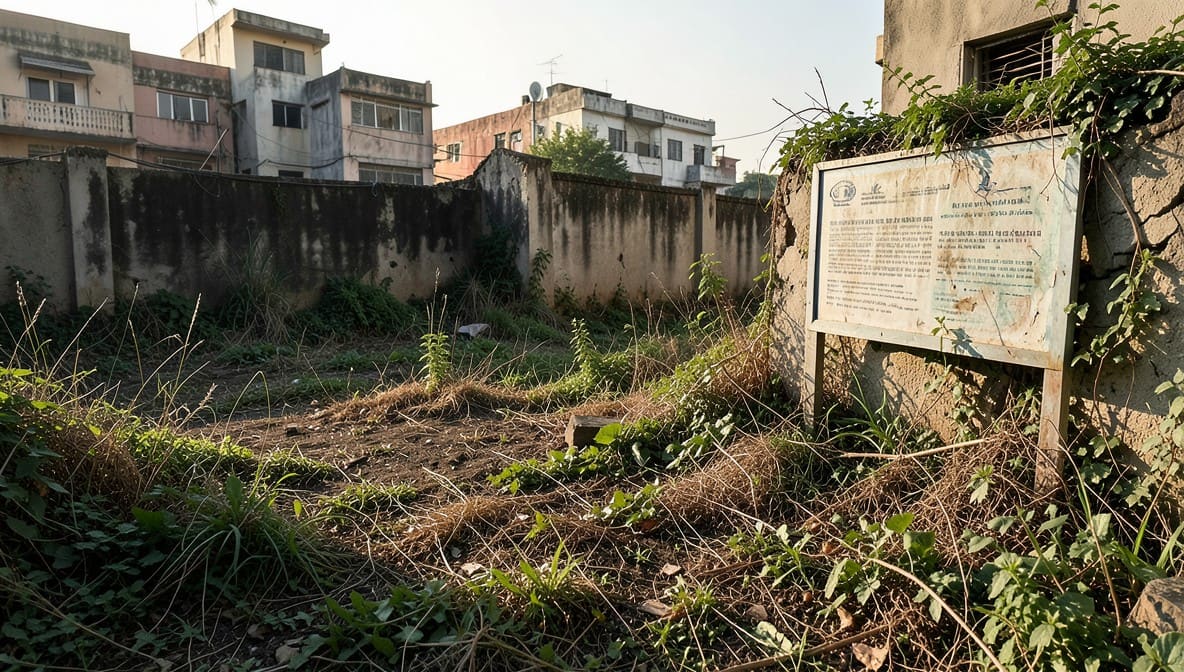
The repeal of the Urban Land (Ceiling & Regulation) Act, 1976, has extinguished the State’s claim to surplus land declared under Section 10(3) if possession was never taken before the repeal date. The Bombay High Court has clarified that mere declaration of surplus status without physical occupation does not sustain vesting post-repeal, restoring the owner’s rights.
Background & Facts
The Dispute
The petitioner, Thomas More Pereira, is the legal heir of his mother, who was the original owner of a 20,948.40 sq.mts. plot at Bund Garden Road, C.T.S. No.13/2, Pune. Proceedings under the Urban Land (Ceiling & Regulation) Act, 1976 (ULC Act) were initiated against this land in 1976. The Competent Authority declared 13,410.88 sq.mts. as surplus on 22.12.1977, and the surplus land was notified as vested in the State under Section 10(3) on 12.03.1979. However, the State never took physical possession of the land.
Key Facts
- The petitioner’s mother filed a return under Section 6(1) on 10.09.1976.
- Draft statement under Section 8(3) issued on 20.09.1977; objections dismissed on 22.12.1977.
- Final declaration under Section 9 issued on 22.12.1977; surplus land notified as vested on 12.03.1979.
- Surplus land was allotted to Pune Area Housing Development Board on 24.02.1979 for Rs.77,200 as occupancy price.
- The petitioner’s mother filed an appeal under Section 33 on 07.03.1979, rejected on 09.03.1979 on grounds of laches.
- Writ Petition No.877 of 1979 filed on 29.03.1979; stay granted on 30.03.1979; dismissed on 24.09.1982.
- Civil Appeal No.3331 of 1982 filed in the Supreme Court on 08.10.1982; stay granted on 05.11.1982; dismissed on 25.07.1996.
- Scheme under Section 20(1)(a) filed on 14.03.1987 (Scheme No.A-225) remains pending.
- Section 21 exemption application rejected on 08.07.1996.
- Appeal against rejection filed on 07.08.1996; Government issued oral stay against possession.
- Notice for possession served on 14.08.1998; Writ Petition No.4446 of 1998 filed on 18.08.1998; ad-interim injunction granted on 18.08.1998 and confirmed by order dated 31.08.1998.
- No further hearing or adverse order was passed on the 1996 appeal.
- On 12.08.2005, the petitioner was informed by phone that possession would be taken on 17.08.2005.
- The ULC Act was repealed in Maharashtra with effect from 29.11.2007.
Procedural History
- 10.09.1976: Initial return filed under Section 6(1)
- 20.09.1977: Draft statement issued
- 22.12.1977: Objections dismissed; final declaration issued
- 12.03.1979: Notification under Section 10(3) published; land vested in State
- 24.02.1979: Surplus land allotted to Pune Area Housing Development Board
- 29.03.1979: Writ Petition No.877 of 1979 filed; stay granted
- 24.09.1982: Writ Petition dismissed by Bombay HC
- 08.10.1982: Civil Appeal No.3331 of 1982 filed in Supreme Court
- 05.11.1982: Supreme Court granted stay
- 25.07.1996: Supreme Court dismissed Civil Appeal; upheld vesting
- 07.08.1996: Appeal filed under Section 33 against rejection of Section 21 application
- 14.08.1998: Notice for possession served
- 18.08.1998: Writ Petition No.4446 of 1998 filed; injunction granted
- 31.08.1998: Injunction confirmed by Bombay HC
- 29.11.2007: ULC Act repealed in Maharashtra
- 12.08.2005: Notice of intended possession received
- 20.05.2005: Writ Petition No.5381 of 2005 filed
- 28.09.2011: Interim relief granted
- 16.02.2026: Judgment reserved
- 08.04.2026: Judgment pronounced
The Parties' Positions
Petitioner: Argued that since possession of the surplus land was never taken by the State before the repeal of the ULC Act on 29.11.2007, the vesting under Section 10(3) abated. He relied on Voltas Limited v. Addl. Collector to assert that the Repeal Act extinguished the State’s claim where possession was not taken.
Respondents: Contended that vesting under Section 10(3) was complete upon notification, irrespective of possession. They argued that delays in taking possession were due to litigation initiated by the landowner, and that the Repeal Act did not reverse vested rights.
Relief Sought
The petitioner sought a declaration that, as a consequence of the repeal of the ULC Act, all proceedings under the Act in relation to the land lapses and the land no longer vests in the State Government.
The Legal Issue
The central question was whether vesting of surplus land under Section 10(3) of the Urban Land (Ceiling & Regulation) Act, 1976 continues to subsist after the Act’s repeal on 29.11.2007, if physical possession of the land was never taken by the State Government prior to repeal.
Arguments Presented
For the Petitioner
The petitioner relied on the Division Bench judgment in Voltas Limited v. Addl. Collector and Competent Authority to argue that Section 3(1)(a) of the Urban Land (Ceiling & Regulation) Repeal Act, 1999 only saves vesting where possession has been taken. Since no possession was ever taken in this case, the vesting under Section 10(3) was extinguished by the repeal. He emphasized that Sections 10(5), 10(6), 11, and 14 of the ULC Act, which enable enforcement and compensation, were repealed and cannot be invoked post-repeal. The petitioner further argued that the State’s inaction for over two decades, despite having ample opportunity after the Supreme Court’s dismissal of the appeal in 1996, amounted to acquiescence.
For the Respondent
The respondents contended that vesting under Section 10(3) is a legal transfer of title, independent of physical possession. They cited the Supreme Court’s 1996 decision upholding the notification as conclusive proof of vesting. They argued that the Repeal Act was intended to prevent future proceedings, not to undo completed vesting. They further claimed that delays in possession were caused by the petitioner’s own litigation, and that the State cannot be penalized for the pendency of judicial remedies initiated by the landowner. They asserted that the allotment of land to MHADA and payment of occupancy price conferred a legitimate public interest that could not be nullified by repeal.
The Court's Analysis
The Court undertook a detailed statutory interpretation of Section 3(1)(a) of the Repeal Act, 1999, which states: "Nothing contained in this Act shall affect the vesting of any vacant land under sub-section (3) of section 10 of the principal Act, possession of which has been taken over by the State Government." The Court observed that this provision is a saving clause, not a retrospective validation. It does not create vesting; it only preserves vesting that has already occurred with possession.
"The purpose of enacting Section 3(1)(a) of the Repeal Act is to save or protect vesting of vacant lands in the State Government and out of the vacant lands that might have vested in the State Government by virtue of declarations made under sub-section (3) of Section 10 of the Principal Act, only vesting of those lands in the State Government of which possession has been taken has been saved."
The Court held that the absence of any provision in the Repeal Act to divest the State of ownership of land where possession was not taken implies that such vesting is rendered ineffective. The Court further noted that Sections 10(5) and 10(6), which empower the Competent Authority to take possession, and Sections 11 and 14, which govern compensation, were repealed and are no longer available. Without these enforcement mechanisms, the State cannot enforce its claimed ownership.
The Court distinguished the respondents’ reliance on the Supreme Court’s 1996 judgment, which upheld the notification of vesting, by emphasizing that the judgment did not address the effect of repeal. The Court held that the legal status of the land is governed by the law in force at the time of adjudication, not by past declarations alone.
The Court also noted that the State had over seven years (from 1996 to 2003) and then another four years (until 2007) to take possession after the Supreme Court’s final decision, yet failed to act. The Court concluded that the State’s inaction, coupled with the statutory repeal, extinguished its claim.
The Verdict
The petitioner succeeded. The Court declared that as a consequence of the repeal of the Urban Land (Ceiling & Regulation) Act, 1976, with effect from 29.11.2007, all proceedings initiated under the Act in relation to the land measuring 20,948.40 sq.mts. at C.T.S. No.13/2, Bund Garden Road, Pune, have abated. The land no longer vests in the State Government. The Court made the rule absolute and disposed of Civil Application No.38 of 2022.
What This Means For Similar Cases
Vesting Without Possession Is Not Permanent
- Practitioners must now argue that mere notification under Section 10(3) does not create an irrevocable title if possession was never taken.
- Any claim by the State to land declared surplus under the ULC Act must be supported by proof of actual possession before 29.11.2007.
- Post-repeal, owners can challenge State possession claims on the ground of statutory abatement.
Repeal Acts Can Erase Incomplete Vesting
- The judgment establishes that repeal statutes with saving clauses operate prospectively and may extinguish rights if the conditions for preservation are unmet.
- This principle applies beyond the ULC Act - any statute repealed with a saving clause requiring physical or procedural completion (e.g., land acquisition, tenancy regularization) may be similarly affected.
- Legal notices or allotments without physical control are insufficient to sustain State claims post-repeal.
Delay by the State Can Be Fatal to Claims
- The Court’s observation that the State had ample opportunity to act between 1996 and 2007 signals that laches and inaction can defeat even legally valid vesting.
- Practitioners representing landowners should highlight prolonged delays in enforcement as evidence of abandonment or acquiescence.
- This creates a new strategic avenue in land disputes: argue that the State’s failure to act within a reasonable time after judicial finality nullifies its claim under the repeal.