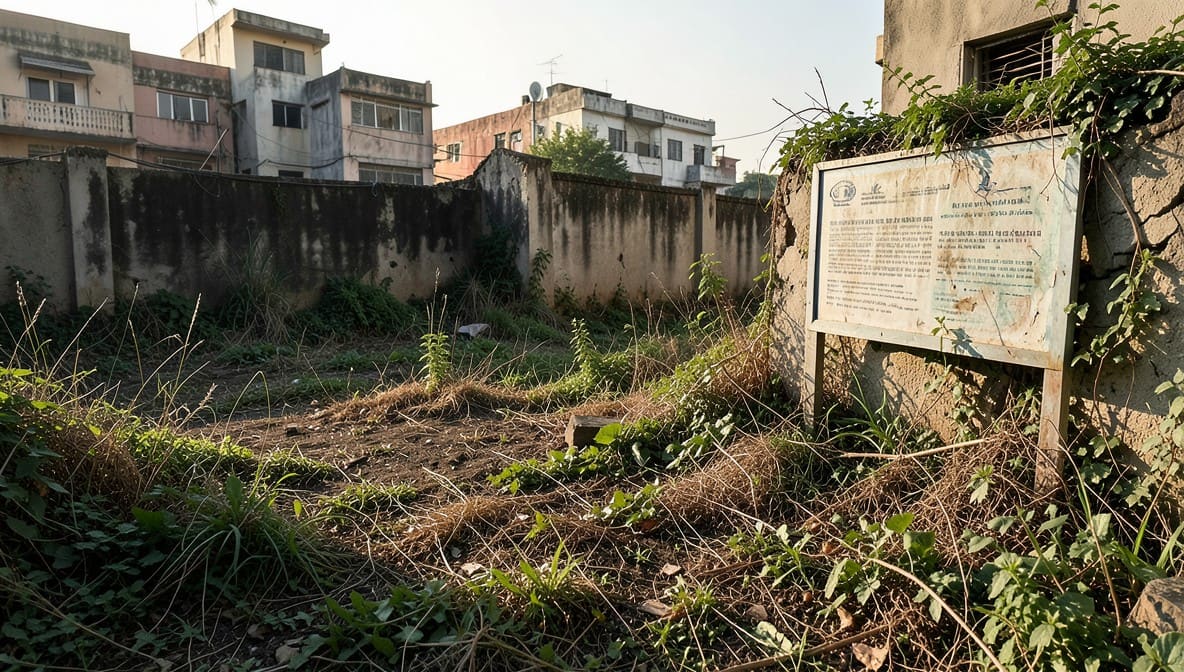
The Madhya Pradesh High Court has reaffirmed that any transfer of excess vacant land under the Urban Land (Ceiling and Regulation) Act, 1976, after publication of the Section 10(1) notification is void ab initio. This ruling decisively bars subsequent purchasers from challenging acquisition proceedings initiated against the original landholder, reinforcing the statutory prohibition on post-notification transfers.
Background & Facts
The Dispute
The petitioner, Gambhir Singh Yadav, claims ownership of a 3,410 square metre plot in Village Jodhupura, District Gwalior, based on a registered sale deed dated 06.02.1990 executed by Kharga, S/o Chhote Kumhar. The land was originally held by Kharga, who was subject to proceedings under the Urban Land (Ceiling and Regulation) Act, 1976 (ULCRA) initiated well before the sale deed was executed. The State contends that the transfer was void under Section 10(4) of the Act and that the petitioner has no legal standing to challenge the acquisition.
Key Facts
- The land, Survey No. 88, admeasuring 4,910 square metres, was subject to ULCRA proceedings initiated against Kharga.
- Notices under Section 6(2) of the Act were issued on 16.06.1979 and 18.02.1983.
- On 30.06.1984, the competent authority determined that 3,410 square metres constituted excess vacant land, non-agricultural and not ancestral.
- The final statement under the Act was issued on 16.10.1989.
- Notification under Section 10(1) was published in the Official Gazette on 23.10.1989, inviting claims.
- Notification under Section 10(3) was published on 04.12.1989, declaring the excess land vested absolutely in the State Government free from all encumbrances.
- The sale deed in favour of the petitioner was executed on 06.02.1990, after both Section 10(1) and 10(3) notifications.
- A notice under Section 10(5) was issued on 08.01.1990, directing surrender of possession.
- Physical possession of the land was taken by the State on 30.03.1990.
- The petitioner was never a party to the ULCRA proceedings and was not named in any order.
Procedural History
- 16.06.1979: First notice under Section 6(2) issued to Kharga.
- 18.02.1983: Second notice under Section 6(2) issued.
- 30.06.1984: Competent authority declares 3,410 sq.m. as excess vacant land.
- 16.10.1989: Final statement issued under ULCRA.
- 23.10.1989: Notification under Section 10(1) published.
- 04.12.1989: Notification under Section 10(3) published; land vests absolutely in State.
- 06.02.1990: Petitioner acquires land via sale deed from Kharga.
- 08.01.1990: Notice under Section 10(5) served on Kharga.
- 30.03.1990: State takes physical possession of excess land.
- 2016: Writ Petition No. 5011 of 2016 filed before the High Court of Madhya Pradesh at Gwalior.
- 16.06.2026: Case reserved for judgment.
- 01.07.2026: Judgment pronounced.
The Parties' Positions
For the Petitioner
The petitioner contends that the acquisition proceedings are vitiated due to non-service of notices under Sections 10(5) and 10(6) of the ULCRA. He argues that he was never given an opportunity to be heard before possession was taken, and that the possession receipt is a mere paper transaction. He relies on State of Uttar Pradesh v. Hariram (2013) 4 SCC 280 and Uttam Singh v. State of M.P. (20.09.2023) to assert procedural irregularities.
For the Respondent/State
The State argues that the petitioner has no locus standi as he was not a party to the ULCRA proceedings. It further contends that the sale deed dated 06.02.1990 was executed after the Section 10(1) and 10(3) notifications, rendering it void under Section 10(4). The State asserts that Kharga had no transferable interest after vesting, and thus could not convey any title to the petitioner.
Relief Sought
The petitioner seeks:
- Quashing of the acquisition proceedings and orders under ULCRA.
- Declaration that the proceedings abated under the Urban Land (Ceiling and Regulation) Repeal Act.
- Any other relief deemed fit by the Court.
The Legal Issue
The central question was whether a subsequent purchaser, who acquires land after the publication of a Section 10(1) notification under the Urban Land (Ceiling and Regulation) Act, 1976, can challenge the acquisition proceedings initiated against the original landholder, when the transfer itself is declared void under Section 10(4).
Arguments Presented
For the Petitioner
The petitioner’s counsel argued that the State failed to serve notices under Sections 10(5) and 10(6) on him, violating principles of natural justice. He contended that physical possession was never lawfully taken and that the possession receipt was fabricated. He relied on State of Uttar Pradesh v. Hariram to argue that procedural lapses invalidate acquisition, and on Uttam Singh to assert that the petitioner’s continued physical possession entitles him to relief.
For the Respondent/State
The State’s counsel countered that the petitioner has no locus standi because he was never a party to the proceedings and was not the landholder against whom the ULCRA action was initiated. He emphasized that Section 10(4) explicitly voids any transfer after the Section 10(1) notification, making the sale deed null and void ab initio. He further argued that the Repeal Act cannot revive a transaction void under the principal Act.
The Court's Analysis
The Court undertook a strict textual interpretation of Section 10(4) of the Urban Land (Ceiling and Regulation) Act, 1976, which states: "During the period commencing on the date of publication of the notification under sub-section (1) and ending with the date specified in the declaration made under sub-section (3)-- (i) no person shall transfer by way of sale, mortgage, gift, lease or otherwise any excess vacant land... and any such transfer made in contravention of this provision shall be deemed to be null and void."
The Court held that the language of the provision is unambiguous and mandatory. The sale deed dated 06.02.1990 was executed after the Section 10(1) notification (23.10.1989) and after the vesting declaration under Section 10(3) (04.12.1989). Therefore, the transfer was statutorily void from inception.
"Once the transfer is void in the eyes of law, the petitioner cannot claim any enforceable right on the basis of such transaction nor can he seek to challenge proceedings which had attained finality against the original landholder."
The Court rejected the petitioner’s reliance on State of Uttar Pradesh v. Hariram and Uttam Singh, distinguishing those cases on the ground that they involved parties with legally recognized rights in the property. The petitioner, by contrast, derived title from a void transaction and thus had no standing to invoke the Court’s writ jurisdiction under Article 226.
The Court further held that the doctrine of nemo dat quod non habet applies: a person cannot transfer a better title than he himself possesses. Since Kharga’s title was extinguished upon vesting under Section 10(3), no valid title passed to the petitioner.
Regarding the Repeal Act, the Court held that its benefits are conditional and cannot be invoked to validate a transaction that was void under the principal Act. The petitioner’s claim of abatement was therefore without legal basis.
The Verdict
The writ petition was dismissed. The Court held that the sale deed dated 06.02.1990 was void ab initio under Section 10(4) of the Urban Land (Ceiling and Regulation) Act, 1976. The petitioner lacked locus standi to challenge acquisition proceedings initiated against Kharga. No relief was granted. The State’s acquisition of the 3,410 square metres of land remained valid and unchallenged.
What This Means For Similar Cases
Void Transfers Under ULCRA Cannot Be Salvaged
- Practitioners must verify the status of land under ULCRA before advising on property transactions post-1976.
- Any sale deed executed after Section 10(1) notification is legally null and cannot be enforced.
- Title searches must include verification of ULCRA notifications and vesting orders.
Locus Standi Requires Legally Recognized Interest
- A purchaser cannot challenge acquisition proceedings if their title is derived from a void transfer.
- Only original landholders or persons with independent legal rights may challenge ULCRA proceedings.
- Courts will not entertain writ petitions from parties whose claim is based on a transaction declared void by statute.
Repeal Act Does Not Revive Void Transactions
- The Urban Land (Ceiling and Regulation) Repeal Act, 2020, cannot be used to validate transfers void under Section 10(4).
- The Repeal Act’s benefits apply only to lawful, subsisting claims, not to transactions that were void at inception.