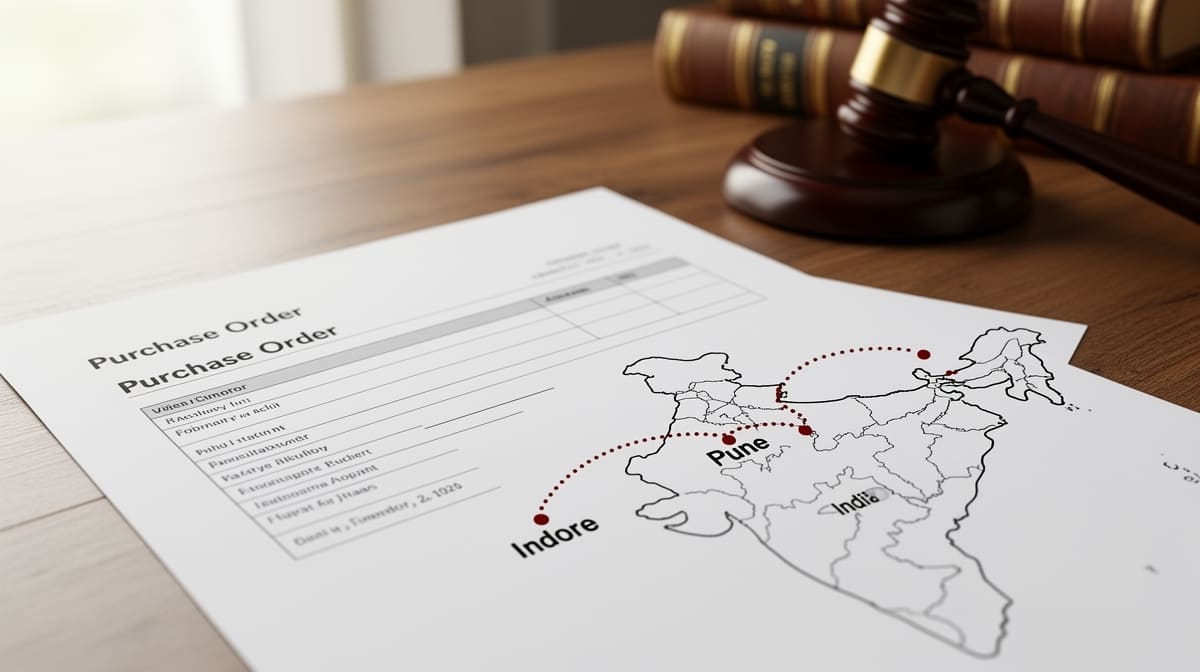
The Bombay High Court has clarified that the grant of leave under Clause XII of the Letters Patent does not confer permanent or irrevocable jurisdiction on a transferee court when a suit for immovable property is transferred due to enhanced pecuniary limits. This judgment reasserts the primacy of Section 16 of the CPC in determining territorial jurisdiction for suits concerning land, regardless of prior judicial permissions granted by the High Court.
Background & Facts
The Dispute
The appellant, Nouveau Exports Pvt. Ltd., filed Suit No. 4241 of 2011 in the Bombay High Court seeking specific performance of an agreement for sale dated 20.10.2000 and possession of undivided property No. 79, Jeevan Nagar, Kilokari, New Delhi. The suit was valued at Rs. 24 lakhs, exceeding the then pecuniary jurisdiction of the Bombay City Civil Court. The plaintiff alleged that the agreement was executed in Mumbai and that part of the cause of action arose there, thereby invoking jurisdiction under Clause XII of the Letters Patent.
Key Facts
The agreement for sale was executed on 20.10.2000 in Mumbai.
The subject property is located in New Delhi.
The plaintiff claimed that part of the cause of action arose in Mumbai due to execution and delivery of the agreement.
Leave under Clause XII of the Letters Patent was granted by the Bombay High Court on 17.08.2011 via endorsement on the plaint.
The suit was transferred to the Bombay City Civil Court on 27.11.2015 following enhancement of its pecuniary jurisdiction to Rs. 1 crore under the Bombay City Civil Court (Amendment) Act, 2012.
Defendant No. 1 filed Chamber Summons No. 2273 of 2015 under Order VII Rule 11 CPC seeking rejection of the plaint on grounds of lack of territorial jurisdiction.
The Trial Court, by order dated 12.01.2017, dismissed the application, holding jurisdiction as a preliminary issue to be decided at trial.
The High Court, by order dated 10.07.2018, quashed the Trial Court’s order and remanded the matter for fresh consideration under Section 16 CPC.
The Trial Court, by impugned order dated 17.02.2020, returned the plaint under Order VII Rule 10 CPC, holding that the suit was for land and must be filed in Delhi.
Procedural History
20.10.2000: Agreement for sale executed in Mumbai.
17.08.2011: High Court grants leave under Clause XII of Letters Patent.
27.11.2015: Suit transferred from High Court to Bombay City Civil Court due to enhanced pecuniary jurisdiction.
12.01.2017: Trial Court dismisses application for rejection of plaint under Order VII Rule 11 CPC.
10.07.2018: Bombay High Court sets aside Trial Court’s order and remands for reconsideration under Section 16 CPC.
17.02.2020: Trial Court returns plaint under Order VII Rule 10 CPC, holding lack of territorial jurisdiction.
11.12.2025: Bombay High Court appoints Mr. Naushad Engineer as amicus curiae.
15.07.2026: Present appeal decided by Division Bench.
The Parties' Positions
Appellant (Plaintiff): Argued that once leave under Clause XII is granted, the transferee court (City Civil Court) cannot revisit jurisdiction; the suit must proceed as if originally filed in the High Court.
Respondents (Defendants): Contended that the suit is for land under Section 16 CPC, and territorial jurisdiction is determined by location of property; leave under Letters Patent is irrelevant after transfer.
Amicus Curiae: Supported respondents, emphasizing that Section 4A(2) of the Bombay City Civil Court Act, 1948, treats transferred suits as if originally instituted in the City Civil Court, thereby subjecting them to full application of CPC provisions including Sections 16, 17, and 20.
Relief Sought
The appellant sought reversal of the order dated 17.02.2020, restoration of the suit in the Bombay City Civil Court, and direction to proceed with trial. The respondents sought confirmation of the return of plaint and dismissal of the appeal.
The Legal Issue
The central question was whether the City Civil Court, upon receiving a suit transferred from the High Court under Section 4A(2) of the Bombay City Civil Court Act, 1948, is bound by the High Court’s prior grant of leave under Clause XII of the Letters Patent, or whether it retains the power to examine territorial jurisdiction afresh under Section 16 of the CPC when the suit is for immovable property.
Arguments Presented
For the Appellant
The appellant relied on Isha Distribution House Pvt. Ltd. v. Aditya Birla Nuvo Ltd. and Indian Mineral & Chemicals Co. v. Deutsche Bank to argue that once leave under Clause XII is granted, the issue of territorial jurisdiction becomes a mixed question of law and fact, to be decided only at trial after written statement. Counsel contended that permitting the City Civil Court to return the plaint under Order VII Rule 10 would amount to a review of the High Court’s jurisdictional decision, which is impermissible. He further argued that the word "return" in Order VII Rule 10 implies the plaint was previously filed in that court, which was not the case here. He warned that allowing such returns would lead to de novo trials and frustrate legislative intent behind pecuniary jurisdiction enhancements.
For the Respondent
The respondents, supported by amicus curiae, contended that Section 4A(2) of the Bombay City Civil Court Act, 1948, explicitly treats transferred suits as if originally instituted in the City Civil Court. Therefore, the provisions of Sections 16, 17, and 20 of the CPC apply fully, and the grant of leave under Clause XII is irrelevant post-transfer. They relied on Adcon Electronics Pvt. Ltd. v. Daulat & Anr. to establish that a suit for land is one where the relief sought relates to title or possession of immovable property - a clear case here. They argued that Clause XII jurisdiction is exclusive to the High Court and cannot be inherited by subordinate courts. The City Civil Court, as a court of original jurisdiction under the CPC, must apply territorial jurisdiction rules without deference to prior High Court orders.
The Court's Analysis
The Court undertook a detailed statutory interpretation of Section 4A(2) of the Bombay City Civil Court Act, 1948, and Clause XII of the Letters Patent. It held that the phrase "as if it had been originally instituted in that Court" is not a mere procedural formality but a substantive legal fiction that subjects the transferred suit to the full regime of the Code of Civil Procedure, including Section 16, which mandates that suits for immovable property must be instituted in the court within whose jurisdiction the property is situated.
"The grant of leave under Clause XII confers jurisdiction on the High Court, which jurisdiction does not ipso facto get transferred to the City Civil Court, by transfer of the suit, if the City Civil Court lacks jurisdiction."
The Court distinguished Isha Distribution House on the ground that it involved a complex factual dispute over where the cause of action arose, requiring evidence. In contrast, the present suit was unambiguously for land - the property was in Delhi, and the relief sought was possession. There was no factual ambiguity; the jurisdictional defect was clear and patent.
The Court further rejected the appellant’s argument that the City Civil Court could only send the matter back to the High Court. It held that Section 15 CPC requires suits to be instituted in the court of lowest grade competent to try them. Since the High Court’s jurisdiction was invoked only due to pecuniary limits, and those limits were now exceeded, the suit properly belonged in the City Civil Court - which, as a court of original jurisdiction under the CPC, must apply territorial jurisdiction rules without being bound by the High Court’s prior leave.
The Court emphasized that the Trial Court did not review or overturn the High Court’s grant of leave. It merely applied Section 16 CPC to determine whether the suit, now treated as originally filed in the City Civil Court, was properly instituted. The return of the plaint under Order VII Rule 10 was not a rejection but a procedural correction to ensure the suit is filed in the correct forum.
The Verdict
The appeal was dismissed. The Bombay High Court upheld the order dated 17.02.2020 of the Bombay City Civil Court, directing the return of the plaint under Order VII Rule 10 of the CPC for presentation to the Delhi High Court. The Court held that the suit, being for immovable property situated in Delhi, must be instituted in the court having territorial jurisdiction over Delhi. No monetary relief, interest, or costs were awarded as the matter was procedural. The interim application was disposed of as infructuous.
What This Means For Similar Cases
Territorial Jurisdiction Overrides Prior Leave
Practitioners must now treat suits for land transferred from High Court to City Civil Court as subject to Section 16 CPC from the moment of transfer.
Prior grant of leave under Clause XII cannot be invoked to override territorial jurisdiction objections raised in the transferee court.
Clear Cases Permit Early Jurisdictional Challenge
Where the suit is unambiguously for land (i.e., relief seeks title or possession), the defendant may file an application under Order VII Rule 10 for return of plaint even at the stage of written statement.
No need to wait for trial; the defect is apparent on the face of the plaint.
Statutory Transfer Creates Fresh Jurisdictional Status
Section 4A(2) does not preserve the procedural posture of the transferring court. The transferee court must assess jurisdiction as if the suit was filed there originally.
This applies equally to suits transferred due to pecuniary enhancement or reduction - jurisdiction is re-evaluated under CPC, not Letters Patent.
Avoiding De Novo Trials
If a suit is returned under Order VII Rule 10, the plaintiff must refile in the proper court. The limitation period is preserved under Section 14 CPC if the earlier filing was in good faith.
Practitioners should advise clients to file suits in the correct territorial jurisdiction from the outset to avoid delays and costs.