The Bombay High Court has clarified that a contractual stipulation stating 'subject to Indore jurisdiction' does not automatically oust the territorial jurisdiction of other courts unless there are clear connecting factors linking the contract's formation or performance to the stipulated forum. This ruling reinforces the principle that jurisdiction cannot be conferred by agreement where the cause of action has no territorial nexus to the chosen court.
Background & Facts
The Dispute
The dispute arose from a commercial transaction between Hydrotek Engineers (plaintiff) and NCM Shoava Engineers (Pvt.) Ltd. and Mr. Neeraj Mujumdar (defendants). The plaintiff, engaged in manufacturing and exporting heavy-duty engineering components, supplied piping kits and accessories to the defendants pursuant to purchase orders issued by the defendants. Invoices were raised for the delivered goods, but payment was defaulted. The plaintiff instituted a summary suit for recovery of the outstanding amount with interest before the Civil Judge, Pune.
Key Facts
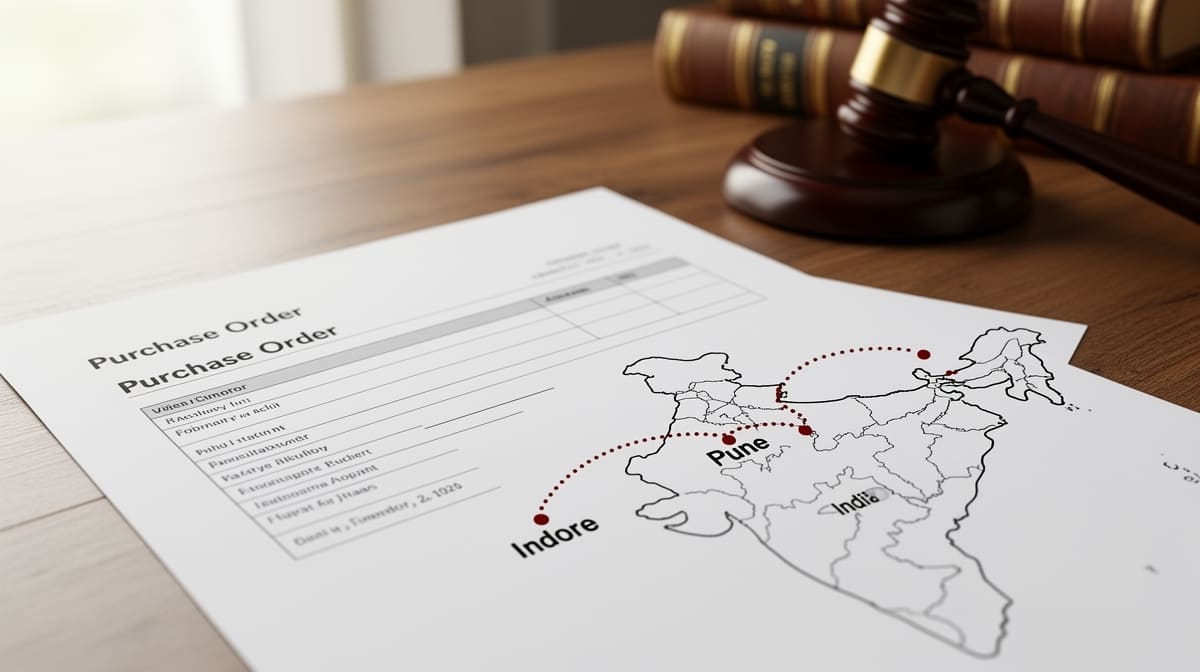
- The defendants issued purchase orders from their office in Indore.
- The purchase orders contained a clause: "subject to Indore jurisdiction".
- The plaintiff delivered the goods to the defendants within the territorial limits of Pune.
- Invoices were raised and dispatched from Pune.
- Payment was to be made against delivery in Pune.
- The defendants did not reside or carry on business in Pune.
- No part of the contract’s formation, performance, or breach occurred in Indore.
Procedural History
- 17.10.2019: Trial Court granted leave to defend the summary suit subject to deposit of the claimed amount.
- 2019: Defendants filed Writ Petition No. 954/2019 challenging the conditional leave to defend - still subjudice.
- Prior to 04.10.2023: Defendants filed an application under Order VII Rule 11 CPC seeking rejection of the plaint on grounds of absence of cause of action and exclusive jurisdiction in Indore.
- 04.10.2023: Civil Judge, Pune, rejected the application, holding that a part of the cause of action arose in Pune and jurisdictional objections are not grounds for rejection under Order VII Rule 11.
- 24.12.2025: Revision application heard and reserved.
- 17.03.2026: Judgment pronounced by the Bombay High Court.
Relief Sought
The applicants sought rejection of the plaint under Order VII Rule 11 CPC on the grounds that: (1) the plaint did not disclose a cause of action; and (2) the parties had contractually excluded all courts except the Court at Indore.
The Parties' Positions
- Applicants (Defendants): Argued that the jurisdiction clause in the purchase orders, though not using the word "exclusive," clearly intended to oust all other courts, including Pune.
- Respondent (Plaintiff): Contended that the cause of action arose in Pune through delivery, invoicing, and payment obligations, and that the jurisdiction clause was vague and unenforceable.
The Legal Issue
The central question was whether a contractual clause stating "subject to Indore jurisdiction" in purchase orders is sufficient to oust the territorial jurisdiction of all other courts, including the court where the cause of action wholly or partly arose, under Order VII Rule 11 of the Code of Civil Procedure, 1908.
Arguments Presented
For the Appellant/Petitioner
The applicants relied on Swastik Gases Private Limited v. Indian Oil Corporation Limited, A.B.C. Laminart Pvt. Ltd. v. A.P. Agencies, and Rakesh Kumar Verma v. HDFC Bank Ltd. to argue that:
- The absence of words like "only" or "exclusive" is not decisive.
- The maxim expressio unius est exclusio alterius applies - specifying one court implies exclusion of others.
- The purchase orders were issued from Indore, and the parties intended to confine litigation to that forum.
- The jurisdiction clause is valid under Section 28 of the Indian Contract Act, 1872, as it does not absolutely restrict legal recourse but merely channels it.
For the Respondent/State
The respondent argued that:
- The clause "subject to Indore jurisdiction" is ambiguous and does not clearly oust other courts.
- The cause of action arose in Pune - where the purchase order was placed, goods delivered, invoices raised, and payment due.
- Under Section 20(c) of the CPC, jurisdiction is determined by where the cause of action arises, not by private agreement.
- The Supreme Court in Hanil Era Textiles Ltd. v. Puromatic Filters (P) Ltd. held that jurisdiction clauses must be supported by connecting factors - none existed here.
- Even if jurisdiction were disputed, rejection of the plaint under Order VII Rule 11 is impermissible - the proper remedy is return of plaint under Order VII Rule 10.
The Court's Analysis
The Court began by rejecting the respondent’s argument that the defendants’ filing of an application for leave to defend constituted submission to Pune’s jurisdiction. It held that Order VII Rule 11 permits rejection of a plaint at any stage if its conditions are met, regardless of subsequent procedural steps.
"The fact that the defendants have filed an application for leave to defend in a summary suit... does not preclude the defendants from seeking the rejection of the plaint."
The Court then examined whether the plaint disclosed a cause of action. It found that the plaint clearly alleged sale, delivery, invoicing, and non-payment - all occurring in Pune - thus satisfying Clause (a) of Order VII Rule 11. The rejection ground on this basis was untenable.
The pivotal issue was the jurisdiction clause. The Court applied the three-limb test from Rakesh Kumar Verma: (1) the clause must not violate Section 28 of the Contract Act; (2) the chosen court must have inherent jurisdiction; and (3) the parties must have clearly intended to confer exclusive jurisdiction.
The Court emphasized that jurisdiction cannot be created by contract where none exists under the CPC. The mere issuance of a purchase order from Indore does not constitute a connecting factor for cause of action. As held in A.B.C. Laminart, the cause of action arises where the contract is made (acceptance communicated), performed, or breached - not where the offer originates.
"Incontrovertibly, the purchase order was placed at the office of the plaintiff within the local limits of the jurisdiction of the Court at Pune. The delivery of the goods was immediate through Vijayraj Transport. The payment was to be made against the delivery."
The Court distinguished Hanil Era Textiles, where multiple connecting factors - offer, acceptance, payment, and delivery - all occurred in Mumbai. Here, no such nexus existed with Indore. The clause "subject to Indore jurisdiction" was too vague and unsupported by facts to oust Pune’s jurisdiction.
The Court concluded that the trial judge correctly rejected the application for rejection of the plaint, and the revision application was without merit.
The Verdict
The revision application was dismissed. The order dated 04.10.2023 of the Civil Judge, Pune, was upheld. The plaint shall proceed for trial. No costs were awarded. The defendants are not entitled to have the plaint rejected under Order VII Rule 11 CPC on grounds of jurisdiction or absence of cause of action.
What This Means For Similar Cases
Jurisdiction Clauses Must Be Supported by Connecting Factors
- Practitioners must now demonstrate that the chosen forum has a tangible connection to the contract - offer, acceptance, performance, payment, or delivery - not merely the place of issuing a purchase order.
- A clause like "subject to [City] jurisdiction" without corroborating facts will not suffice to oust statutory jurisdiction.
Order VII Rule 11 Cannot Be Used to Challenge Territorial Jurisdiction
- Applications under Order VII Rule 11 cannot be used to dispute territorial jurisdiction - the correct remedy is return of plaint under Order VII Rule 10.
- Courts must distinguish between lack of cause of action (grounds for rejection) and lack of territorial jurisdiction (grounds for return).
Contractual Jurisdiction Clauses Are Valid Only If They Do Not Violate Section 28
- Parties may agree to channel disputes to a specific court, but only if: (a) the chosen court has inherent jurisdiction under the CPC; (b) the clause is clear and unambiguous; (c) the agreement does not absolutely bar litigation elsewhere.
- Drafters of commercial contracts must now explicitly link jurisdiction to actual performance points to ensure enforceability.