Topic

termination of service

Termination of service in India refers to the lawful dismissal of an employee under statutes like the Industrial Disputes Act or service rules, where grounds such as fraud, loss of confidence, or misconduct are evaluated by courts.

13 articlesLatest July 2026
Fiduciary Breach Justifies Termination Despite Delay | Embezzlement by Sub-Post Master Not Disproportionate: Rajasthan HC
Case Law Analysis
|Rajasthan High Court

Fiduciary Breach Justifies Termination Despite Delay | Embezzlement by Sub-Post Master Not Disproportionate: Rajasthan HC

The Rajasthan High Court affirmed that termination of a Sub-Post Master for embezzling public funds is not disproportionate, even after an 11-year delay in challenging the penalty, because breach of fiduciary duty in public service undermines public trust and warrants the severest sanction. This reinforces that integrity in public office overrides procedural delays when the misconduct strikes at the core of public accountability.


Charge Memo Required Before Suspension | Suspension Without Formal Charges Violates MG University Statutes & Natural Justice: Kerala HC
Case Law Analysis
|Kerala High Court

Charge Memo Required Before Suspension | Suspension Without Formal Charges Violates MG University Statutes & Natural Justice: Kerala HC

The Kerala High Court has ruled that a suspension order cannot substitute a formal charge memo under Mahatma Gandhi University Statutes, rendering termination void for violating natural justice. This sets a critical precedent for academic employees: procedural fairness demands a specific, written charge before any disciplinary action, not just administrative suspension.

Maharashtra Private Schools Rules, 1981 | Termination Invalid Without Procedural Compliance Under Rule 14: Bombay HC
Case Law Analysis
|Bombay High Court

Maharashtra Private Schools Rules, 1981 | Termination Invalid Without Procedural Compliance Under Rule 14: Bombay HC

The Bombay High Court has ruled that terminating an untrained teacher under the Maharashtra Private Schools Rules, 1981 without following mandatory procedural safeguards under Rule 14 renders the order void. This reinforces that administrative convenience cannot override statutory due process for school employees, setting a binding precedent for all grant-in-aid institutions in Maharashtra.

Natural Justice | Termination of Service Requires Fresh Notice; Cannot Be Decided on Unnotified Proposal : Allahabad HC
Case Law Analysis
|Allahabad High Court

Natural Justice | Termination of Service Requires Fresh Notice; Cannot Be Decided on Unnotified Proposal : Allahabad HC

The Allahabad High Court has ruled that an employer cannot terminate a government lecturer based on a termination proposal never formally communicated or subjected to a fresh hearing. This reinforces that procedural fairness demands specific notice for each distinct disciplinary action - even when suspension proceedings are ongoing. The ruling impacts all public sector employers handling service terminations under administrative law.

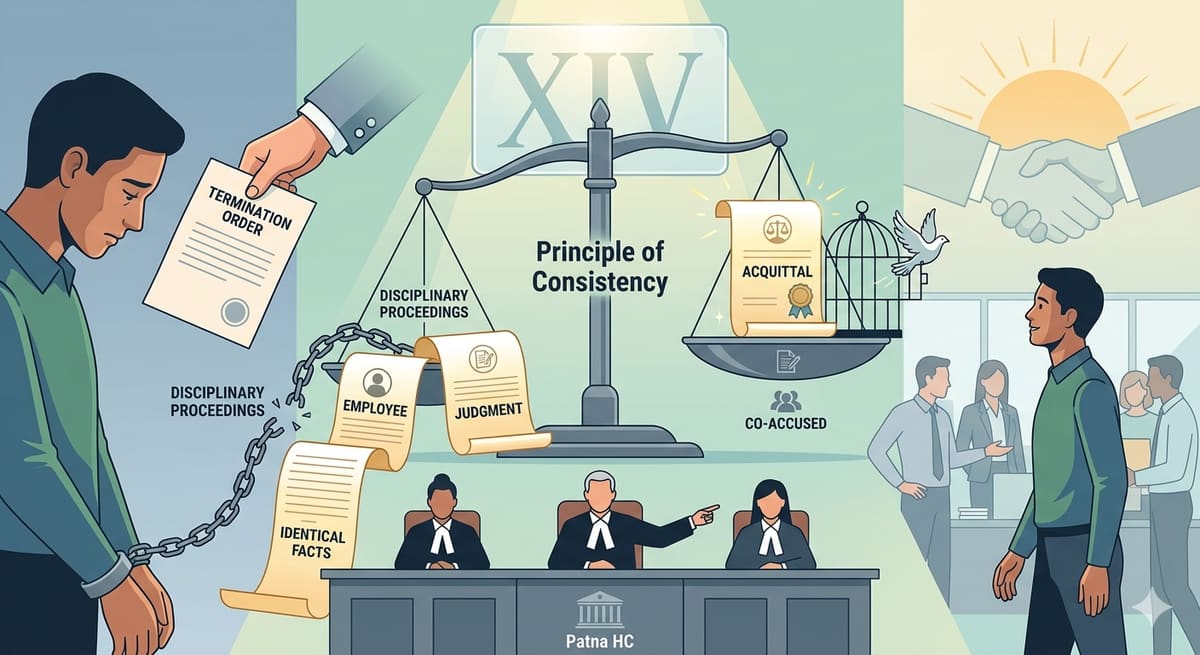
Article 14 & Principle of Consistency | Termination Orders Must Align with Co-Accused Acquittal in Identical Facts : Patna HC
Case Law Analysis
|Patna High Court

Article 14 & Principle of Consistency | Termination Orders Must Align with Co-Accused Acquittal in Identical Facts : Patna HC

Patna High Court sets aside termination orders of two police constables, ruling that administrative justice under Article 14 mandates uniformity when a coordinate bench has already reinstated co-accused in identical departmental proceedings. The decision underscores that inconsistent disciplinary actions violate equality principles, impacting all public servants facing parallel charges.

Haryana Contractual Employees Act 2024 | Termination After Acquittal in Internal Enquiry Illegal; Reinstatement Mandated : Punjab & Haryana HC
Case Law Analysis
|Punjab and Haryana High Court

Haryana Contractual Employees Act 2024 | Termination After Acquittal in Internal Enquiry Illegal; Reinstatement Mandated : Punjab & Haryana HC

The Punjab & Haryana High Court ruled that termination of a contractual employee under the Haryana Contractual Employees (Security of Service) Act, 2024, is invalid if the employee is acquitted in an internal enquiry. The court mandated reinstatement with continuity of service, reinforcing statutory protections for contractual workers against arbitrary termination.

Loss of Confidence Justifies Termination Under Industrial Disputes Act | Proven Misappropriation Overrides Long Service : Delhi HC
Case Law Analysis
|Delhi High Court

Loss of Confidence Justifies Termination Under Industrial Disputes Act | Proven Misappropriation Overrides Long Service : Delhi HC

Delhi High Court upholds termination of a workman for misappropriating ₹40,403 despite 18 years of service, ruling that financial dishonesty irreparably breaches employer trust. The judgment reinforces that loss of confidence is a standalone ground for dismissal under service law, irrespective of subsequent restitution or tenure.

Acquittal Does Not Guarantee Reinstatement | Civic Police Volunteer Termination Upheld Despite Acquittal After 12-Year Delay : Calcutta HC
Case Law Analysis
|Calcutta High Court

Acquittal Does Not Guarantee Reinstatement | Civic Police Volunteer Termination Upheld Despite Acquittal After 12-Year Delay : Calcutta HC

Calcutta High Court rules that acquittal in a criminal case does not automatically entitle a Civic Police Volunteer to reinstatement, especially when termination was based on involvement in a criminal case and a 12-year delay renders the claim untenable. The court emphasizes administrative discretion over statutory mandates for remobilization.

Non-Disclosure of Compounded Offences Not Grounds for Termination in Low-Responsibility Posts | EWS Constable Case : Sikkim HC
Case Law Analysis
|Sikkim High Court

Non-Disclosure of Compounded Offences Not Grounds for Termination in Low-Responsibility Posts | EWS Constable Case : Sikkim HC

The Sikkim High Court ruled that suppressing minor, compounded criminal cases in recruitment for low-responsibility public roles cannot justify termination, especially for economically disadvantaged candidates. The judgment anchors this in Article 21’s guarantee of dignity and the principle of reformative justice, setting a precedent for equitable treatment in public employment screening.