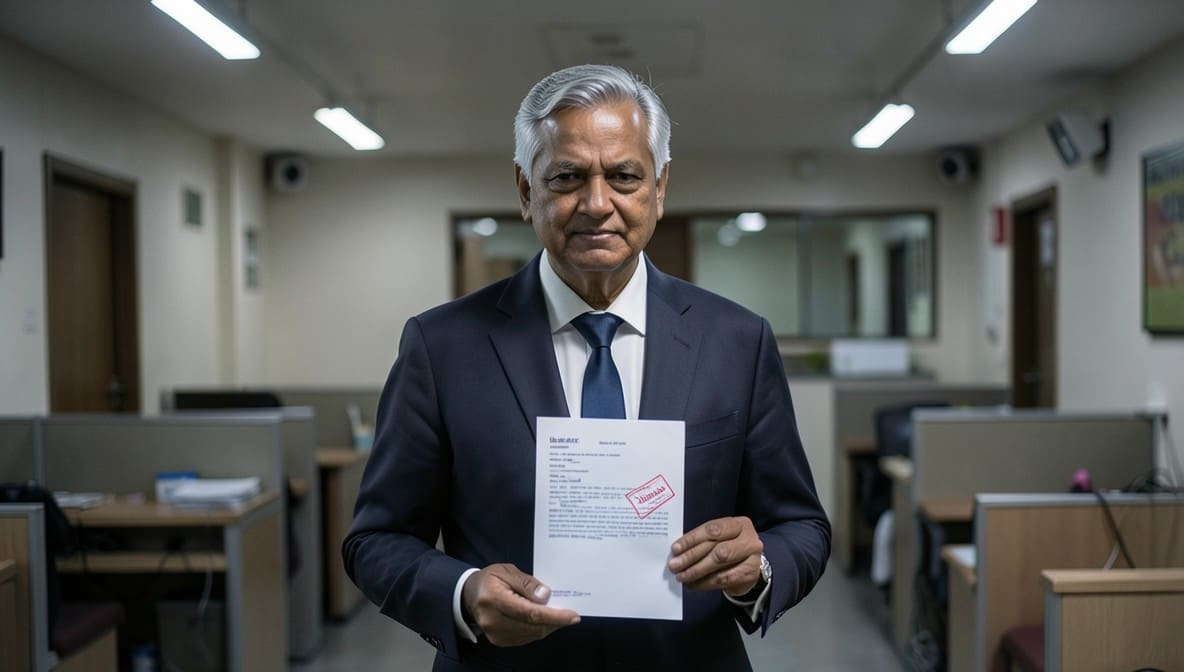
The Rajasthan High Court has affirmed that termination from service for embezzlement by a public official entrusted with public funds constitutes a proportionate penalty, even when challenged after a prolonged delay. The judgment reinforces the principle that breach of fiduciary trust in public service warrants the harshest disciplinary consequence.
Background & Facts
The Dispute
The petitioner, Ramswaroop Meena, served as a Sub-Post Master in the Department of Posts, Government of India. He was charged with misappropriating funds deposited by postal account-holders, a serious violation of his statutory and fiduciary obligations under the Postal Services framework. The disciplinary proceedings culminated in his termination from service.
Key Facts
The petitioner was appointed as a Group-C employee in the Department of Posts
He was posted as Sub-Post Master at a branch office in Kota, Rajasthan
On 30.03.2009, a charge-sheet was issued under Rule 14 of the Central Civil Services (Classification, Control and Appeal) Rules, 1965, alleging embezzlement of public deposits
The charge specifically stated that he diverted funds entrusted to him by postal customers for personal use
An inquiry was conducted, and the charges were found proved
His services were terminated by the Disciplinary Authority on 11.11.2011
A revision petition filed by him was dismissed on 21.03.2013
A review petition was dismissed on 31.03.2014
No further action was taken by the petitioner for over eleven years
On 15.02.2025, he filed Original Application No. 580/2025 before the Central Administrative Tribunal, Jaipur
The Tribunal dismissed the application on 03.11.2025 on grounds of inordinate delay and merit
The petitioner filed the present writ petition on 18.02.2026
Procedural History
30.03.2009: Charge-sheet issued under Rule 14 of CCS (CCA) Rules, 1965
11.11.2011: Disciplinary Authority ordered termination of services
21.03.2013: Revision petition dismissed by competent authority
31.03.2014: Review petition dismissed
15.02.2025: Original Application No. 580/2025 filed before Central Administrative Tribunal
03.11.2025: Tribunal dismissed OA on limitation and merit
18.02.2026: Writ Petition No. 4400/2026 filed before Rajasthan High Court
15.07.2026: Judgment delivered by Division Bench
Relief Sought
The petitioner sought quashing of the Tribunal’s order dated 03.11.2025 and reduction of the penalty of termination to a lesser punishment, arguing that the punishment was disproportionate to the charge.
The Legal Issue
The central question was whether the penalty of termination from service for embezzlement of public funds by a Sub-Post Master is so shockingly disproportionate as to warrant judicial interference under the Court’s supervisory jurisdiction, particularly after an eleven-year delay in challenging the order.
Arguments Presented
For the Petitioner
The petitioner’s counsel contended that while the charge of misappropriation was serious, the penalty of termination was excessive. He argued that the petitioner had served for over two decades, had no prior disciplinary record, and that lesser penalties such as compulsory retirement or withholding of increments would have sufficed. He relied on the doctrine of proportionality in administrative law and cited State of Punjab v. Baldev Singh to argue that punishment must be commensurate with the gravity of the offence.
For the Respondent
The Additional Solicitor General submitted that the petitioner’s delay of over eleven years in challenging the termination order was inordinate and unexplained, rendering the application liable to be dismissed on limitation grounds alone. On merit, he emphasized that embezzlement by a public servant entrusted with public funds constitutes a gross breach of fiduciary duty, which strikes at the core of public trust. He cited Union of India v. T.R. Sharma to argue that such misconduct justifies termination as a matter of course.
The Court's Analysis
The Court declined to re-examine the Tribunal’s findings on limitation, noting that no substantial challenge was raised against them. The focus was confined to the proportionality of punishment. The Court observed that the petitioner, as a Sub-Post Master, occupied a position of public trust, entrusted with the safekeeping of money deposited by thousands of account-holders. His role was not merely clerical but fiduciary in nature.
"Being Sub-Post Master, it was his statutory and moral obligation to ensure the safety of the amount deposited with the Post Office by the account-holders but, he misappropriated the amount so deposited for his own use. It amounted to gross abuse of the fiduciary duty cast upon him."
The Court held that embezzlement of public funds is not a mere administrative lapse but a criminal breach of trust. The penalty of termination was not imposed arbitrarily but was the only appropriate sanction to preserve institutional integrity and deter similar misconduct. The Court rejected the argument that length of service or absence of prior misconduct could mitigate the gravity of the offence. It emphasized that public servants holding positions of financial responsibility must be held to the highest standard of accountability.
The Court further noted that the delay in approaching the Tribunal - eleven years without any explanation - further weakened the petitioner’s claim. Even if the punishment were disproportionate, the delay alone would have been sufficient to dismiss the petition.
The Verdict
The writ petition was dismissed. The Court upheld the termination of services ordered on 11.11.2011, finding it neither arbitrary nor disproportionate. The orders of the Central Administrative Tribunal dated 03.11.2025 and the revision and review orders dated 21.03.2013 and 31.03.2014 were affirmed. All pending applications were disposed of.
What This Means For Similar Cases
Fiduciary Breach Justifies Termination
Practitioners must recognize that embezzlement or misappropriation by public servants in roles involving financial handling - such as Post Masters, Treasury Officers, or Bank Officials - will almost invariably attract termination
Lesser penalties are rarely upheld when public funds are involved, regardless of tenure or past record
The doctrine of proportionality does not shield public servants from termination for breach of fiduciary duty
Delay Is Fatal in Service Matters
Delay beyond five years in challenging disciplinary orders is now treated as fatal unless a compelling explanation is provided
Courts will not entertain belated challenges to termination, even if the punishment appears harsh, if the delay remains unexplained
Practitioners must advise clients to exhaust remedies within six months of receiving the final order
Supervisory Jurisdiction Has Limits
High Courts will not interfere with disciplinary penalties under Article 226 unless the punishment is so grossly disproportionate as to be perverse
The Court’s role is not to re-appreciate evidence or substitute its view on punishment
Termination for financial misconduct is now firmly established as a legally sustainable outcome