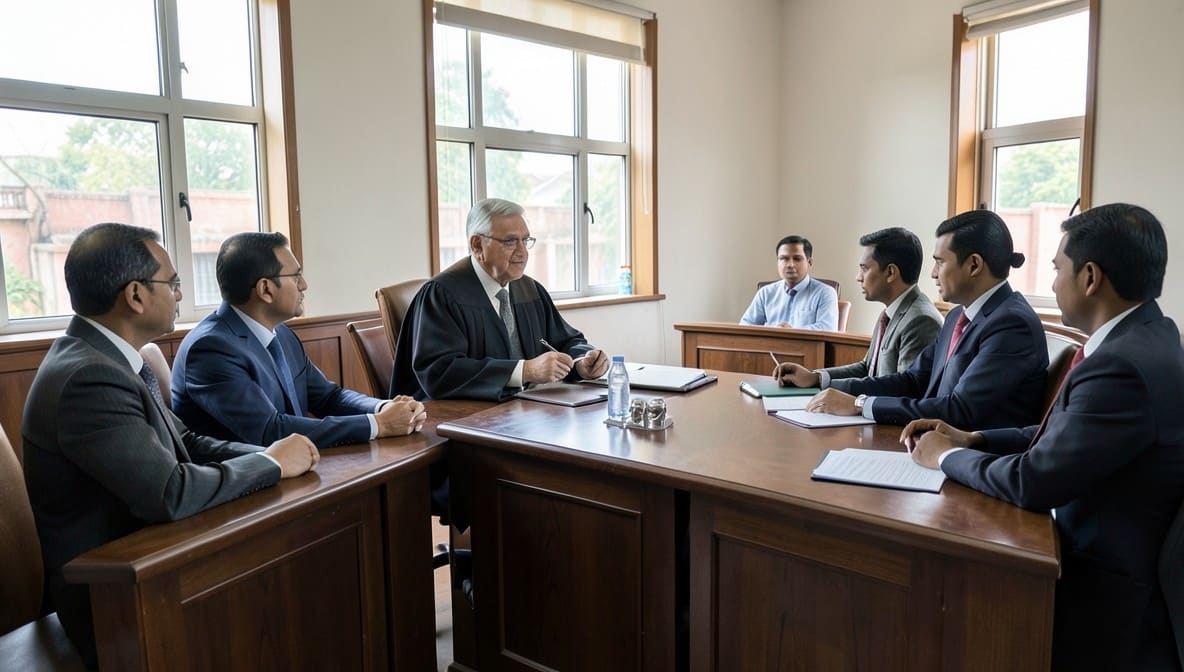
The Allahabad High Court has reaffirmed that administrative authorities cannot expand the scope of proceedings beyond the notice issued, particularly when it involves termination of service. In a significant ruling, the Court held that a proposal for termination, never intimated to the affected party, cannot be adjudicated without violating the foundational principles of natural justice.
Background & Facts
The Dispute
The petitioner, Committee of Management, Janta Vidyalaya Inter College, Mathura, initiated disciplinary proceedings against Respondent-3, Sri Govind Tripathi, a Lecturer in Geography, on grounds of alleged misconduct. The Committee proposed two actions: suspension and termination. While the suspension proposal was formally forwarded to the District Inspector of Schools (DIOS), Mathura, the termination proposal was adopted internally by the Committee but not formally communicated to the DIOS for adjudication.
Key Facts
- Respondent-3 was employed as a Lecturer at Janta Vidyalaya Inter College, Magorra, Mathura
- On 15.12.2025, the Committee communicated a proposal for suspension to the DIOS
- The petitioner filed Writ-A No. 1536 of 2026 on 20.01.2026, seeking expeditious disposal of the suspension proposal
- On 04.02.2026, this Court disposed of the writ petition with an observation that the DIOS would decide the suspension matter within 15 days after giving an opportunity of hearing
- On 11.02.2026 and 07.03.2026, the DIOS issued notices to the parties for hearing on the suspension proposal only
- During this period, the Committee adopted a separate proposal for termination of Respondent-3 on 18.03.2026 and forwarded it to the DIOS
- The DIOS, in the impugned order dated 28.04.2026, considered and disapproved both the suspension and termination proposals without issuing any fresh notice regarding termination
- The inquiry report against Respondent-3 was not supplied to him, and he was not given an opportunity to respond to it
- The petitioner was not afforded an opportunity to present its case on the termination proposal
Procedural History
- 15.12.2025: Proposal for suspension communicated by petitioner to DIOS
- 20.01.2026: Writ-A No. 1536 of 2026 filed before Allahabad High Court seeking direction for expeditious decision on suspension
- 04.02.2026: Writ petition disposed of with direction to DIOS to decide within 15 days
- 11.02.2026: DIOS issued first notice for hearing on suspension
- 07.03.2026: DIOS issued second notice for hearing on suspension
- 18.03.2026: Committee of Management adopted proposal for termination
- 28.04.2026: DIOS passed impugned order disapproving both suspension and termination proposals without fresh notice
- 05.05.2026: Writ-A No. 8127 of 2026 filed challenging the impugned order
- 26.05.2026: Judgment delivered by the High Court
The Parties' Positions
For the Petitioner (Committee of Management): Argued that the termination proposal was never formally submitted to the DIOS for adjudication, and no notice was issued to the parties to consider termination. The impugned order, therefore, exceeded the scope of the proceedings and violated the principle of audi alteram partem.
For Respondent-3 (Sri Govind Tripathi): Contended that the inquiry against him was conducted in violation of due process - the inquiry report was not supplied, and he was not given a fair opportunity to defend himself.
For the State (Respondent-1): Attempted to defend the order as a valid administrative decision, but conceded that the termination proposal was not part of the original notice.
Relief Sought
The petitioner sought quashing of the impugned order dated 28.04.2026 to the extent it disapproved the termination proposal, and a direction for fresh proceedings with proper notice and opportunity of hearing.
The Legal Issue
Can an administrative authority, acting under delegated powers, adjudicate a proposal for termination of service when no notice was issued to the affected parties regarding that specific proposal, and the original notice was limited to suspension?
Arguments Presented
For the Petitioner
The petitioner relied on the doctrine of audi alteram partem and the principle that administrative action must be confined to the scope of the notice issued. It was submitted that the termination proposal was a distinct and more severe action than suspension, requiring separate notice, opportunity to be heard, and a fair inquiry. The failure to provide notice on termination rendered the entire adjudication on that point void ab initio. The petitioner also highlighted that the inquiry report was not shared with Respondent-3, further compounding the procedural illegality.
For the Respondent
Respondent-3 supported the petitioner’s contention, emphasizing that the inquiry was conducted without compliance with mandatory procedural safeguards under service rules. He argued that the non-supply of the inquiry report and denial of opportunity to cross-examine or respond violated his fundamental right to fair hearing under Article 14 of the Constitution. The State did not dispute that the termination proposal was not part of the original notice.
The Court's Analysis
The Court examined the nature of the impugned order and the procedural history with meticulous care. It noted that the heading of the order dated 28.04.2026 explicitly stated that the DIOS was considering the proposal of suspension. The Court observed that the DIOS, without issuing any fresh notice or calling for submissions on termination, proceeded to adjudicate a matter of far greater consequence - termination of service.
"The proposal for termination was never communicated to the respondent or the petitioner as a matter under consideration by the DIOS. To decide upon it without notice is a clear violation of the principles of natural justice."
The Court emphasized that administrative bodies, even when vested with quasi-judicial powers, cannot act beyond the scope of the notice issued. The doctrine of nemo judex in causa sua and audi alteram partem are not mere formalities but substantive guarantees of fairness. The Court further noted that the inquiry report, which formed the basis of the adverse findings, was not supplied to Respondent-3, thereby denying him the right to rebut the allegations.
The Court distinguished this case from routine administrative decisions where minor deviations may be excused. Termination of service, it held, is a drastic measure that demands strict adherence to procedural norms. The fact that the Committee had adopted the termination proposal internally did not absolve the DIOS of its duty to ensure due process.
The Court also rejected the State’s attempt to justify the order as a "convenient consolidation" of two proposals. It held that such an approach would erode the very foundation of administrative fairness.
The Verdict
The writ petition was allowed in part. The Court set aside the portion of the impugned order dated 28.04.2026 that disapproved the proposal for termination of Respondent-3. The matter was remitted to the District Inspector of Schools, Mathura, for fresh consideration of the termination proposal. The parties were directed to appear before the DIOS on 10.06.2026, and a reasoned order must be passed within four weeks thereafter, after considering all submissions and any procedural defects in the inquiry. Meanwhile, Respondent-3 was directed to rejoin his duties with immediate effect, and the petitioner was ordered to pay his salary pending the fresh decision, subject to final outcome. Failure to allow rejoining would invite imposition of exemplary costs.
What This Means For Similar Cases
Procedural Notice Is Non-Negotiable
- Practitioners must insist that any new or additional charge, especially one involving termination, requires a fresh notice and opportunity of hearing
- Administrative authorities cannot "amend" or "expand" the scope of proceedings ex parte
- A proposal for suspension and termination are distinct actions under service law - one cannot be subsumed under the other
Inquiry Reports Must Be Disclosed
- Failure to supply an inquiry report to the charged employee renders the entire proceeding void
- The right to know the case against oneself is a mandatory precondition under Article 14 and service rules
- Any order based on undisclosed evidence is liable to be set aside
Remedial Reinstatement Pending Decision
- Courts may direct reinstatement with salary pending fresh proceedings where termination is quashed
- This prevents irreparable harm to the employee’s livelihood while ensuring procedural fairness
- Non-compliance with such directions invites costs and contempt proceedings