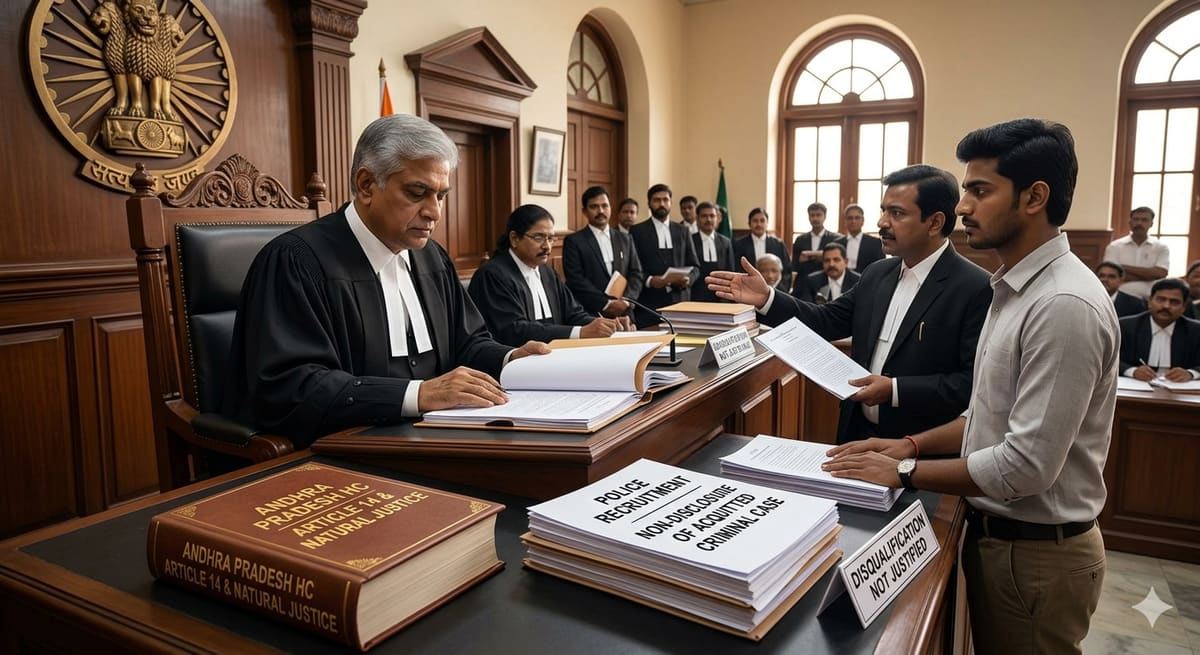
The Sikkim High Court has delivered a significant ruling affirming that non-disclosure of compounded, trivial criminal cases in public employment applications cannot justify termination, particularly when the post involves minimal discretion and the candidate hails from an economically and socially disadvantaged background. The judgment reinforces constitutional values of reformative justice and social equity in service law.
Background & Facts
The Dispute
Vikash, a matriculate from a rural village in Sonbhadra, Uttar Pradesh, applied for the post of Constable (Washerman) in the Sashastra Seema Bal (SSB) under the Economically Weaker Section (EWS) quota in 2020. He was selected and joined duty on 5 March 2024. His appointment was temporary, with a two-year probation period. On 17 August 2024, his service was terminated on grounds of suppression of two prior criminal cases disclosed in his recruitment forms.
Procedural History
- 2017: FIR No. 56/2017 registered under Sections 380/457 IPC; later closed as false after police investigation and court acceptance.
- 2020: FIR No. 252/2020 registered under Sections 323, 504, 506 IPC involving family dispute; case compounded on 5 October 2023, resulting in acquittal.
- 2024: Termination order issued by SSB for non-disclosure of both cases in application and verification forms.
- 2025: Writ petition filed before the High Court of Sikkim challenging termination.
Relief Sought
The petitioner sought setting aside of the termination order, reinstatement in service, and payment of pending salary and arrears. He argued that the offences were trivial, non-convictable, and legally non-disclosable under constitutional principles of reformative justice and social equity.
The Legal Issue
The central question was whether non-disclosure of a compounded, non-convictable criminal case in a public employment application, for a low-responsibility post, constitutes sufficient grounds for termination, especially when the candidate belongs to an economically weaker section and the offence bears no relevance to the duties of the position.
Arguments Presented
For the Petitioner
The petitioner relied on Avtar Singh v. Union of India (2016) to argue that suppression of trivial offences must be evaluated contextually. He cited Krishan Kumar v. DG CISF and Ravindra Kumar v. State of Uttar Pradesh to emphasize that employers must consider the nature of the offence, its outcome, and the candidate’s social background. He contended that the 2017 case was closed as false and the 2020 case ended in acquittal through compromise, making it legally irrelevant. He further invoked the reformative theory and constitutional mandate under Articles 14 and 21 to argue against stigmatization of economically disadvantaged youth.
For the Respondent
The State relied on Union of India v. Bipad Bhanjan Gayen and Union of India v. Shishu Pal to assert that any suppression in application or verification forms constitutes a breach of trust and justifies termination, particularly in disciplined forces like SSB. They argued that the duty to disclose is absolute and that non-disclosure, regardless of outcome, undermines institutional integrity.
The Court's Analysis
The Court undertook a nuanced analysis of the triple dimensions of public employment: the nature of the post, the social context of the candidate, and the constitutional imperative of reformative justice. It distinguished between posts requiring high discretion and those like Constable (Washerman), which involve no public interface, investigative authority, or sensitive responsibility.
"The Constitution envisages a social order in which ameliorative measures are undertaken to address historical and structural disadvantages."
The Court rejected the rigid application of Bipad Bhanjan Gayen, noting that it pertained to higher-ranking or sensitive posts. It emphasized that suppression cannot be treated as an automatic ground for termination when the underlying offence is trivial, compounded, and non-convictable. The Court acknowledged the psychological impact of socioeconomic disadvantage, citing Antony S.R. Manstead’s research to show how structural inequality shapes behavior and decision-making.
It held that the principle of proportionality must govern disciplinary action. The employer’s discretion to condone lapses, as affirmed in Avtar Singh, must be exercised with sensitivity to constitutional goals of equality and dignity. The Court observed that condemning a youth from a marginalized background for a non-conviction, family-based dispute, effectively perpetuates systemic exclusion - contrary to the spirit of Article 15(4) and Article 16(4).
The Verdict
The petitioner won. The Court held that non-disclosure of a compounded, non-convictable offence in a low-responsibility public post cannot justify termination, especially when the candidate belongs to an economically weaker section. The termination order was set aside, and the petitioner was reinstated subject to existing terms. Arrears prior to termination were ordered to be paid within three weeks.
What This Means For Similar Cases
Non-Disclosure Is Not Automatic Ground for Termination
- Practitioners must now argue that termination for non-disclosure requires a contextual assessment of the offence’s nature, outcome, and relevance to the post.
- For posts like constables, clerks, or support staff, suppression of trivial, compounded, or acquitted cases should not trigger automatic dismissal.
- Employers must record reasons for rejecting condonation - mere assertion of "breach of trust" is insufficient.
Social Background Must Inform Character Assessment
- Evidence of socioeconomic disadvantage, educational limitations, or rural upbringing must be considered as mitigating factors.
- Legal arguments should integrate sociological data and constitutional principles under Articles 14, 15, and 21 to challenge rigid institutional norms.
- Employers cannot equate poverty with moral deficiency; the law demands empathy, not stigma.
Reformative Justice Overrides Retributive Discipline
- The reformative theory is now firmly embedded in service jurisprudence for youth from marginalized backgrounds.
- Courts will scrutinize whether termination serves public interest or merely enforces punitive conformity.
- Institutions must align disciplinary policies with the NITI Aayog’s Social Inclusion Framework and National Education Policy 2020 goals.