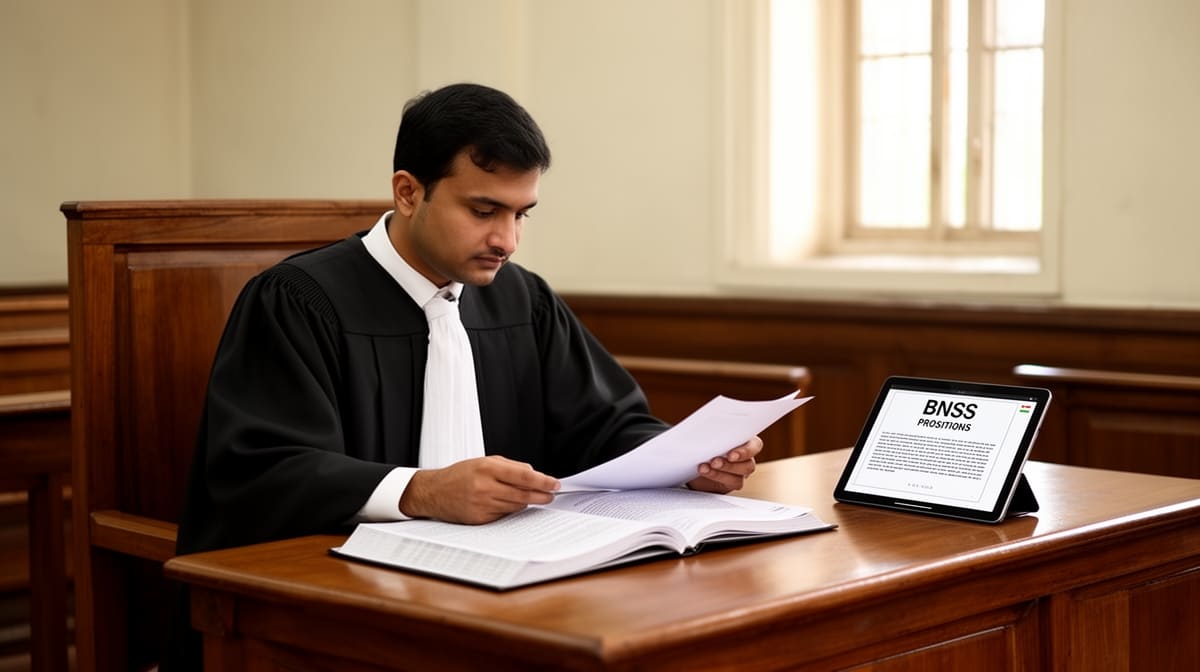
The Karnataka High Court has reaffirmed a critical procedural safeguard in criminal prosecutions initiated through protest petitions: magistrates must independently examine the police 'B' report before taking cognizance of any offence. This ruling prevents premature judicial intervention and reinforces the separation between investigative and adjudicatory functions.
Background & Facts
The Dispute
The present criminal petition challenges the order dated 13.06.2019 passed by the Additional Civil Judge and JMFC at Haveri, which accepted a protest petition and took cognizance of offences under Sections 143, 147, 323, 324, 354(B), 504, 506 read with 149 of the Indian Penal Code. The complaint arose from an alleged altercation between the petitioners and respondent No. 2, Ningappa, over a land dispute in Bharadi village, Haveri district. The police investigated the matter and filed a 'B' report under Section 169 CrPC, concluding no cognizable offence was made out.
Key Facts
- The incident occurred on 15.04.2016, leading to the registration of Police Case No. 254/2016 at Guttal Police Station.
- The investigation concluded on 12.05.2019, with the police filing a 'B' report recommending closure.
- The complainant, respondent No. 2, filed a protest petition on 13.05.2019 challenging the 'B' report.
- The learned Magistrate, without examining the contents of the 'B' report, recorded the sworn statement of the complainant on 13.06.2019 and took cognizance of the offences.
- Cognizance was taken and chargesheet proceedings initiated under C.C. No. 512/2019.
Procedural History
- 15.04.2016: Alleged incident leading to registration of Police Case No. 254/2016.
- 12.05.2019: Police filed 'B' report recommending closure of the case.
- 13.05.2019: Complainant filed protest petition challenging the 'B' report.
- 13.06.2019: JMFC, Haveri, recorded sworn statement of complainant and took cognizance without examining the 'B' report.
- 13.06.2019: C.C. No. 512/2019 commenced.
- 22.04.2022: Criminal Petition No. 100782/2022 filed before Karnataka High Court under Section 482 CrPC.
- 29.06.2026: Hearing concluded and order passed by Justice Anant Ramanath Hegde.
The Parties' Positions
Petitioners (Accused): Argued that the Magistrate violated mandatory procedure under Section 190 CrPC and the binding precedent in Dr. Ravikumar v. Mrs. K.M.C. Vasantha. They contended that cognizance was taken without any judicial scrutiny of the police's reasons for closure.
Respondent No. 2 (Complainant): Maintained that the Magistrate had sufficient grounds to take cognizance after recording the sworn statement and that the 'B' report was merely a recommendation, not binding.
Respondent No. 1 (State): Did not oppose the petition and acknowledged the procedural lapse.
Relief Sought
The petitioners sought quashing of the order dated 13.06.2019 in C.C. No. 512/2019 and the entire proceedings arising therefrom, on the ground of procedural illegality.
The Legal Issue
The central question was whether a Magistrate, upon receipt of a protest petition challenging a police 'B' report, is required to examine the contents of the 'B' report before recording the complainant’s statement and taking cognizance under Section 190 CrPC.
Arguments Presented
For the Petitioner
The petitioners relied on the binding decision of a coordinate bench of this Court in Dr. Ravikumar v. Mrs. K.M.C. Vasantha, which held that the Magistrate must first apply his mind to the 'B' report, assess its adequacy, and determine whether it is well-reasoned or requires further investigation. Only after this step can the Magistrate consider the protest petition. Failure to do so renders the cognizance illegal and void ab initio.
For the Respondent
Respondent No. 2 contended that the Magistrate’s recording of the sworn statement of the complainant was sufficient to establish prima facie grounds for taking cognizance, and that the 'B' report is not a statutory bar to proceeding with a protest petition. He argued that the Magistrate is not bound by the police’s opinion and may independently evaluate the complaint.
The Court's Analysis
The Court observed that the impugned order dated 13.06.2019 contains no reference to the 'B' report, its contents, or any analysis thereof. The order merely records the complainant’s statement and proceeds to take cognizance. This omission is fatal.
"The Magistrate cannot bypass the mandatory requirement of examining the 'B' report merely because a protest petition has been filed. The 'B' report is not a mere formality; it is the product of a statutory investigation and must be scrutinized before judicial intervention."
The Court emphasized that Dr. Ravikumar laid down a clear procedural hierarchy: (1) receipt of 'B' report, (2) judicial examination of its reasoning, (3) decision to accept or reject it, and (4) only then, consideration of the protest petition. Skipping step two violates the principles of natural justice and the statutory scheme under Section 190 CrPC.
The Court further noted that the police's conclusion under a 'B' report is not conclusive, but it is presumptively valid and must be addressed judicially. Ignoring it amounts to abdicating the Magistrate’s duty to act as a filter against frivolous or vexatious prosecutions.
The Verdict
The petition is allowed in part. The order dated 13.06.2019 in C.C. No. 512/2019 is set aside. The matter is remitted to the jurisdictional Magistrate to reconsider the 'B' report dated 12.05.2019, apply his mind to its contents, and then decide whether to accept or reject it. Only after this step may the Magistrate proceed to consider the protest petition and take cognizance in accordance with law, as laid down in Dr. Ravikumar v. Mrs. K.M.C. Vasantha. The Magistrate shall complete this exercise within six weeks from the date of receipt of this order.
What This Means For Similar Cases
Judicial Scrutiny of 'B' Reports Is Mandatory
- Practitioners must now insist that any protest petition proceeding be preceded by a documented judicial review of the 'B' report.
- Magistrates who skip this step risk having their orders quashed under Section 482 CrPC.
- Defence counsel should file applications under Section 200 CrPC to compel the Magistrate to record reasons for accepting or rejecting the 'B' report.
Protest Petitions Are Not a Shortcut to Cognizance
- A protest petition does not override statutory procedure under Section 190 CrPC.
- The complainant’s sworn statement alone cannot substitute for judicial evaluation of the police investigation.
- Courts will not permit circumvention of the 'B' report scrutiny process, even if the complainant alleges police bias.
Procedural Compliance Trumps Substantive Allegations
- Even in serious cases involving violence or caste-based offences, procedural irregularities in taking cognizance are fatal.
- The Court’s focus remains on the legality of the process, not the merits of the allegations.
- This judgment reinforces that due process is non-negotiable, regardless of the gravity of the alleged offence.