The National Green Tribunal has affirmed that prolonged environmental non-compliance, even without intent to harm, triggers strict liability under environmental statutes. In this case, a slaughterhouse’s failure to contain effluent for over ten months resulted in a legally enforceable compensation liability of Rs.64.8 lakh, setting a clear precedent for enforcement timelines and financial accountability.
Background & Facts
The Dispute
The applicant, Kedar Dattatray Gurav, filed an original application before the National Green Tribunal alleging that M/s Ichalkaranji Agro Foods (Respondent No.1), a slaughterhouse operating in Ichalkaranji, Kolhapur, was illegally discharging untreated and partially treated effluent into a nearby nalla (drainage channel), which ultimately flows into the river Panchganga. The discharge allegedly violated the terms of the Consent to Operate granted by the Maharashtra Pollution Control Board (MPCB) and breached the Slaughter House Rules, 2011. The applicant sought closure of the facility, restoration of the nalla and river, and quantification of environmental damage.
Key Facts
- The slaughterhouse has been operational since 2004 at R.S. No.613, Site No.115, Shanti Nagar, Ichalkaranji.
- The MPCB granted Consent to Operate under Red Category on 08.02.2022, valid until 31.10.2024, later extended to 31.10.2027.
- On 11.04.2023, MPCB officials conducted a site inspection and observed unauthorized discharge of effluent through bypass arrangements into the nalla.
- The effluent discharge was found to originate from skin-cleaning and washing activities, with an estimated volume of 3 MLD.
- The applicant filed a complaint with MPCB on 25.08.2023, prompting further investigation.
- MPCB issued Proposed Directions on 12.05.2023 and 31.08.2023 under Section 33A of the Water (Prevention and Control of Pollution) Act, 1974, and Section 31A of the Air (Prevention and Control of Pollution) Act, 1981.
- A bank guarantee of Rs.2,50,000 was forfeited by MPCB in October 2023.
- The applicant approached the NGT on 15.04.2024.
- The Joint Committee appointed by the NGT on 29.04.2025 confirmed on 10.07.2025 that the bypass channels had been permanently sealed by the slaughterhouse.
- The period of non-compliance was established as 324 days: from 11.04.2023 to 29.02.2024.
- The slaughterhouse claimed that the holes observed were for rainwater drainage, not effluent bypass, and that effluent volume was minimal (500 litres/day).
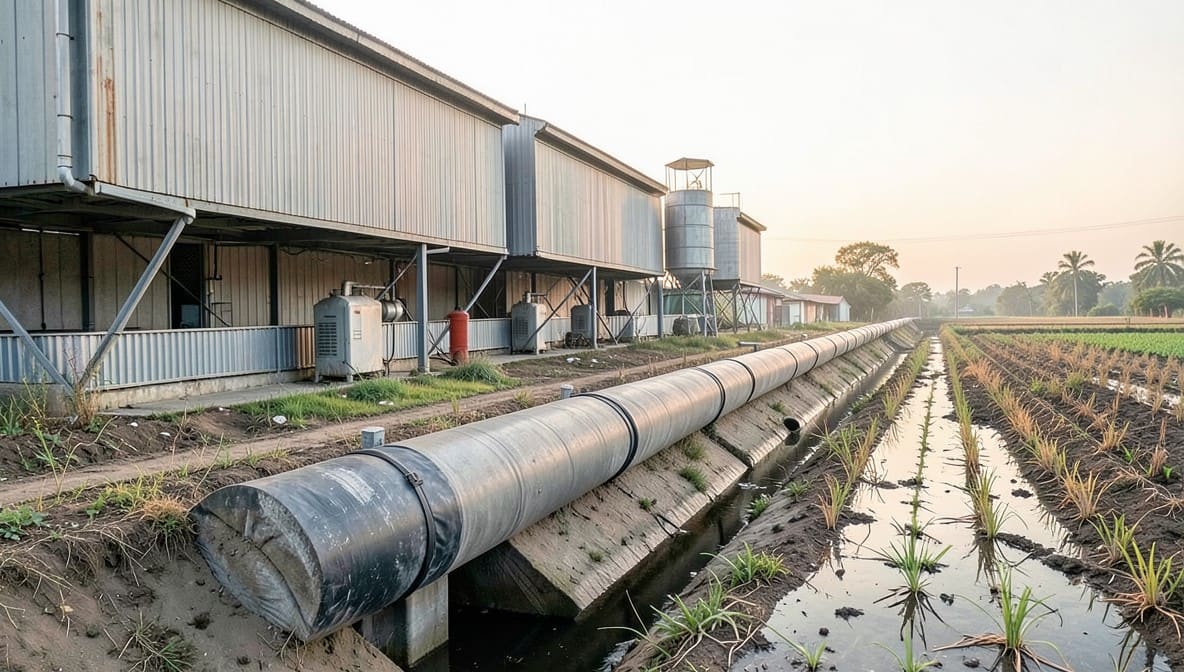
- The slaughterhouse asserted that treated effluent was being used for irrigation on 8 acres of its own farmland via closed pipelines.
- Type-1 waste (vegetable matter) was composted on its own land; Type-2 waste (animal offal) was transported to M/s Maharashtra Food Processing, Phaltan.
- The slaughterhouse was not regularly operating at the time of the NGT’s inspection due to non-availability of livestock.
Procedural History
- 11.04.2023: MPCB inspection reveals effluent discharge into nalla.
- 12.05.2023: MPCB issues Proposed Direction under Section 33A.
- 25.08.2023: Applicant files complaint with MPCB.
- 31.08.2023: MPCB issues second Proposed Direction.
- 29.02.2024: Joint inspection by MPCB and Ichalkaranji Municipal Corporation confirms partial compliance; bypass still present.
- 10.07.2025: Joint Committee submits report confirming permanent sealing of bypass and compliance with directions.
- 26.04.2024: NGT admits the application and issues notices.
- 11.07.2024: Respondent No.1 files reply affidavit.
- 22.07.2024: MPCB files reply affidavit.
- 20.01.2025: Respondent No.1 files second reply affidavit.
- 08.07.2025: Respondent No.1 files rejoinder affidavit.
- 15.07.2025: MPCB files additional reply affidavit.
- 15.03.2026: Respondent No.1 submits written submission challenging EDC amount.
- 13.03.2026: Case reserved.
- 09.04.2026: Judgment pronounced.
Relief Sought
The applicant sought:
- Direction to Respondent No.1 to comply with MPCB’s Proposed and Interim Directions.
- Closure of the slaughterhouse.
- Constitution of an Expert Committee to quantify environmental loss.
The Parties' Positions
Applicant: Argued that the slaughterhouse had engaged in continuous illegal discharge for 324 days, causing irreversible damage to the nalla and Panchganga river. Emphasized the failure of MPCB to act promptly and the need for punitive measures.
Respondent No.1: Denied illegal discharge, claimed the holes were for rainwater, effluent volume was negligible, and all waste was treated and reused. Argued that the EDC amount was arbitrary and calculated without hearing. Asserted that compliance was achieved before the NGT’s intervention.
MPCB: Confirmed non-compliance from 11.04.2023 to 29.02.2024 (324 days), calculated EDC at Rs.64.8 lakh based on statutory norms, and stated that the amount was not contested until after the Joint Committee’s report.
The Legal Issue
The central question was whether a slaughterhouse’s failure to comply with environmental directives for a continuous period of 324 days, even after partial remediation, justifies the imposition of an Environmental Damage Compensation (EDC) of Rs.64.8 lakh under the principles of strict liability and statutory enforcement, and whether the absence of formal objection to the EDC calculation during proceedings constitutes waiver.
Arguments Presented
For the Appellant
The applicant’s counsel argued that the discharge of effluent into a natural water channel, even if treated, constitutes environmental degradation under the Environment (Protection) Act, 1986. He emphasized the irreversible harm to aquatic ecosystems and the precedent set in M.C. Mehta v. Union of India for holding polluters strictly liable. He contended that the 324-day violation period was well-documented by MPCB and the Joint Committee, and that the slaughterhouse’s remedial actions, while commendable, did not negate liability for past harm.
For the Respondent
Respondent No.1’s counsel argued that the EDC amount was arbitrary and not based on scientific assessment. He cited the Joint Committee’s findings that the bypass had been permanently sealed and effluent was now fully contained. He emphasized that the slaughterhouse had operated for 20 years without prior complaints and that the EDC calculation ignored the minimal volume of effluent (500 litres/day) and the beneficial use of treated water for irrigation. He further argued that the forfeiture of the bank guarantee (Rs.2.5 lakh) already constituted punishment, and imposing an additional Rs.64.8 lakh violated principles of natural justice and proportionality.
MPCB’s counsel defended the EDC calculation as per the MPCB’s own guidelines under the Water Act, noting that the amount was derived from the duration of violation, category of industry (Red), and volume of effluent. He stated that the respondent had not filed any formal objection to the EDC calculation until the final written submission, which was too late.
The Court's Analysis
The Tribunal examined the evidence submitted by MPCB, the Joint Committee, and the affidavits of the parties. It noted that the non-compliance period of 324 days, from 11.04.2023 to 29.02.2024, was corroborated by multiple inspections and was not disputed by Respondent No.1 until the final written submission dated 15.03.2026.
"The period of non-compliance was established by the MPCB and confirmed by the Joint Committee, and no formal objection was filed by the respondent no.1 against the EDC calculation until after the report was submitted."
The Tribunal held that the absence of timely objection to the EDC amount, despite multiple opportunities to contest it during the proceedings, amounted to acquiescence. The Tribunal further observed that the EDC was calculated in accordance with MPCB’s internal guidelines, which are recognized under the Environment (Protection) Act, 1986, and are not arbitrary.
The Tribunal acknowledged the respondent’s remedial actions - sealing of bypasses, upgrading the ETP, and using treated effluent for irrigation - as commendable and indicative of good faith. However, it emphasized that environmental law operates on the principle of strict liability: once a violation occurs, liability attaches regardless of subsequent remediation.
The Tribunal rejected the argument that the EDC was punitive, noting that EDC is not a penalty but a compensatory mechanism for environmental restoration. The forfeiture of the bank guarantee was treated as a separate administrative action and did not preclude the imposition of EDC.
The Tribunal also dismissed the claim of limitation, noting that the cause of action arose with each day of non-compliance, and the application was filed within a reasonable time after the last known violation.
The Verdict
The applicant’s prayer for closure of the slaughterhouse and constitution of an Expert Committee was dismissed. The Tribunal held that the slaughterhouse had remediated the violation and was now compliant. However, the Tribunal upheld the Environmental Damage Compensation of Rs.64,80,000 (Sixty-Four Lakhs Eighty Thousand Rupees) calculated by MPCB for the 324-day period of non-compliance. Respondent No.1 was directed to deposit the full amount with MPCB within one month of the judgment. MPCB was directed to utilize the amount for environmental improvement in the affected area within six months and submit a compliance report to the Tribunal within one month after utilization.
What This Means For Similar Cases
Environmental Violations Trigger Strict Liability Regardless of Remediation
- Practitioners must advise clients that even if pollution is later contained or remediated, liability for past violations remains enforceable.
- Delayed compliance does not erase liability; the duration of non-compliance is the key metric for EDC calculation.
- EDC is compensatory, not punitive, and cannot be offset by prior administrative penalties like bank guarantee forfeiture.
Timely Objection Is Critical in Environmental Proceedings
- Failure to contest an EDC calculation during the initial stages of proceedings may be construed as waiver.
- Parties must file formal objections to proposed penalties or compensation amounts at the earliest opportunity, preferably in the first reply affidavit.
- Post-hearing submissions challenging EDC amounts are unlikely to be entertained if the issue was not raised earlier.
MPCB’s Internal Guidelines Carry Legal Weight
- MPCB’s EDC calculation methodology, though not codified in statute, is recognized by NGT as a legitimate administrative standard.
- Industries must assume that MPCB’s published norms will be applied unless proven arbitrary or disproportionate.
- Legal challenges to EDC must be supported by independent environmental impact assessments, not merely assertions of low volume or good intent.