The Bombay High Court has reaffirmed that eligibility for benefits under slum redevelopment schemes is strictly tied to official survey records and inclusion in Annexure-II, rejecting claims based on self-declared occupancy or structural splits.
Background & Facts
The Dispute
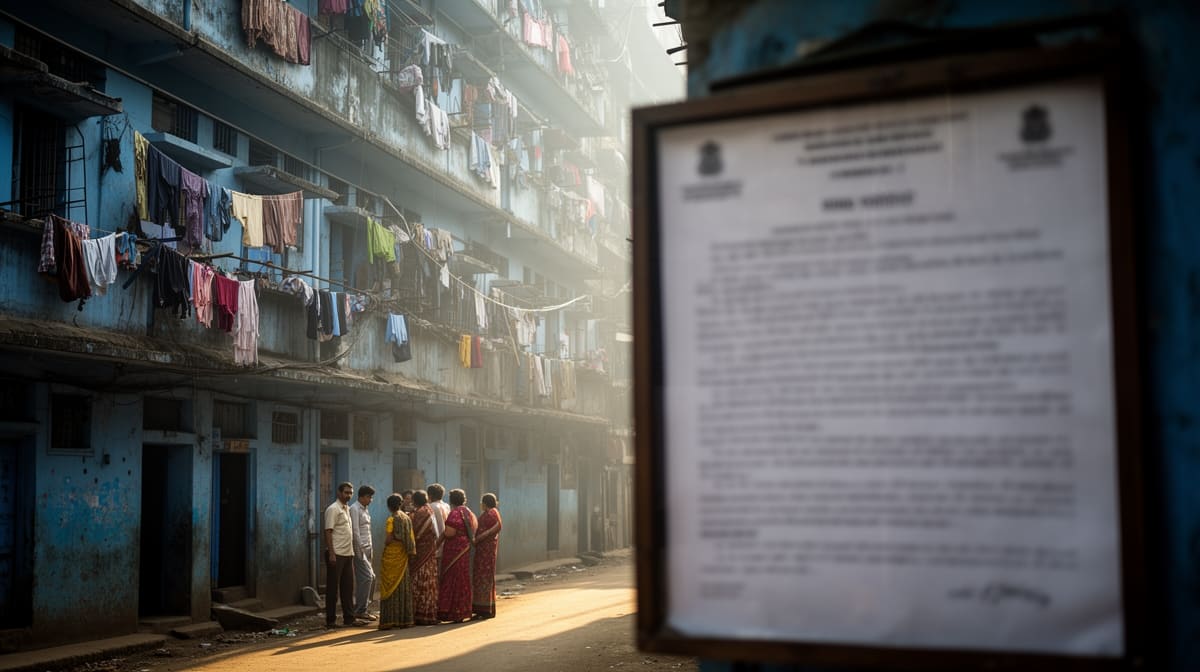
The petitioners, six residents and business owners residing in BMC Patra Chawl No. 51 to 54 in Byculla (West), Mumbai, sought judicial intervention to compel the Mumbai Municipal Corporation (MCGM) and associated authorities to recognize their structures as eligible for inclusion in the Supplementary Annexure-II under the Maharashtra Slum Areas (Improvement, Clearance and Redevelopment) Act, 1971. They claimed continuous occupation since 1995 and asserted that their structures - allegedly split from existing tenements - were overlooked during the 2018 survey, thereby excluding them from redevelopment benefits.
Key Facts
- The land in question is CTS No. 1840 (part), owned by MCGM, comprising both BMC tenements and slum structures.
- A composite redevelopment scheme was initiated under Section 33(7) of the Development Control and Promotion Regulation, 2034 and Section 33(10) of the Slum Act.
- Zamzam Co-operative Housing Society (Respondent No. 5) was formed by residents and appointed M/s Hi Rock Constructions Pvt. Ltd. (Respondent No. 6) as developer.
- A survey was conducted in 2018 by the Assistant Municipal Corporation and Senior Colony Officer, resulting in the preparation of Annexure-II listing eligible occupants.
- The petitioners’ structures were not included in Annexure-II because they were alleged splits of existing tenements, which MCGM regulations prohibit.
- MCGM issued multiple letters between 2018 and 2025 to petitioners explaining that room splits (e.g., Room No. 5A, 7A, 9, 6A) were not recognized under BMC rules and could not be separately surveyed.
- Petitioner No. 6 claimed Shop No. 1A, but the site only has Shop No. 1, certified at 17.35 sq. mtrs in Annexure-II under Sheikh Rehmat Ali Abbas Ali.
- Petitioner No. 5 claimed a paan beedi shop on the footpath, asserting it was not part of MCGM estate.
Procedural History
- 2018: Survey conducted; Annexure-II prepared; petitioners’ structures excluded.
- 2018 - 2025: Multiple written representations by petitioners to MCGM seeking recognition of split rooms; all rejected.
- 5th March 2026: Petitioners filed appeals under Section 35 of the Slum Act before the Additional Collector & Appellate Authority.
- 20th January 2026: MCGM issued notice to vacate structures; challenged in Writ Petition (L) No. 2879 of 2026.
- 19th August 2024: Order passed in Writ Petition (L) No. 2879 of 2026 directing petitioners to vacate and accept transit rent.
- 12th February 2026: Petitioner No. 8 (Atikur Rehman) vacated Room No. 5 and accepted rent.
- 19th February 2026: Petitioners No. 3, 4, and 6 accepted transit rent; Petitioner No. 6 has not yet vacated.
- 12th March 2026: Present writ petition heard and dismissed by Bombay High Court.
The Parties' Positions
Petitioners: Argued that their structures existed since 1995, were protected under the Slum Act, and that failure to survey them violated Article 21 (right to shelter). They claimed procedural lapse by MCGM and sought inclusion in Annexure-II.
Respondents (MCGM, Society, Developer): Contended that Annexure-II was prepared based on official records and that room splits were not legally recognized. All petitioners’ claims were found to be attempts to gain undue benefit from redevelopment, as their structures were not independently documented.
Relief Sought
The petitioners sought:
- A writ of mandamus directing MCGM and the Colony Officer to survey their structures.
- A direction to the Additional Collector to decide their appeals under Section 35 of the Slum Act within a specified time.
- Inclusion of their names in the Supplementary Annexure-II after verification and hearing.
The Legal Issue
The central question was whether a claimant’s eligibility for slum redevelopment benefits under the Maharashtra Slum Act can be established solely on self-declared long-term occupation, or whether inclusion in the officially certified Annexure-II following a statutory survey is a mandatory precondition.
Arguments Presented
For the Petitioners
Counsel argued that the petitioners had occupied the premises since 1995 and were protected under the Slum Act. They contended that the failure of MCGM to survey their structures - despite repeated requests - constituted a violation of Article 21 and deprived them of their right to shelter. They relied on the principle that procedural lapses by authorities cannot be used to deny fundamental rights.
For the Respondent-State and Others
The State and developer argued that Annexure-II was the legally recognized document for determining eligibility. The MCGM had consistently rejected room splits under its own regulations, and no legal provision permits fragmentation of tenements. The petitioners had already accepted transit rent and agreed to vacate under a prior court order, indicating acquiescence to the scheme’s terms. Their current claims were deemed opportunistic and without legal basis.
The Court's Analysis
The Court examined the statutory framework under the Slum Act and the procedural compliance of MCGM. It emphasized that Annexure-II, prepared after a formal survey, is the authoritative document for determining beneficiary status in redevelopment schemes. The Court noted that the petitioners’ structures were not independently surveyed because they were not distinct tenements but unauthorized splits of existing rooms.
"The petitioners are now trying to make out the case that a proper survey was not carried out. They are questioning the survey which was conducted in the year 2018 pursuant to which the Annexure-II... was also prepared."
The Court reviewed MCGM’s correspondence from 2018 to 2025, which clearly stated that room splits were not permissible under BMC regulations. It further observed that the petitioners had already accepted transit rent and agreed to vacate under a prior order, which included a certification by MCGM that they were eligible for allotment upon redevelopment - subject to their inclusion in the original Annexure-II.
The Court held that while the right to shelter under Article 21 is fundamental, it cannot override established procedural norms governing redevelopment. The absence of a survey does not create a right where none existed under the law. The petitioners’ remedy, if any, lies in the appellate forum under Section 35 of the Slum Act, not in a writ petition seeking to circumvent the survey process.
The Verdict
The writ petition was dismissed. The Court held that the petitioners are not entitled to inclusion in Annexure-II as their structures were not independently surveyed or recognized under MCGM regulations. However, the petitioners are not deprived of all remedies: they may pursue their appeals under Section 35 of the Slum Act before the Additional Collector. The Court declined to impose costs, noting the petitioners had already accepted transit rent and agreed to vacate under a prior order.
What This Means For Similar Cases
Annexure-II Is the Sole Basis for Eligibility
- Practitioners must verify Annexure-II status before filing any claim under slum redevelopment schemes.
- Oral testimony or self-declared occupancy cannot substitute for official survey records.
- Any challenge to exclusion must be grounded in procedural irregularities in the survey process, not mere non-inclusion.
Room Splits Are Not Recognized Legally
- Claims based on partitioned rooms (e.g., Room 5A, 7A) will be rejected unless the split was legally sanctioned prior to the survey.
- Municipal regulations prohibiting structural alterations must be strictly followed.
- Petitioners must demonstrate lawful tenancy at the time of survey, not subsequent occupation.
Writ Petitions Cannot Substitute Appellate Remedies
- Courts will not intervene via writ jurisdiction where statutory appellate mechanisms exist.
- Petitioners must exhaust remedies under the Slum Act before approaching High Courts.
- Acceptance of transit benefits may be construed as acquiescence to the scheme’s terms.