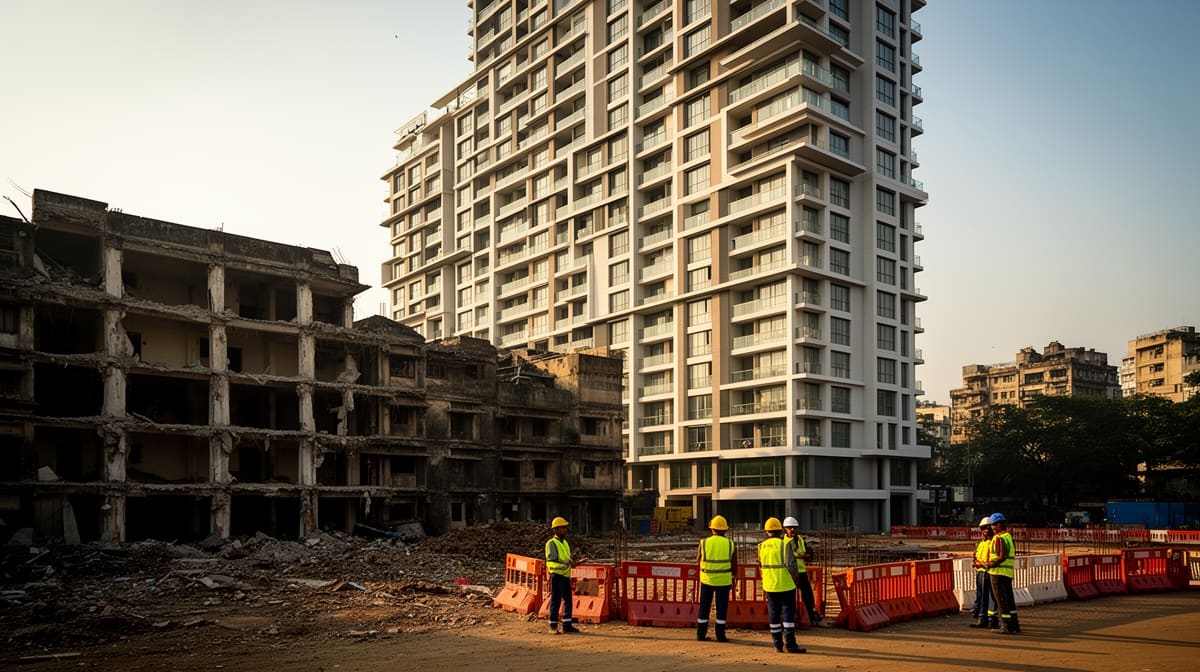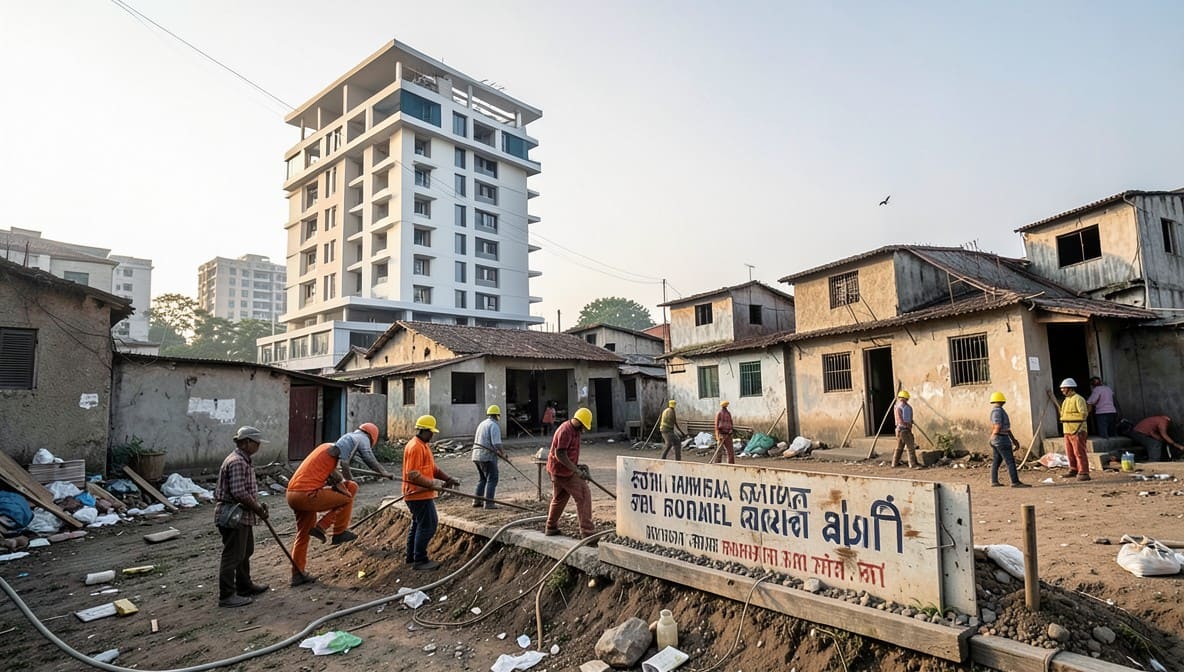
The Bombay High Court has clarified that administrative authorities under the Maharashtra Slum Areas Act cannot ignore conclusive judicial findings on possession, even when a party’s name appears in the initial survey list. This judgment reinforces the primacy of adjudicated facts over bureaucratic records in slum rehabilitation schemes.
Background & Facts
The Dispute
The dispute centers on eligibility for permanent alternate accommodation under the Binakumari SRA Cooperative Housing Society scheme. The petitioner, Subhash Ramharsh Gupta, claims exclusive possession of Hut No. 43 in Roshanlal Patra Chawl, inherited from his mother, Amoladevi Gupta, who was the original occupier and society member. His brother, Hanuman Ramharsh Gupta (Respondent No. 7), was listed as the occupier in Annexure II, the official survey document certified in 1996. The petitioner was allotted Flat No. 204 in the rehabilitation building, but Respondent No. 7 challenged this allocation, leading to administrative proceedings.
Procedural History
- 1995: Share certificate issued to Amoladevi Gupta, mother of both parties
- 1996: Annexure II certified by Competent Authority listing Respondent No. 7 as occupier of Hut No. 43
- 2000: Amoladevi executed an affidavit transferring her rights to the petitioner
- 2003: Agreement for rehabilitation executed in Amoladevi’s name
- 2007: Hut demolished; temporary and permanent accommodation allotted to petitioner
- 2007: Respondent No. 7 files civil suit (SC Suit No. 3715 of 2007) claiming dispossession and entitlement
- 2010: City Civil Court dismisses Respondent No. 7’s suit, finding no proof of two separate rooms or dispossession
- 2022: Appellate Authority dismisses petitioner’s appeal, upholding Annexure II
- 2025: Grievance Redressal Committee affirms dismissal
- 2026: Writ petition filed under Article 227
Relief Sought
The petitioner seeks quashing of the impugned orders and reinstatement of his entitlement to Flat No. 204, arguing that the judicial findings in SC Suit No. 3715 of 2007 conclusively establish his family’s exclusive possession and invalidate Respondent No. 7’s claim.
The Legal Issue
The central question was whether administrative authorities under the Maharashtra Slum Areas Act are bound by conclusive judicial findings on possession in a civil suit, even when a party’s name appears in the original Annexure II.
Arguments Presented
For the Petitioner
The petitioner’s counsel argued that the City Civil Court’s 2010 judgment, which found Respondent No. 7 failed to prove exclusive possession or dispossession, constituted a binding adjudication of facts. The authorities erred in mechanically relying on Annexure II without considering this judicial record. Documents such as the share certificate, rehabilitation agreement, and voter records corroborated the petitioner’s continuous possession through his mother. The transfer via affidavit, though informal, was valid under customary practice and supported by conduct.
For the Respondent
Respondent No. 7’s counsel contended that Annexure II, certified in 1996, was the authoritative record of occupancy at the time of survey. Any subsequent transfer by affidavit could not override this statutory document. The pending appeal against the civil suit judgment, they argued, rendered the 2010 findings non-final and thus inadmissible for administrative purposes. The petitioner’s allotment, they claimed, was an irregularity that must be corrected to uphold the integrity of the survey process.
The Court's Analysis
The Court emphasized that Annexure II is not an infallible or conclusive record of occupancy, but merely a preliminary survey document. The authorities erred in treating it as determinative, ignoring the broader evidentiary context. The Court noted that the petitioner and Respondent No. 7 both derived their claims from a common parent, and neither claimed independent ownership. The critical issue was not who was listed in 1996, but who was in actual possession and entitled under the scheme.
"The learned Judge, City Civil Court has recorded categorical findings that Respondent No. 7 failed to establish that he was dispossessed of the part of the subject hut, as claimed."
The Court held that the judgment in SC Suit No. 3715 of 2007, though appealed, was not stayed and contained clear, unchallenged findings that there was only one hut, later divided by a common wall. This directly contradicted Respondent No. 7’s claim of two separate entitlements. The authorities’ conclusion that the petitioner’s appeal was an attempt to "mislead" was legally unsustainable. The Court stressed that administrative bodies cannot override judicial findings on factual matters unless those findings are set aside by a higher court.
The Court further observed that documents such as the 1995 share certificate, 2003 rehabilitation agreement, and voter records collectively established the petitioner’s de facto possession through his mother. The mere fact that Respondent No. 7’s name appeared in Annexure II did not extinguish the petitioner’s claim, especially where the survey process was flawed and the civil court had already rejected the rival claim.
The Verdict
The petitioner won. The Bombay High Court held that administrative authorities must give effect to judicial findings on possession in civil suits, even if a party’s name appears in Annexure II. The impugned orders were quashed, the petitioner’s allotment was protected, and the matter was remanded for fresh adjudication in light of the civil court’s findings.
What This Means For Similar Cases
Judicial Findings Bind Administrative Decisions
- Practitioners must cite pending or concluded civil suits as decisive evidence in slum rehabilitation disputes
- Authorities cannot ignore court findings merely because an appeal is pending, unless a stay is granted
- The burden shifts to the state to prove why a judicial finding should not be accepted
Annexure II Is Not Conclusive Proof
- Annexure II is a survey record, not a title deed or final determination
- Later documents - share certificates, agreements, voter IDs, ration cards - can override it if they establish continuous possession
- Practitioners should compile a timeline of possession evidence, not rely solely on survey lists
Dual Claims from Common Ancestry Require Nuanced Evaluation
- When siblings claim rights through a common parent, authorities must examine actual occupation, not just names on lists
- The scheme’s intent is to rehabilitate actual occupants, not to reward procedural errors in survey documentation
- Authorities must distinguish between joint tenancy and separate entitlements - this case confirms one hut cannot yield two allotments