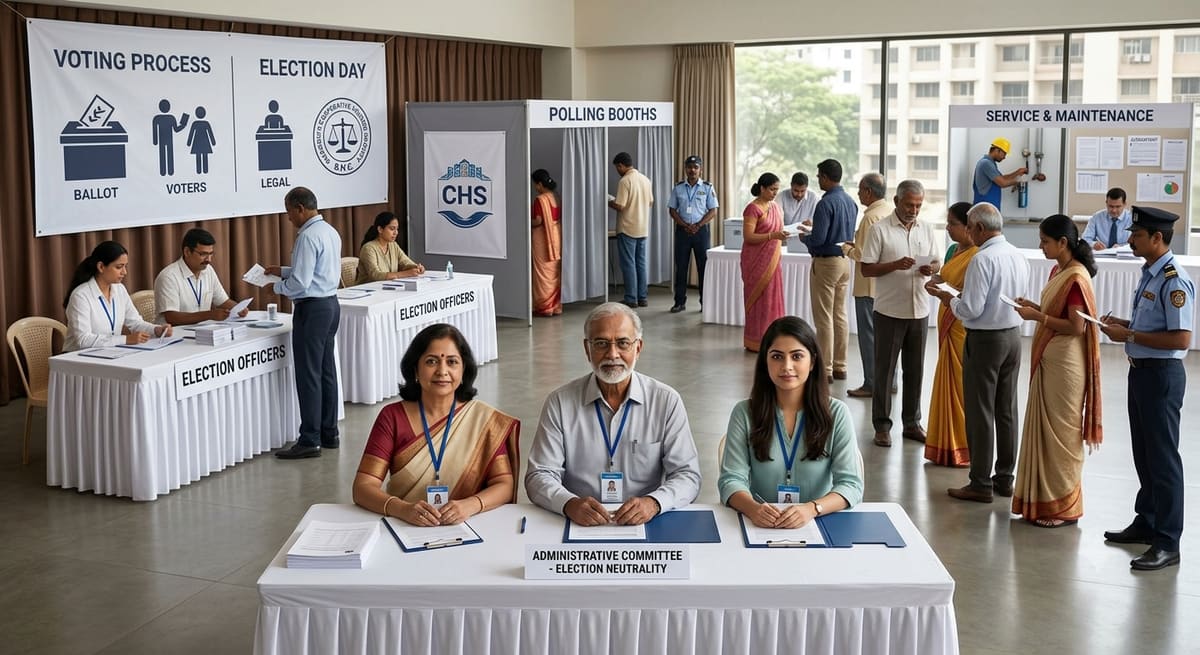
The Bombay High Court has clarified that when a co-operative housing society loses statutory quorum, the appointment of an Authorised Officer triggers an immediate and non-negotiable obligation to conduct fresh elections without undue delay. This judgment reinforces the principle that democratic governance in co-operative societies cannot remain suspended indefinitely, even in the absence of a functioning managing committee.
Background & Facts
The Dispute
The petitioners, three members of the Managing Committee of a C-Class Co-operative Housing Society, challenged the order of the Appellate Authority rejecting their application for interim relief against the appointment of an Authorised Officer under Section 77A of the Maharashtra Co-operative Societies Act, 1960. The appointment was made due to the Managing Committee falling below the statutory minimum of ten members.
Key Facts
- The Managing Committee originally had ten members as required under the Act
- On 18.08.2025, the strength of the Committee reduced to eight members following the resignation of two members
- The petitioners contend that the resignations were addressed to the Registrar and not to the Society itself, and therefore should not be legally recognized
- The respondents argue that the resignations were submitted because the Society refused to accept them, leaving no alternative but to approach the Registrar
- It is undisputed that the Authorised Officer has already taken charge of the Society’s affairs as of the date of the petition
- No functioning Managing Committee currently exists to administer the Society
Procedural History
- 18.08.2025: Managing Committee strength reduced to eight members
- Post-18.08.2025: Application filed before the Appellate Authority seeking interim stay on appointment of Authorised Officer
- Date unspecified (prior to 2026): Appellate Authority rejected the application for interim relief
- 2026: Writ Petition No. 4686 of 2026 filed before the Bombay High Court
- 15.04.2026: Hearing concluded and judgment delivered
Relief Sought
The petitioners sought: (1) stay on the operation of the order appointing the Authorised Officer; (2) restoration of the existing Managing Committee; and (3) direction to the Registrar to treat the resignations as invalid due to improper address.
The Legal Issue
The central question was whether the appointment of an Authorised Officer under Section 77A of the Maharashtra Co-operative Societies Act, 1960, upon loss of quorum, permits interim relief to restore a non-functional committee, and what is the court’s obligation to ensure continuity of democratic governance in such circumstances.
Arguments Presented
For the Petitioner
The petitioners argued that resignations addressed to the Registrar, rather than to the Society, are procedurally invalid under the Act and its bylaws. They contended that the Committee remained legally constituted until formal acceptance of resignations by the Society, and that the Registrar’s acceptance was ultra vires. They relied on the principle of nemo iudex in causa sua to argue that the Registrar, as an administrative authority, cannot unilaterally determine the validity of resignations affecting the composition of an elected body.
For the Respondent
The State contended that the statutory requirement of a minimum ten-member Committee was clearly breached on 18.08.2025, triggering the mandatory provisions of Section 77A. The appointment of the Authorised Officer was therefore lawful and necessary to prevent administrative paralysis. The State further argued that the petitioners’ challenge to the validity of resignations was collateral to the primary issue of quorum loss and could not justify interim relief once the Officer had assumed charge.
The Court's Analysis
The Court acknowledged the petitioners’ procedural objection regarding the mode of resignation but held that the factual reality - the Committee’s strength having fallen below ten members - was undisputed. The Court observed that the validity of the resignations, while potentially contestable in a separate proceeding, could not override the statutory imperative to maintain functional governance.
"Once this fact is undisputed, no interim relief could have been granted staying the operation of the order appointing the Authorised Officer."
The Court emphasized that the purpose of Section 77A is not punitive but remedial - to ensure that the affairs of the Society are not left in abeyance due to administrative vacuum. The Court further noted that the interest of justice demands that the democratic process be restored promptly, as prolonged suspension of elected bodies undermines the very foundation of co-operative autonomy.
The Court rejected the petitioners’ request to restore the defunct Committee, holding that such a remedy would be contrary to statutory intent. Instead, it focused on the positive duty of the Authorised Officer to conduct elections without delay.
The Verdict
The petition was disposed of with directions. The Authorised Officer is directed to complete the election process and ensure the constitution and notification of a duly elected Managing Committee within two months from the date of judgment (15.04.2026). The petitioners’ prayer for interim stay was denied. No costs were awarded.
What This Means For Similar Cases
Election Timelines Are Mandatory, Not Discretionary
- Practitioners must now treat the two-month deadline as a statutory imperative under Section 77A, not a suggestion
- Any delay beyond this period may attract contempt proceedings or judicial intervention under Article 226
- Co-operative societies must initiate election planning immediately upon quorum loss, not wait for Registrar’s notice
Resignation Validity Is Secondary to Quorum Compliance
- Challenges to resignation validity must be pursued separately; they do not suspend the operation of Section 77A
- The Registrar’s acceptance of resignations is procedural, not substantive - the fact of reduction in strength triggers the statutory mechanism
- Legal notices challenging resignations should be filed promptly but cannot be used to stall elections
Authorised Officers Are Duty-Bound Administrators, Not Interim Governors
- Authorised Officers must act as facilitators of elections, not as de facto managing committees
- Their powers are limited to conducting elections and maintaining day-to-day operations - no policy-making or financial disbursements beyond routine maintenance
- Failure to complete elections within two months renders their continued tenure unlawful