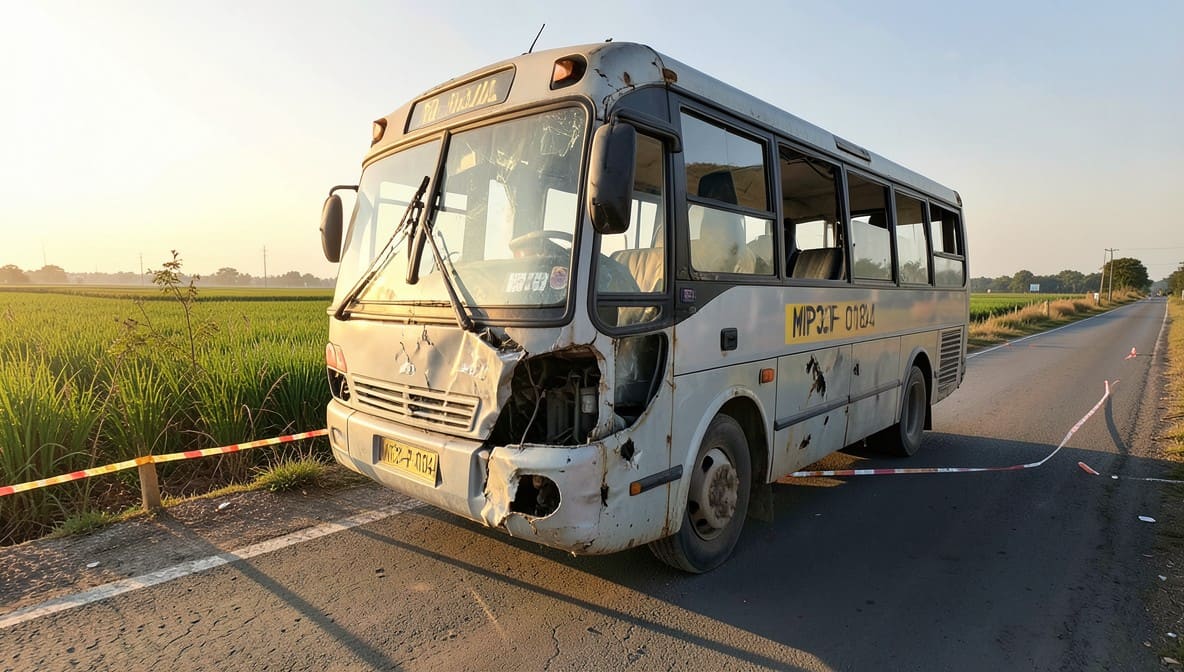
The Bombay High Court has reaffirmed that insurers cannot evade liability in motor accident claims by challenging the authenticity of insurance policies through unauthenticated electronic records. The judgment underscores the non-negotiable requirement of a Section 65B certificate for the admissibility of digital evidence, setting a clear precedent for future claims where insurers rely on internal digital logs to deny coverage.
Background & Facts
The Dispute
The dispute arose from a motor accident on 30.12.2009 at approximately 07:10 a.m. on Dr. B.A. Road, Mumbai, involving a taxi bearing registration number MH-01-X-4050. The respondent, Siddanth Sanjay Jamsandekar, then a 12-year-old child, was walking along the roadside when he was struck by the speeding vehicle. He sustained polytrauma, fractures, internal organ injuries, and ear damage, requiring prolonged hospitalization and multiple outpatient treatments.
The claimant filed an application before the Motor Accident Claims Tribunal (MACT), Mumbai, seeking compensation for medical expenses, pain and suffering, loss of amenities of life, special diet, and conveyance costs. The policy presented by the claimant was issued by HDFC ERGO General Insurance Company Limited, the appellant, for the period 2010 - 2011.
Key Facts
- The accident occurred on 30.12.2009.
- The claimant was 12 years old at the time of the accident.
- An FIR bearing No. 332 of 2009 was filed by the claimant’s father at Bhoiwada Police Station on 31.12.2009.
- The claimant filed MACT Application No. 547 of 2010 on 15.01.2010.
- The claimant submitted a physical copy of the insurance policy dated 01.04.2010 with policy number details, vehicle registration, engine number, chassis number, and premium bifurcation.
- The appellant challenged the policy’s authenticity, claiming it was forged.
- The appellant produced computer printouts from its premium register for the period 01.04.2009 to 30.08.2009 to show no policy was issued.
- No FIR was filed by the appellant against any person for forgery of the policy.
- The claimant produced hospital discharge summaries and receipts totaling Rs. 6,611/- for treatment expenses.
Procedural History
- 30.12.2009: Accident occurred.
- 31.12.2009: FIR filed at Bhoiwada Police Station.
- 15.01.2010: MACT Application No. 547 of 2010 filed.
- 12.04.2016: MACT passed award granting Rs. 76,611/- including NFL, with 9% interest from date of filing.
- 07.04.2026: First Appeal (FA(ST) No. 34194 of 2016) heard and decided by Bombay High Court.
The Parties' Positions
Appellant (HDFC ERGO): Contended the policy was fake, citing discrepancies in format and absence of policy in its digital records. Relied on unauthenticated computer printouts of premium register for 2009 - 2010 to prove non-issuance. Argued that since the policy was forged, it could not bind the insurer.
Respondent (Claimant): Maintained the policy was genuine, bearing all mandatory details. Argued that the insurer failed to produce a Section 65B certificate for its electronic records, rendering them inadmissible. Highlighted that no FIR was filed by the insurer against any person for forgery.
Relief Sought
The appellant sought to set aside the MACT award of Rs. 76,611/- with 9% interest, arguing the compensation was excessive and the policy was fraudulent. The respondent sought confirmation of the award and payment of the amount with interest.
The Legal Issue
The central question was whether Section 65B of the Indian Evidence Act renders electronic records inadmissible in the absence of a certificate under Section 65B(4), and whether an insurer can deny liability based on unauthenticated digital printouts when the claimant has produced a physically valid policy.
Arguments Presented
For the Appellant
The appellant argued that the insurance policy submitted by the claimant was forged, citing differences in format compared to its own policy template. It relied on computer-generated printouts from its premium register for the period 01.04.2009 to 30.08.2009 to prove the policy was never issued. It contended that the MACT erred in accepting the policy without verifying its authenticity through digital records and that the absence of a police complaint against the forger further indicated fraud. It also argued that the compensation awarded was arbitrary and unsupported by documentary evidence.
For the Respondent
The respondent countered that the insurer’s printouts constituted electronic evidence under Section 65B of the Indian Evidence Act, which requires a certificate under Section 65B(4) for admissibility. Since no such certificate was produced, the printouts were inadmissible. She relied on Arjun Panditrao Khotkar v. Kailash K. Gorantyal to establish that oral testimony cannot substitute for the mandatory certificate. She emphasized that the policy presented contained all mandatory details - registration number, engine number, chassis number, premium bifurcation - and that the insurer had not filed any FIR against the alleged forger, indicating acquiescence.
The Court's Analysis
The Court conducted a meticulous review of the evidence and legal principles governing electronic records. It noted that the insurer’s primary defense rested on digital printouts of its premium register, which were clearly electronic records under Section 65B. The Court emphasized that the Supreme Court in Arjun Panditrao Khotkar v. Kailash K. Gorantyal had unequivocally held that a certificate under Section 65B(4) is a condition precedent to the admissibility of secondary electronic evidence. The Court quoted:
"Section 65-B(4) of the Evidence Act clearly states that secondary evidence is admissible only if led in the manner stated and not otherwise. To hold otherwise would render Section 65-B(4) otiose."
The Court observed that the insurer failed to produce any certificate under Section 65B(4), rendering its printouts legally inadmissible. Consequently, the insurer’s claim that the policy was not issued could not be substantiated. The Court further noted that the policy submitted by the claimant contained all essential details required under the Motor Vehicles Act and Insurance Act, including the vehicle’s registration number, engine number, chassis number, and premium breakdown.
The Court rejected the insurer’s argument that format discrepancies proved forgery, holding that policies issued in different years may vary in layout and that such variation does not establish fraud. It also noted that the insurer had not taken any criminal action against the person who allegedly presented the forged policy, which undermined its claim of being a victim of fraud.
Regarding compensation, the Court upheld the MACT’s award of Rs. 40,000/- for pain and suffering, Rs. 5,000/- for special diet, Rs. 5,000/- for conveyance, and Rs. 6,611/- for medical expenses, citing Chaus Taushif Alimiya v. Memon Mahmmad Umar Anwarbhai as precedent for awarding such heads of compensation to minors suffering polytrauma. The Court found the total award of Rs. 76,611/- to be reasonable and well-reasoned.
The Court also affirmed the 9% interest rate, noting it was aligned with prevailing bank deposit rates and justified given the appellant’s status as a large corporate insurer.
The Verdict
The appeal was dismissed. The Court upheld the MACT’s award of Rs. 76,611/- with 9% interest from the date of filing of the MACT application (15.01.2010) until realization. The appellant was directed to pay the amount within three weeks from the date of uploading of the order. If the amount was not deposited with the MACT or the High Court, the appellant must pay directly to the claimant. No costs were awarded.
What This Means For Similar Cases
Electronic Evidence Must Be Certified Under Section 65B
- Practitioners must ensure that any digital record submitted by an insurer - premium logs, policy databases, internal audit reports - is accompanied by a valid Section 65B(4) certificate.
- Failure to produce the certificate renders the evidence inadmissible, regardless of its probative value.
- Insurers cannot rely on oral testimony from employees to authenticate electronic records; the certificate is mandatory.
Insurer Liability Cannot Be Avoided by Alleging Forgery Without Action
- An insurer that suspects policy forgery must file an FIR against the perpetrator; silence implies acceptance or negligence.
- A claimant’s production of a policy with all mandatory details creates a prima facie case of insurance coverage.
- Courts will not entertain speculative claims of forgery without corroborative, admissible evidence.
Compensation for Minors Must Reflect Physical and Psychological Impact
- Awards for pain and suffering, special diet, and conveyance for minors are not discretionary but are justified by medical evidence of polytrauma.
- The tender age of the claimant and severity of injuries must be central to compensation assessment.
- Precedents like Chaus Taushif Alimiya provide clear benchmarks for such awards.