The Andhra Pradesh High Court recently delivered a significant judgment on the validity of Wills under the Indian Succession Act, 1925. The Court dismissed a second appeal, upholding the first appellate court's decision that a registered Will dated 31.08.1990 was the last testament of the testatrix, while an unregistered Will dated 29.12.1991 was surrounded by suspicious circumstances and thus not proved in accordance with law. This judgment reinforces the principle that the propounder of a Will must remove all suspicious circumstances to satisfy the court's conscience.
Background & Facts
The Dispute
The dispute revolves around the ownership of a house property in Kakinada, East Godavari District. The plaintiffs, legal heirs of late Saladi Hanumantha Rao, claimed title over the property based on a registered Will dated 31.08.1990 executed by Smt. Pamarthi Subbayamma in favour of Hanumantha Rao. The defendants, relatives of Subbayamma, contested this claim, relying on an unregistered Will dated 29.12.1991 allegedly executed by Subbayamma in their favour.
Key Facts
- Plaintiffs: Sons, daughter, and wife of late Saladi Hanumantha Rao
- Defendants: Relatives of late Pamarthi Subbayamma, including her brothers' families
- Property: House property purchased by Subbayamma under a registered sale deed dated 14.02.1962
- Registered Will (Ex.A-2): Dated 31.08.1990, bequeathing the property to Hanumantha Rao
- Unregistered Will (Ex.B-1): Dated 29.12.1991, allegedly bequeathing the property to the defendants
- Deaths: Subbayamma died on 24.10.1993; Hanumantha Rao died on 07.08.1994
- Legal Notices: Hanumantha Rao issued a legal notice dated 08.12.1993 claiming the property under Ex.A-2; defendants replied with notices dated 31.01.1994 and 08.02.1994 alleging Ex.A-2 was forged and relying on Ex.B-1
Procedural History
- 16.02.2006: Trial Court (II Additional Senior Civil Judge, Kakinada) dismissed the suit in O.S.No. 59 of 2000
- 14.09.2015: First Appellate Court (III Additional District Judge, East Godavari District) allowed the appeal (A.S.No. 94 of 2006) and reversed the trial court's decree
- 29.08.2025: Second appeal (SA No. 494 of 2016) admitted by the High Court; substantial questions of law framed
- 15.06.2026: High Court dismissed the second appeal, confirming the first appellate court's judgment
The Parties' Positions
Plaintiffs' Case:
- Subbayamma purchased the property and constructed the house with her own funds
- She executed a registered Will (Ex.A-2) dated 31.08.1990 in favour of Hanumantha Rao
- The Will was executed in a sound and disposing state of mind
- Subbayamma lived with Hanumantha Rao until her death
- The defendants were merely in permissive occupation of the property
Defendants' Case:
- The property was purchased with contributions from late Saladi Gangaraju and late Saladi Parthasaradhi
- Subbayamma executed an earlier Will (Ex.B-2) dated 18.04.1983 in favour of Gangaraju and Parthasaradhi
- She later executed an unregistered Will (Ex.B-1) dated 29.12.1991, bequeathing the property to the defendants
- The defendants claimed title by adverse possession and alleged Ex.A-2 was forged
Relief Sought
The plaintiffs sought:
- Declaration of title over the plaint schedule property
- Recovery of possession from the defendants
- Damages of Rs. 2,000 per month for use and occupation of the property
The Legal Issue
The central legal questions were:
- Whether the unregistered Will (Ex.B-1) dated 29.12.1991 was validly proved in accordance with law, given the suspicious circumstances surrounding its execution?
- Whether the registered Will (Ex.A-2) dated 31.08.1990, being the last testament, should prevail over the alleged unregistered Will?
- Whether the defendants' inconsistent pleas (benami purchase, adverse possession, and reliance on Ex.B-1) vitiated their claim to the property?
Arguments Presented
For the Appellants (Defendants)
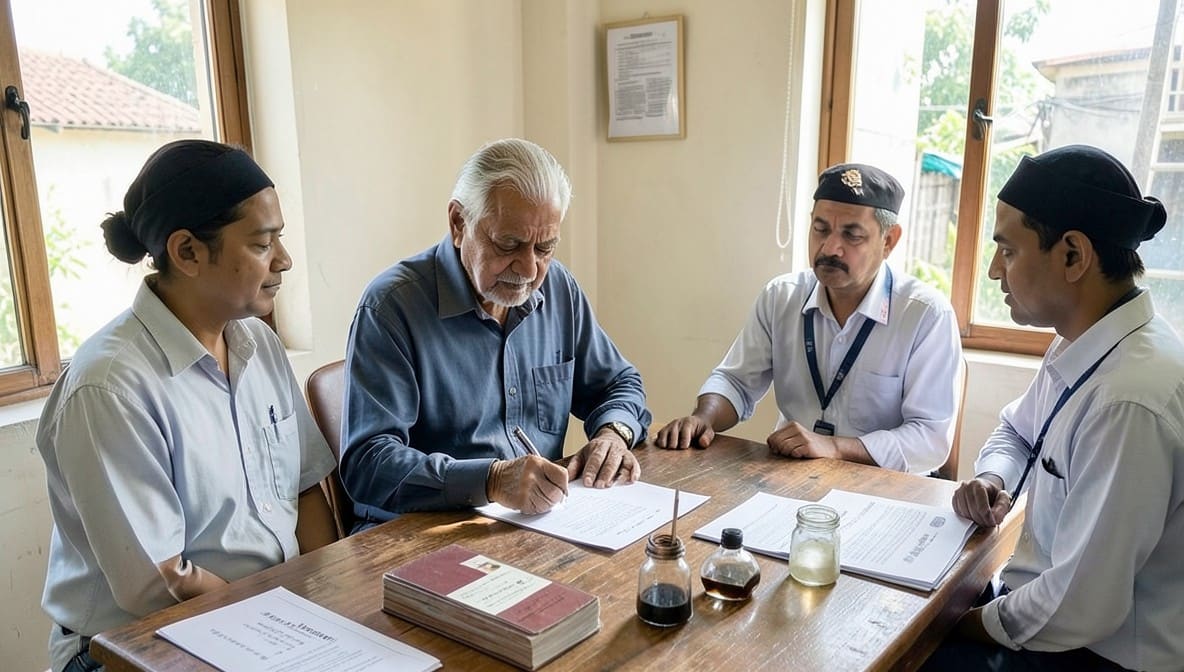
- Ex.B-1 Will is valid: The defendants contended that Ex.B-1 unregistered Will dated 29.12.1991 was validly executed and proved through the evidence of D.W.2, one of the attestors
- Suspicious circumstances not proven: The appellants argued that the plaintiffs failed to establish suspicious circumstances surrounding Ex.B-1
- Ex.B-2 Will prevails: They relied on Ex.B-2 Will dated 18.04.1983, which was not revoked in Ex.A-2, to claim title
- Inconsistent pleas: The appellants took inconsistent positions, claiming the property was benami, acquired by adverse possession, and bequeathed under Ex.B-1
For the Respondents (Plaintiffs)
- Ex.B-1 Will surrounded by suspicious circumstances: The respondents argued that Ex.B-1 was executed under dubious circumstances, including:
- Execution at the house of a beneficiary (Pardhasaradhi)
- Presence of beneficiaries during execution
- Disputes between Subbayamma and the defendants' family from 1990 till her death
- Failure to mention Ex.B-1 in a counter filed in earlier suit proceedings
- Ex.A-2 Will is the last testament: The plaintiffs relied on Ex.A-2 registered Will dated 31.08.1990, which was proved through the evidence of attestors P.W.2 and P.W.3
- No suspicious circumstances around Ex.A-2: The respondents contended that Ex.A-2 was free from suspicious circumstances and was the last valid Will of Subbayamma
The Court's Analysis
The Court undertook a detailed analysis of the evidence and legal principles governing the validity of Wills:
Burden of Proof and Suspicious Circumstances
The Court relied on the settled principle that the propounder of a Will must satisfy the court's conscience by removing all suspicious circumstances. It cited H. Venkatachala Iyengar v. B.N. Thimmajamma, where the Supreme Court held:
"A propounder of the will has to prove the due and valid execution of the will and that if there are any suspicious circumstances surrounding the execution of the will the propounder must remove the said suspicions from the mind of the court by cogent and satisfactory evidence."
The Court observed that suspicious circumstances must be "real, germane and valid" and not merely the fantasy of a doubting mind. It applied this principle to Ex.B-1, noting several suspicious circumstances:
- Execution at beneficiary's house: Ex.B-1 was allegedly executed at the house of Pardhasaradhi, a beneficiary, in the presence of another beneficiary (D.W.1)
- Disputes between parties: There were ongoing civil suits between Subbayamma and the defendants' family from 1990 until her death in 1993
- Failure to mention Ex.B-1: D.W.1 did not refer to Ex.B-1 in a counter filed in earlier suit proceedings, raising doubts about its existence
- Relative as attestor: D.W.2, an attestor to Ex.B-1, admitted being a close relative of a beneficiary, which cast doubt on his impartiality
Evidence of Attestors
The Court emphasized that the evidence of attestors is crucial in proving a Will. It noted:
- The defendants failed to examine another attestor to Ex.B-1, relying solely on D.W.2, whose evidence was not impartial
- The evidence of the scribe (D.W.3) could not be equated with that of an attestor, as held in Leela v. Muruganatham
Registered Will vs. Unregistered Will
The Court distinguished between registered and unregistered Wills, citing Rani Purnima Devi v. Kumar Khagendra Narayan Dev:
"If a will has been registered, that is a circumstance which may, having regard to the circumstances, prove its genuineness. But the mere fact that a will is registered will not by itself be sufficient to dispel all suspicion regarding it where suspicion exists."
The Court held that Ex.A-2, being a registered Will, carried a presumption of genuineness, which the defendants failed to rebut. In contrast, Ex.B-1, being unregistered and surrounded by suspicious circumstances, was not proved in accordance with law.
Last Will Prevails
The Court reiterated the principle that the last Will prevails over earlier Wills. It held that Ex.A-2, being the last testament of Subbayamma, should be given effect. The Court noted:
- There was no clear revocation of Ex.B-2 Will in Ex.A-2, but this was not mandatory
- Ex.B-1 was not validly proved, and thus Ex.A-2, being the last valid Will, prevailed
Inconsistent Pleas by Defendants
The Court observed that the defendants took three inconsistent pleas:
- The property was purchased in Subbayamma's name as a benami transaction
- The defendants acquired title by adverse possession
- The property was bequeathed to them under Ex.B-1
The Court held that these inconsistent pleas weakened the defendants' case, as they were unsure about the basis of their claim.
The Verdict
The High Court dismissed the second appeal, confirming the judgment and decree of the first appellate court. The Court held:
- Ex.B-1 unregistered Will dated 29.12.1991 was not proved in accordance with law due to suspicious circumstances surrounding its execution
- Ex.A-2 registered Will dated 31.08.1990 was the last valid testament of Subbayamma, and the plaintiffs, as legal representatives of Hanumantha Rao, were entitled to the plaint schedule property
- The defendants' inconsistent pleas vitiated their claim to the property
- No costs were awarded to either party in the second appeal
What This Means For Similar Cases
Propounder Must Remove Suspicious Circumstances
- The judgment reinforces that the burden of proof lies on the propounder of a Will to remove all suspicious circumstances
- Courts will closely scrutinize the execution of a Will, especially when it is unregistered or executed in favour of close relatives
- Evidence of attestors must be impartial and credible; reliance on relatives or beneficiaries as attestors may weaken the case
Registered Wills Carry Presumption of Genuineness
- Registered Wills are presumed genuine unless the opposing party provides strong evidence to the contrary
- Unregistered Wills are viewed with greater suspicion and require stricter proof
- The last Will prevails unless earlier Wills are clearly revoked
Inconsistent Pleas Weaken Legal Claims
- Parties must avoid taking inconsistent positions in property disputes, as this undermines their credibility
- Courts may reject claims where parties fail to establish a clear and consistent basis for their title to the property