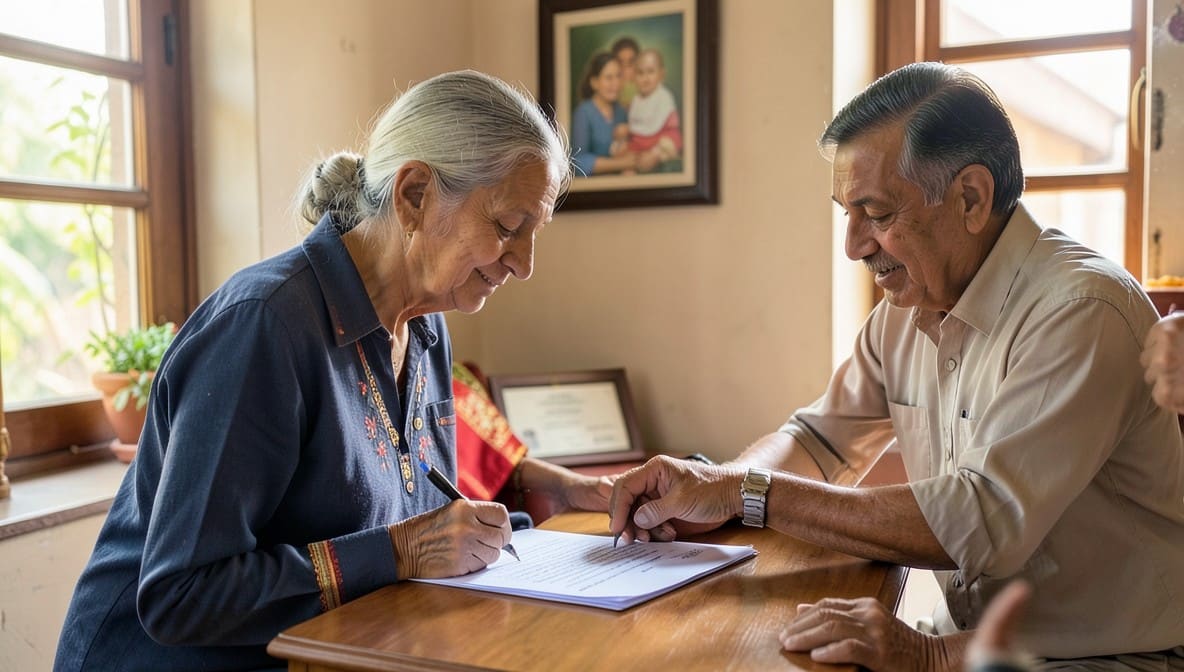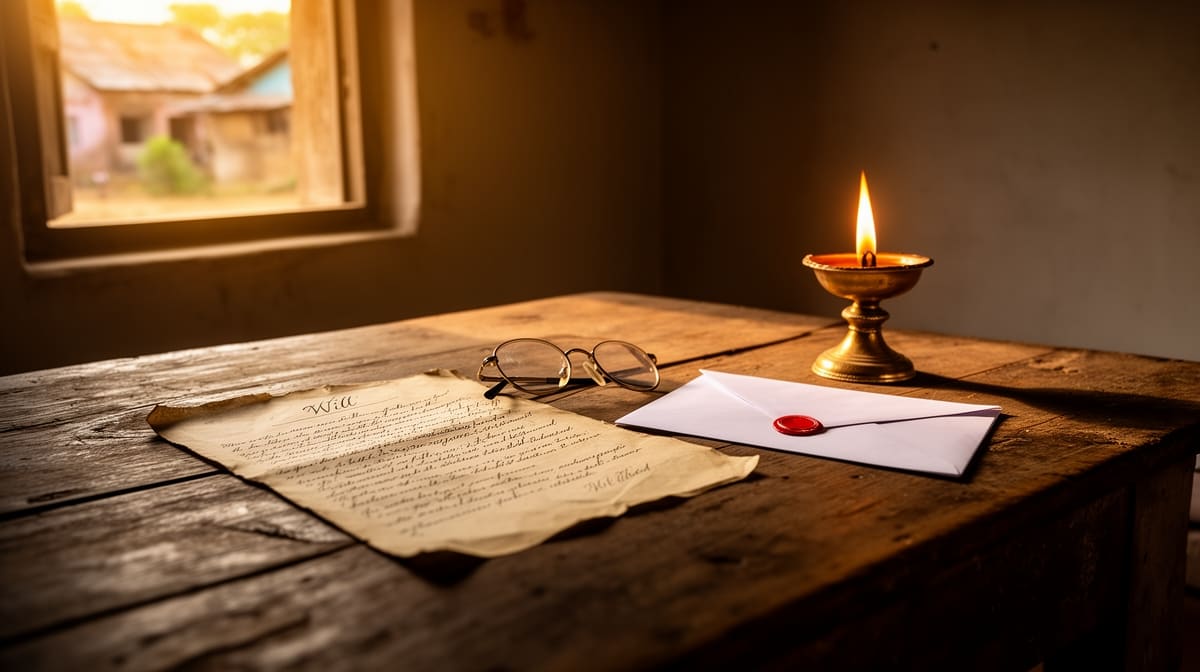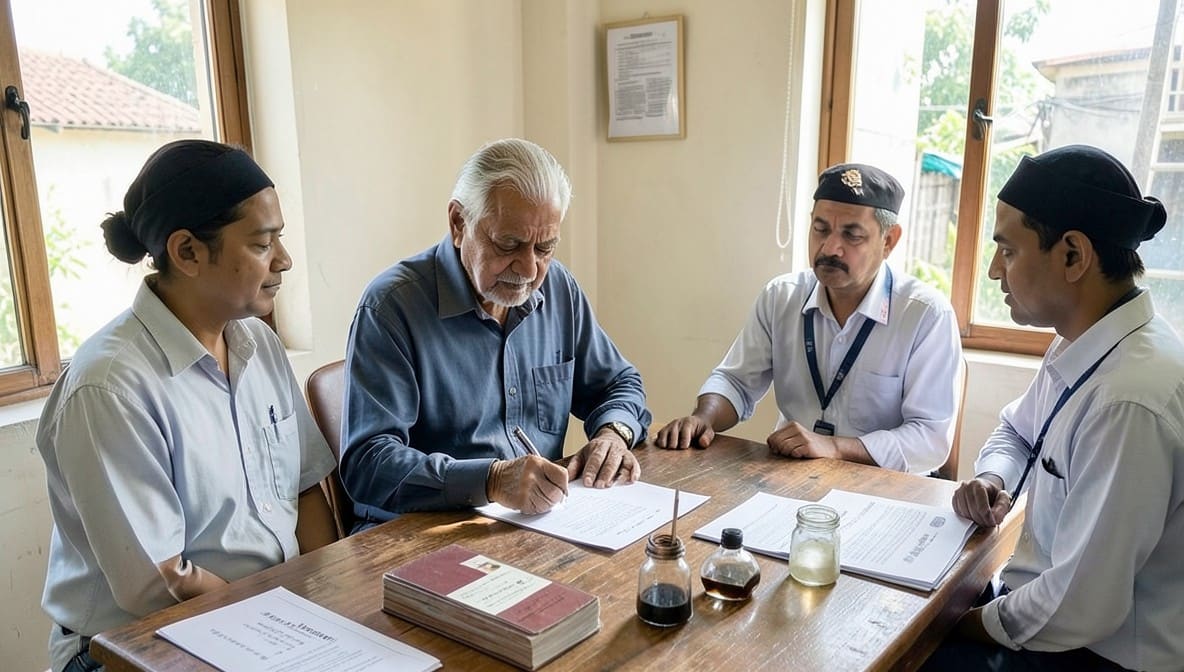
The Punjab and Haryana High Court has affirmed that a registered Will excluding a son from inheritance is valid if the testator’s testamentary capacity is established and no suspicious circumstances are proven. The judgment clarifies that mere familial relationship of attesting witnesses or the testator’s age does not invalidate a Will, and that ancestral property status cannot be inferred from historical joint ownership in pre-partition territories.
Background & Facts
The Dispute
The dispute centers on the validity of a registered Will executed by Hira Singh on 14.11.1979, bequeathing all his movable and immovable property to his three sons - respondents/plaintiffs Mukhinder Singh, Hardeep Singh, and another - and excluding his eldest son, appellant/defendant Amarjit Singh. Hira Singh died on 03.02.1980, two months after executing the Will. The respondents filed a suit for declaration of title and possession over agricultural land measuring 52 bighas 8 biswas and a house, along with tractor no. PUV 5570, which was separately bequeathed under an earlier Will dated 06.10.1975. The appellant contested the Will’s validity, claiming the property was ancestral and that his exclusion was illegal.
Key Facts
- Hira Singh migrated from Pakistan to India after Partition and acquired the suit property using proceeds from the sale of ancestral land in Pakistan.
- The suit property was allotted to Hira Singh individually after Partition.
- Hira Singh executed a Will on 06.10.1975 bequeathing tractor no. PUV 5570 to respondent/plaintiff no.2.
- On 14.11.1979, he executed a second Will, registered at Moga, bequeathing all remaining property to the three sons equally, excluding Amarjit Singh.
- Amarjit Singh had filed a civil suit (No. 254 dated 28.07.1979) seeking injunction against Hira Singh to prevent alienation of the suit property; interim relief was denied on 05.11.1979 and appeal dismissed on 22.01.1980.
- Hira Singh was residing with his daughter Mahinder Kaur at the time of executing the Will, not at his usual residence in Village Mahorana.
- The Will was attested by Partap Singh (PW-1), father-in-law of respondent/plaintiff no.2, and Bhupinder Singh (PW-3), brother-in-law of Partap Singh.
- The appellant admitted that Hira Singh had already gifted 188 bighas 3 biswas of land to his three sons, including him, in equal shares.
- The Will explicitly states that sufficient land had already been given to his sons and that he had no issue.
- Respondents’ daughters (defendants no.2 and 3) admitted the validity of both Wills and relinquished their shares.
Procedural History
- 14.11.1979: Hira Singh executes registered Will (Ex.P-1) bequeathing property to respondents.
- 03.02.1980: Hira Singh dies.
- 20.04.1982: Trial Court (Sub Judge, Malerkotla) decrees suit in favor of respondents, holding Will valid and property not ancestral.
- 22.03.1990: Additional District Judge, Sangrur, dismisses first appeal.
- 1990: Regular Second Appeal filed before Punjab and Haryana High Court (RSA-1391-1990).
- 28.04.2026: High Court delivers judgment dismissing the appeal.
The Parties' Positions
Appellant/Amarjit Singh:
- Argued the suit property was ancestral because Hira Singh inherited it from his father and held it jointly with brothers in pre-Partition Pakistan.
- Claimed the Will was invalid due to suspicious circumstances: testator’s advanced age (82), travel to Moga for registration, attesting witnesses being relatives of beneficiaries, and exclusion without explanation.
- Relied on Angadi Chandranna v. Shankar to assert that property acquired from ancestral funds retains ancestral character.
Respondents/Plaintiffs:
- Contended the property was self-acquired, as it was allotted to Hira Singh individually after Partition.
- Denied that the Will was suspicious: testator was of sound mind, Will was duly registered, and exclusion was justified by prior gifts and litigation.
- Cited Sobha Singh v. Gurbarhshi, Rabindra Nath Mukherjee, and Smt. Sushila Devi to establish that familial witnesses and exclusion of an heir do not invalidate a Will if properly executed.
Relief Sought
The appellant sought reversal of the trial and appellate courts’ decrees, declaration that the suit property was ancestral, and that the Will was invalid. He requested restoration of his share in the property under Hindu succession law.
The Legal Issue
The central questions were: (1) Whether the suit property bequeathed by Hira Singh was ancestral in nature, and (2) Whether the registered Will dated 14.11.1979 was valid despite the attesting witnesses being relatives of beneficiaries and the exclusion of the appellant.
Arguments Presented
For the Appellant
The appellant’s counsel argued that the property was ancestral because Hira Singh held land in equal shares with his five brothers in pre-Partition Pakistan, and the suit property was acquired using proceeds from the sale of that ancestral land. He relied on Angadi Chandranna v. Shankar to assert that property acquired from ancestral funds retains its character. He further contended that the Will was shrouded in suspicious circumstances: Hira Singh was 82 years old and died two months later; he traveled 88 km to Moga for registration despite residing in Malerkotla; the attesting witnesses were closely related to beneficiaries; and the Will omitted any reason for excluding the appellant. He argued these factors raised a presumption of undue influence or lack of testamentary capacity.
For the Respondent
The respondents’ counsel countered that ancestral status requires proof of uninterrupted inheritance over three generations, which was absent. The property was allotted to Hira Singh individually after Partition, and no joint family nucleus existed to convert it into ancestral property. Regarding the Will, they emphasized its registration, the testator’s sound mind (corroborated by PW-6 and DW-1), and the fact that the appellant’s hostility was documented in his own suit for injunction. They cited Sobha Singh, Rabindra Nath Mukherjee, and Smt. Sushila Devi to show that familial witnesses are not invalidating, and exclusion of an heir is permissible if explained. They noted the appellant’s written statement only said “not admitted” to key averments, failing to specifically deny the Will’s execution or the testator’s capacity.
The Court's Analysis
The Court undertook a two-pronged analysis: first, on the nature of the property, and second, on the validity of the Will.
On the issue of ancestral property, the Court held that mere joint ownership of land in pre-Partition Pakistan does not establish ancestral character. The judgment emphasized that for property to be ancestral, it must have been inherited over at least three generations, and the testator must have held it as a coparcener. The jamabandis showed joint ownership in Pakistan, but no evidence proved that the land devolved upon Hira Singh by inheritance from his ancestors. The Court distinguished Angadi Chandranna by noting that the case required proof of a joint family nucleus from which the property was acquired - a threshold unmet here. The Court cited Sobha Singh to affirm that joint khata or equal shares in revenue records do not create a presumption of ancestral status.
"To establish the ancestral character of land it is not sufficient to show that the name of the common ancestor from whom the parties are descended was mentioned in the revenue pedigree. It should also be proved that the descendants of that common ancestor hold the land in ancestral shares and that the land occupied, at the time of the dispute, by the proprietors thereof had devolved upon them by inheritance."
On the validity of the Will, the Court rejected the appellant’s claims of suspicious circumstances. The Court held that the testator’s age and travel to Moga were not suspicious, especially since he was residing with his daughter at the time. The death from a heart attack two months later did not imply incapacity at the time of execution. The Court noted that the Will explicitly stated the reason for exclusion: prior gifts of land and the appellant’s litigation against his father. The Court relied on Smt. Sushila Devi to hold that a testator may exclude an heir without explanation, and that such exclusion alone does not invalidate a Will.
"Prima facie, the circumstance that no bequest was made to the appellant by the testator would make the will appear unnatural but if the execution of the will is satisfactorily proved, the fact that the testator had not bequeathed any property to one of his children cannot make the will invalid."
The Court further held that the attesting witnesses being relatives of beneficiaries is not a suspicious circumstance per se, especially when the Will is registered. The Sub-registrar’s certification that the Will was read over to the testator negated any concern about the witnesses’ interest. The Court cited Rabindra Nath Mukherjee to affirm that in registered Wills, the witnesses’ relationship to beneficiaries becomes inconsequential.
The Court also noted that the appellant’s written statement failed to specifically deny the Will’s execution, testator’s capacity, or registration - mere denial of “not admitted” was insufficient to raise doubt. The burden of proving suspicious circumstances lay on the appellant, which he failed to discharge.
The Verdict
The appeal was dismissed. The High Court upheld the validity of the registered Will dated 14.11.1979 and confirmed that the suit property was not ancestral. The respondents are entitled to full possession of the 52 bighas 8 biswas of agricultural land, the house, and tractor no. PUV 5570. The decree of permanent injunction restraining the appellant from alienating the property remains in force. The Court awarded no costs.
What This Means For Similar Cases
Ancestral Status Requires More Than Joint Ownership
- Practitioners must prove uninterrupted inheritance over three generations to claim ancestral property status.
- Joint revenue records or equal shares in pre-Partition land do not create a presumption of ancestral character.
- Property acquired after Partition using sale proceeds from ancestral land is not automatically ancestral unless a joint family nucleus is proven.
Registered Wills Are Presumed Valid Unless Suspicious Circumstances Are Proved
- The mere fact that attesting witnesses are relatives of beneficiaries does not invalidate a registered Will.
- The Sub-registrar’s certification that the Will was read over to the testator negates concerns about witness interest.
- Exclusion of a child from a Will is not suspicious if the testator’s reasons are documented or inferable from conduct (e.g., prior gifts, litigation).
- A general denial in the written statement (“not admitted”) is insufficient to challenge a Will; specific averments must be rebutted.
Testamentary Capacity Is Not Assumed to Be Deficient Due to Age or Death Soon After Execution
- Advanced age or death shortly after executing a Will does not raise a presumption of incapacity.
- Medical evidence of illness must be presented to challenge testamentary capacity.
- The burden of proving suspicious circumstances lies on the challenger, not the propounder.