The Madhya Pradesh High Court has reaffirmed that the sanctity of an uncontested Will, duly proved by attesting witnesses, cannot be defeated by hyper-technical objections to minor typographical or ink-related irregularities. This judgment reinforces the principle that probate courts must facilitate the testator’s last wishes when no rival claimant emerges and evidence of execution is unchallenged.
Background & Facts
The Dispute
The appellants, Vikas Goswami and others, filed an application under Section 276 of the Indian Succession Act, 1925 for grant of probate of a Will dated 28-12-2015 executed by the deceased, Gopal Prasad Sharma. The Will bequeathed the entire estate to the appellants, who were nieces and nephews of the deceased. The deceased was unmarried and had no lineal descendants. The appellants claimed to have cared for him for over a decade, rendering services that formed the basis of his testamentary intent.
Key Facts
- The Will (Exhibit P1) was executed on 28-12-2015
- The Will was drafted by Krishna Swaroop Shatdhar (PW3), who also attested it as a witness
- The Will was notarized by Meharban Singh Kushwah (PW2), a licensed Notary Public
- Two attesting witnesses, Bhagwan Singh Rawat (PW4) and Ram Kishan Srivastava (PW8), testified that they witnessed the testator sign the Will in their presence
- All witnesses deposed that the testator was of sound mind and under no undue influence
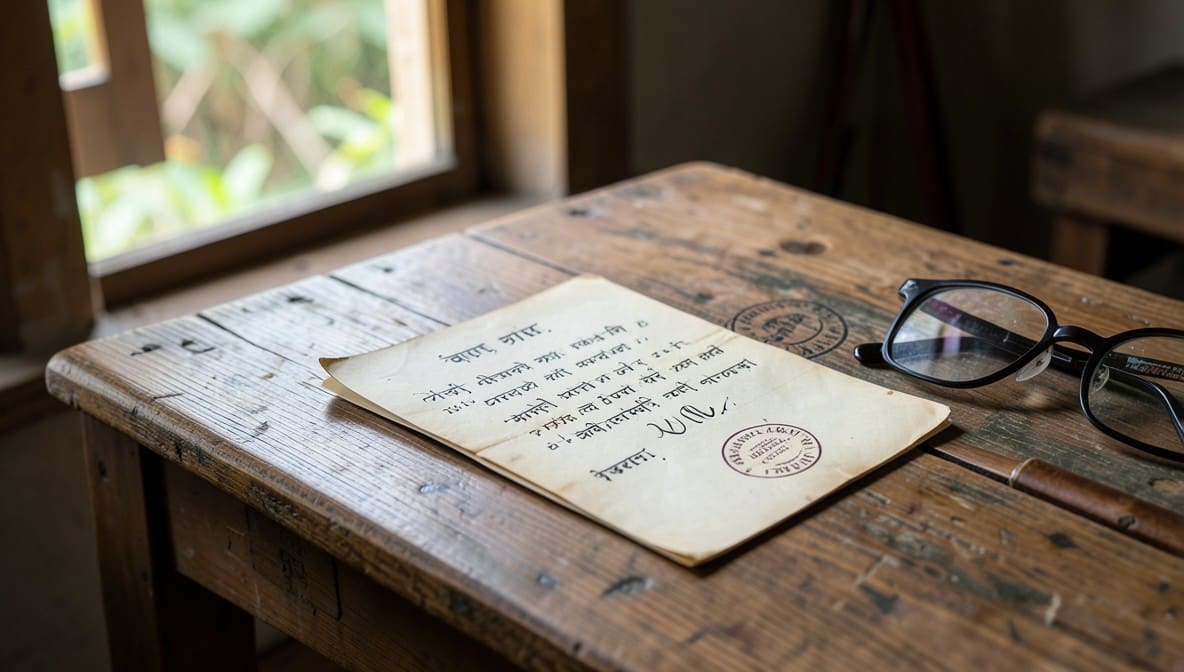
- The Will contained the phrase "स पूण" (entire) which was allegedly overwritten with a different ink
- The appellants filed a corrected application for probate on 15-01-2017, amending the description of the property to reflect the correct extent
- No notice of objection was received from any relative or member of the public despite publication under Section 277 of the Act
- The deceased passed away on 05-01-2017
Procedural History
- 28-12-2015: Will executed by Gopal Prasad Sharma
- 05-01-2017: Death of the testator
- 15-01-2017: Probate application filed before the First Additional District Judge, Dabra
- 04-04-2019: Trial Court rejected the probate application on grounds of "suspicious circumstances" relating to the overwritten phrase "स पूण" and amendment in the application
- 18-04-2019: Notice of appeal served on respondent
- 23-03-2026: Hearing before the High Court of Madhya Pradesh at Gwalior
- 23-03-2026: Judgment delivered
Relief Sought
The appellants sought reversal of the Trial Court’s order dated 04-04-2019 and direct issuance of probate of the Will dated 28-12-2015 in their favour, along with directions to complete formalities and pay court fees within a stipulated time.
The Legal Issue
The central question was whether minor discrepancies in a Will, such as an overwritten word and a subsequent amendment in the probate application, are sufficient to reject probate when the execution of the Will is duly proved by multiple attesting witnesses and no rival claimant has come forward.
Arguments Presented
For the Appellant
The learned counsel contended that the Will was executed in compliance with Section 63 of the Indian Succession Act and Section 68 of the Indian Evidence Act. The drafter, notary, and two attesting witnesses all testified consistently that the testator signed the Will voluntarily and in sound mind. The overwriting of "स पूण" was a clerical correction, not a material alteration, and did not affect the substance of the testamentary disposition. The absence of any objector rendered the testimony of witnesses uncontroverted and entitled to full weight. Reliance was placed on K. Srinivasan v. K. Srinivasan and Smt. Sushila Devi v. Smt. Kamla Devi to argue that probate courts must not act as adversaries to the testator’s intent.
For the Respondent
No one appeared for the respondent or the general public despite service of notice through paper publication. No counter-arguments were presented.
The Court's Analysis
The Court examined the evidence led before the Trial Court and found that all procedural requirements under Section 63 of the Indian Succession Act were satisfied. The attesting witnesses, including the drafter and notary, provided clear, consistent, and unrebutted testimony regarding the testator’s mental capacity and voluntary execution of the Will.
"When the attesting witnesses and the drafter of the Will have stood by the document in their unrebutted testimony, and there is no rival claimant or objector to the estate, the Court should not act as an adversary to defeat the last wishes of the testator."
The Court rejected the Trial Court’s reliance on the overwritten phrase "स पूण" as a ground for rejection, holding that such a minor irregularity, especially in a document drafted in a regional language, does not go to the root of the Will’s genuineness. The Court emphasized that suspicion must be based on material evidence, not conjecture. The amendment in the probate application was a procedural correction to align the claim with the actual property description and did not indicate fraud or fabrication.
The Court further noted that the absence of any objection from the public or family members under Section 277 of the Act strengthened the presumption of validity. The Trial Court’s approach was deemed hyper-technical and contrary to the spirit of succession law, which seeks to uphold the testator’s intent where evidence is clear and unchallenged.
The Verdict
The appellants succeeded. The High Court set aside the order dated 04-04-2019 of the First Additional District Judge, Dabra. The application for probate is allowed. The Trial Court is directed to issue probate of the Will dated 28-12-2015 in favour of the appellants upon completion of necessary formalities and payment of requisite court fees and stamp duty, within two months from the date of production of a certified copy of this order. No order as to costs.
What This Means For Similar Cases
Minor Irregularities Do Not Invalidate Uncontested Wills
- Practitioners must argue that clerical corrections, ink variations, or typographical errors in Wills are immaterial if the execution is proved by credible, unrebutted witnesses
- Courts must distinguish between substantive fraud and minor administrative anomalies
- The burden shifts to the objector to demonstrate material irregularity - silence from the public is a strong indicator of validity
Probate Courts Must Not Act as Adversaries
- Probate proceedings are in rem and not adversarial by nature; courts must facilitate, not obstruct, testamentary intent
- Where no rival claimant appears, the court’s role is to confirm due execution, not to scrutinize every dot and comma
- Reliance on Smt. Sushila Devi v. Smt. Kamla Devi and K. Srinivasan v. K. Srinivasan is now firmly reinforced as binding precedent in MP HC jurisdiction
Documentary Evidence Must Be Interpreted in Context
- Wills drafted in regional languages require contextual interpretation - linguistic variations cannot be treated as defects
- Amendments to probate applications to correct property descriptions are procedural and do not affect the validity of the underlying Will
- Courts must avoid imposing English-language standards on documents in vernacular languages