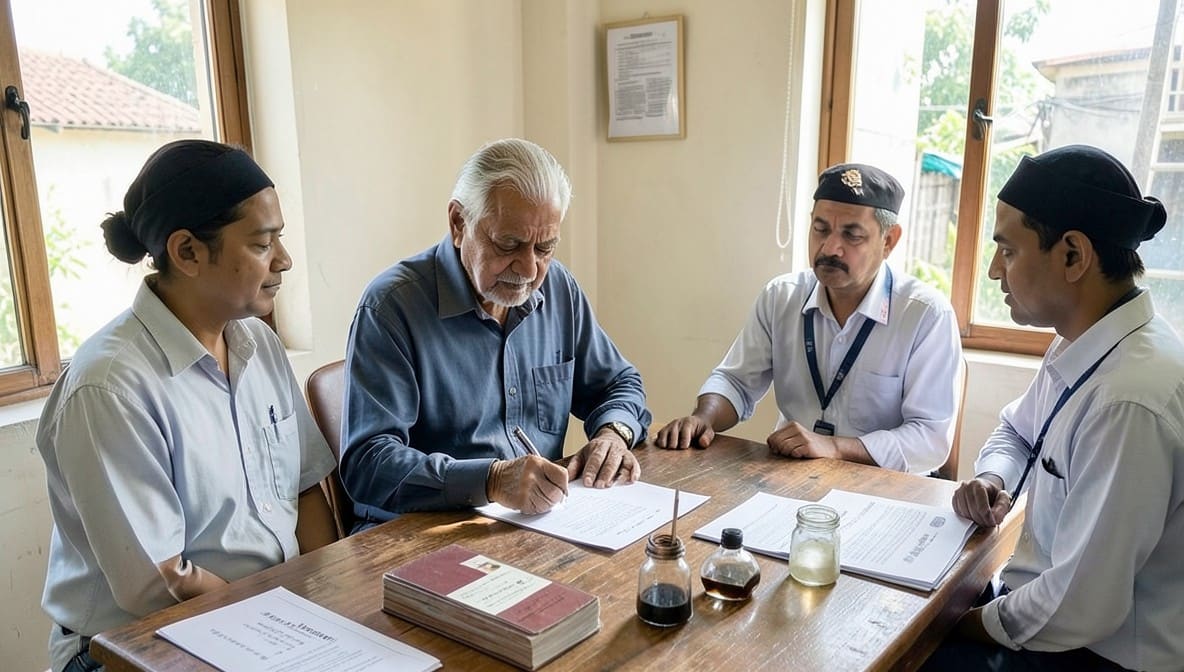
The Himachal Pradesh High Court has clarified that the mere presence of a beneficiary during the execution of a Will does not constitute a suspicious circumstance sufficient to invalidate it. The judgment reinforces the principle that proof of a Will must be assessed holistically, with emphasis on the totality of evidence, registration, and judicial conscience, rather than technical omissions or speculative doubts.
Background & Facts
The Dispute
The plaintiffs, Shiv Dayal and another, filed a civil suit before the Civil Judge (Junior Division), Chachiot, Mandi, seeking to declare two Wills executed by Dharam Chand - dated 20.03.2007 and 11.04.2007 - as null and void. They claimed that Dharam Chand, their cousin, had been cared for by them throughout his life, and that the Wills, which bequeathed the suit property to the defendants, were procured through undue influence and lacked testamentary validity. The plaintiffs also sought possession of the property and a permanent injunction against interference by the defendants.
Key Facts
- Dharam Chand was the son of Moti Ram, and the plaintiffs’ father, Purshottam, was Moti Ram’s brother, making Dharam Chand the plaintiffs’ first cousin.
- The plaintiffs alleged they provided daily care and necessities to Dharam Chand during his lifetime.
- The defendants propounded two Wills: the first dated 20.03.2007, and a second dated 11.04.2007, which the defendants claimed corrected a clerical error in the first.
- Both Wills were registered on the same day as their execution.
- The Wills named the defendants as sole beneficiaries and excluded the plaintiffs and other natural heirs.
- Dharam Chand was 78 years old at the time of execution and had been living with the defendants prior to his death.
- The plaintiffs were in physical possession of the suit land at the time of filing the suit.
- The defendants filed an application before the Tehsildar, Thunag, seeking action against the plaintiffs for unlawful interference with Dharam Chand’s land.
Procedural History
- 30.11.2010: Trial Court (Civil Judge, Junior Division, Chachiot) dismissed the suit, holding that the Wills were duly executed and attested, and that suspicious circumstances were adequately explained.
- 10.01.2012: First Appellate Court (Additional District Judge, Fast Track Court, Mandi) reversed the Trial Court’s decision, setting aside the decree and decreeing the suit on grounds of suspicious circumstances surrounding the Will’s execution.
- 12.06.2012: The High Court admitted the Second Appeal on two substantial questions of law.
- 06.03.2026: The appeal was reserved for judgment.
- 09.04.2026: Judgment delivered by Justice Rakesh Kainthla.
The Parties' Positions
Plaintiffs (Appellants before the High Court): Argued that the Wills were invalid due to suspicious circumstances, including the presence of beneficiaries during execution, exclusion of natural heirs, and lack of clear attestation evidence. They contended that the Appellate Court correctly applied the law.
Defendants (Appellants before the High Court): Contended that the Wills were validly executed, attested, and registered. They argued that the Appellate Court erred in treating mere presence of beneficiaries and exclusion of heirs as suspicious circumstances, and that the Trial Court’s findings were based on proper appreciation of evidence.
Relief Sought
The defendants sought: (1) setting aside of the Appellate Court’s order dated 10.01.2012; (2) restoration of the Trial Court’s decree dated 30.11.2010; and (3) dismissal of the plaintiffs’ suit with costs.
The Legal Issue
The central questions were: (1) Whether the mere presence of a beneficiary at the time of execution of a Will constitutes a suspicious circumstance sufficient to invalidate it; and (2) Whether the failure of attesting witnesses to explicitly state that they signed in the presence of the testator renders the Will unproved under Section 63 of the Indian Succession Act.
Arguments Presented
For the Appellants
The appellants relied on a series of Supreme Court and High Court precedents, including Meena Pradhan v. Kamla Pradhan (2023), Sridevi v. Jayaraja Shetty (2005), and Rabindra Nath Mukherjee v. Panchanan Banerjee (1995), to argue that:
- The presence of beneficiaries during Will execution is not, by itself, a suspicious circumstance.
- Exclusion of natural heirs is inherent in testamentary succession and cannot raise suspicion.
- Registration of the Will raises a presumption of validity and soundness of mind.
- The attestation requirement under Section 63(c) is satisfied if the totality of evidence shows that the testator and witnesses were present together during the entire transaction, even if witnesses do not use precise language.
- The Appellate Court erred in introducing new grounds of suspicion not pleaded by the plaintiffs.
For the Respondents
The respondents contended that:
- The attesting witnesses failed to testify that they signed the Will in the presence of the testator, violating Section 63(c).
- The beneficiaries’ active presence, coupled with the exclusion of natural heirs, created legitimate suspicion.
- The Appellate Court’s factual findings on evidence appreciation were final and should not be disturbed.
- The plaintiffs’ lack of pleading on suspicious circumstances was immaterial because the Appellate Court was entitled to examine the evidence independently.
The Court's Analysis
The Court undertook a comprehensive review of the law on Will execution, emphasizing that the burden on the propounder is not merely to prove formal compliance but to satisfy the judicial conscience when suspicious circumstances are raised.
"Suspicious circumstances must be ‘real, germane and valid’ and not merely ‘the fantasy of the doubting mind.’"
The Court held that the Appellate Court erred in two fundamental respects. First, it introduced new grounds of suspicion - presence of beneficiaries and exclusion of heirs - that were neither pleaded nor proved by the plaintiffs. Citing S. Amarjit Singh v. State (1998) and P.P.K. Gopalan Nambiar v. Balakrishnan Nambiar (1995), the Court reiterated that suspicious circumstances must be specifically pleaded and proved; they cannot be conjured for the first time on appeal.
Second, the Court found that the presence of beneficiaries during execution was not a suspicious circumstance. Quoting Tirath Singh v. Sajjan Singh (1997), Leela v. Drumti Devi (2000), and Sridevi v. Jayaraja Shetty (2005), the Court observed:
"The mere fact that the beneficiary accompanied the testator or was present when the Will was scribed is not sufficient to draw an inference of undue influence."
The Court further held that exclusion of natural heirs is not suspicious, as the very purpose of a Will is to deviate from intestate succession. Citing Rabindra Nath Mukherjee and Uma Devi Nambiar, the Court stated:
"The idea behind executing a Will is to interfere with the normal line of succession. Natural heirs would be debarred in every case of a Will."
On the issue of attestation, the Court rejected the Appellate Court’s technical reading of witness testimony. Citing Gauri v. Munshi Ram (1955), Naresh Charan v. Paresh Charan (1954), and M.B. Ramesh v. K.M. Veeraje Urs (2013), the Court held that compliance with Section 63(c) is a question of fact, not mere wording. Where the evidence shows that the testator and witnesses were present together in one sitting, and no evidence suggests separation during signing, the Court may infer due attestation.
"The question of proof is dealt with in Section 3 of the Indian Evidence Act. A fact may be proved by direct evidence or by circumstantial evidence."
The Court also upheld the Trial Court’s finding that the plaintiffs failed to rebut the presumption of soundness of mind under Section 114 of the Evidence Act, particularly since the Will was registered and no credible evidence of mental incapacity was adduced.
The Verdict
The appeal was allowed. The judgment and decree of the First Appellate Court dated 10.01.2012 were set aside, and the judgment and decree of the Trial Court dated 30.11.2010 were restored. The suit was dismissed with costs. The Court directed that the defendants be permitted to take full possession of the suit property, and all pending applications were disposed of.
What This Means For Similar Cases
Presence of Beneficiaries Is Not Suspicious
- Practitioners must now argue that the mere presence of beneficiaries during Will execution cannot be used to invalidate a Will unless active participation or coercion is proven.
- Courts must distinguish between innocent presence and undue influence; absence of specific allegations or evidence of coercion negates suspicion.
- In probate proceedings, objections based solely on beneficiary presence should be struck out at the pleading stage.
Registration and Circumstantial Evidence Sufficient for Attestation
- Where a Will is registered and witnesses testify to a unified execution process, courts may infer compliance with Section 63(c) even if witnesses omit precise phrases.
- The totality of evidence - including timing, location, registration, and absence of cross-examination on key points - can substitute for explicit testimony.
- Practitioners should focus on reconstructing the sequence of events through circumstantial evidence, not just witness wording.
Pleading Requirements Are Strict
- Suspicious circumstances must be specifically pleaded in the written statement; appellate courts cannot introduce new grounds of suspicion.
- Failure to plead suspicion at the trial level waives the right to raise it on appeal, as per P.P.K. Gopalan Nambiar and Trojan & Co. Ltd. v. Nagappa Chettiar.
- Lawyers must ensure that all grounds challenging a Will are clearly articulated in pleadings to avoid procedural dismissal.
Burden of Proof on Soundness of Mind
- Where a Will is registered and no specific denial of soundness of mind is pleaded, the law presumes the testator was of sound mind.
- Challenging mental capacity requires credible medical or eyewitness testimony; casual observations of illness or talkativeness are insufficient.
- The burden shifts to the challenger to prove unsoundness; mere age or exclusion of heirs does not suffice.