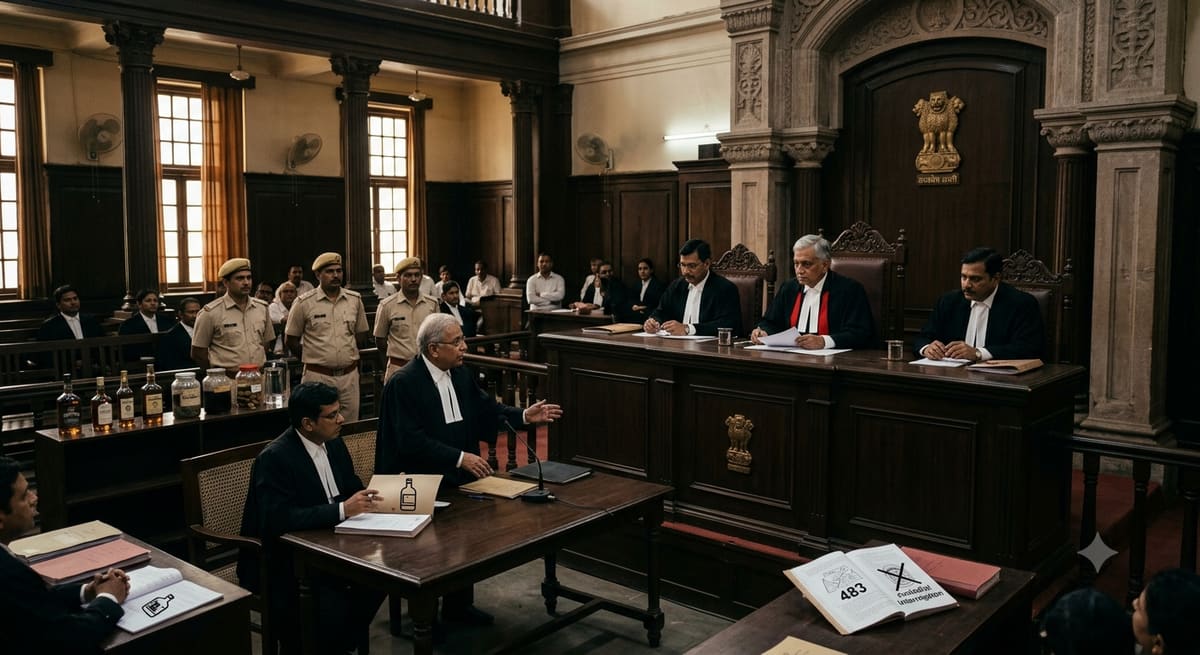
The Madhya Pradesh High Court has reaffirmed the statutory bar on anticipatory bail for offences under Section 34(2) of the Madhya Pradesh Excise Act where illicit liquor exceeding fifty bulk litres is recovered. This ruling underscores the legislative intent to treat large-scale illicit liquor trafficking as a serious public health and law enforcement concern, leaving no room for judicial discretion where the statutory embargo applies.
Background & Facts
The Dispute
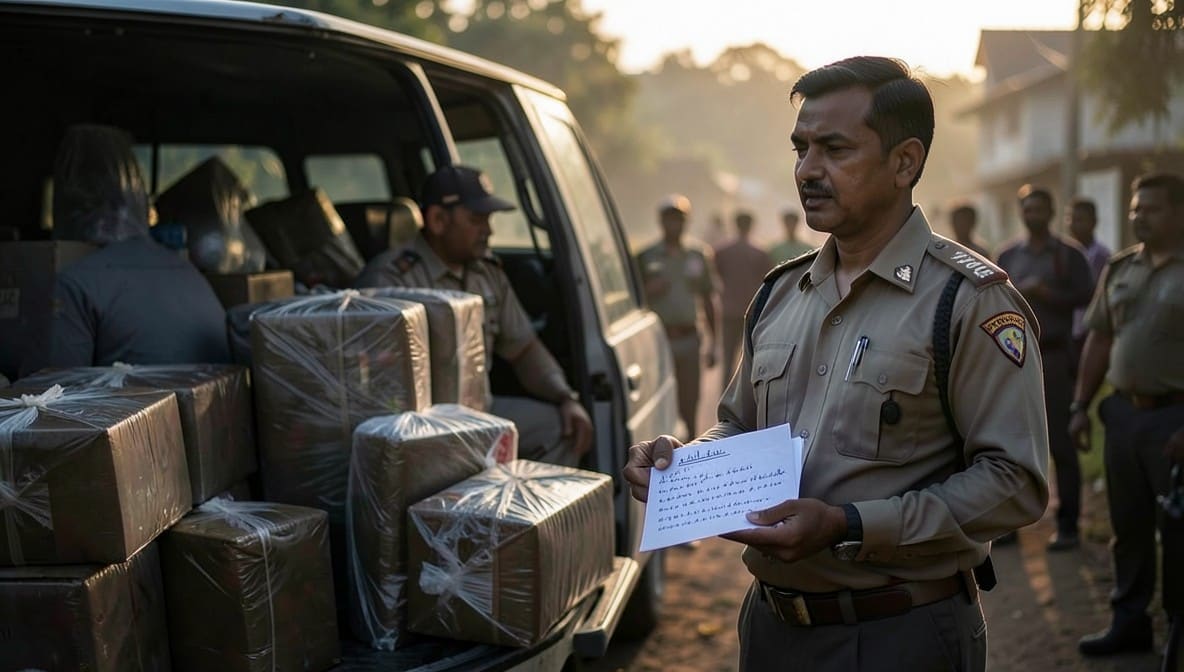
The applicant, Balloo @ Rampal Yadav, is apprehending arrest in connection with Crime No. 146/2026 registered at Police Station Simariya, District Panna, for an offence under Section 34(2) of the Madhya Pradesh Excise Act. The prosecution alleges that on 12.04.2026, police received a credible tip-off regarding storage of illicit liquor in a tapra (cattle shed) owned by the applicant. A raiding party, including Constable Ankit Patel and independent witness Raj Bahadur, conducted a search at approximately 20:30 hours on the same date. During the search, two individuals were spotted; one fled, while Anuj Yadav, the applicant’s nephew, was apprehended. A concealed pit (gaddha) covered with a sheet was uncovered, yielding 65 litres and 700 millilitres of illicit liquor, seized in the presence of witnesses.
Key Facts
- The illicit liquor recovered amounted to 65.7 litres, exceeding the statutory threshold of 50 bulk litres under Section 59-A(i)
- The tapra where the liquor was found is owned and occupied by the applicant
- No liquor was recovered from the applicant’s personal possession
- The applicant is named in the case solely on the basis of the memorandum of co-accused Anuj Yadav
- The applicant has prior criminal history: seven cases, four under the MP Excise Act
- The applicant has been acquitted in most prior cases; only one remains pending
Procedural History
- 12.04.2026: Crime No. 146/2026 registered at Police Station Simariya, District Panna
- 12.04.2026: Raid conducted and 65.7 litres of illicit liquor seized
- 13.05.2026: Application under Section 482 of Bhartiya Nagrik Suraksha Sanhita, 2023 filed for anticipatory bail
- 13.05.2026: Hearing conducted before the High Court at Jabalpur
- 13.05.2026: Order passed dismissing the anticipatory bail application
The Parties' Positions
For the Applicant
The applicant’s counsel argued that the applicant is innocent and has been falsely implicated based solely on the statement of his nephew, Anuj Yadav. He emphasized that no illicit liquor was recovered from the applicant’s person or direct control. He highlighted that the applicant runs a legitimate dairy business and has been acquitted in the majority of his prior cases. He relied on two coordinate bench orders: Ganaram Thakur v. State of Madhya Pradesh (M.Cr.C. No. 20873/2025, dated 09.05.2025) and Hariram Chourasiya alias Lallu Chaurasiya (M.Cr.C. No. 42440/2025, dated 24.09.2025), where anticipatory bail was granted in similar circumstances under Section 34(2).
For the Respondent/State
The State’s counsel contended that the liquor was recovered from a structure owned and occupied by the applicant, establishing his exclusive constructive possession. She emphasized that the applicant has a history of seven criminal cases, four of which relate to the MP Excise Act. She further argued that Section 59-A(i) of the MP Excise Act explicitly prohibits courts from entertaining any application for anticipatory bail where the quantity of illicit liquor exceeds fifty bulk litres, rendering the application non-maintainable.
Relief Sought
The applicant sought anticipatory bail to prevent arrest in connection with Crime No. 146/2026, pending investigation and trial.
The Legal Issue
Whether the court is statutorily barred from entertaining an application for anticipatory bail under Section 482 of the Bhartiya Nagrik Suraksha Sanhita, 2023, when the offence alleged is under Section 34(2) of the Madhya Pradesh Excise Act and the quantity of illicit liquor recovered exceeds fifty bulk litres.
Arguments Presented
For the Appellant/Petitioner
The applicant’s counsel contended that the applicant’s involvement is tenuous, as no liquor was recovered from his person and the sole basis of inclusion is the statement of his nephew. He argued that the prior coordinate bench decisions in Ganaram Thakur and Hariram Chourasiya demonstrate that courts have granted anticipatory bail in similar factual matrices, even under Section 34(2). He submitted that the statutory bar under Section 59-A(i) was not considered in those orders and that the court should exercise its discretion under Section 482 to prevent abuse of process.
For the Respondent/State
The State’s counsel relied on the plain language of Section 59-A(i) of the MP Excise Act, which explicitly prohibits courts from entertaining anticipatory bail applications in cases where the quantity of illicit liquor exceeds fifty bulk litres. She argued that this provision overrides the general provisions of the CrPC and is a clear legislative mandate. She further submitted that the applicant’s criminal antecedents, particularly four prior cases under the same Act, reinforce the need to deny bail to prevent interference with investigation and recurrence of offence.
The Court's Analysis
The Court held that the statutory prohibition under Section 59-A(i) of the Madhya Pradesh Excise Act is absolute and leaves no room for judicial discretion. The provision states: "no application for an anticipatory bail shall be entertained by any court in respect of a person... accused of an offence covered by clause (a) or clause (b) of sub-section (1) of Section 34 with quantity of liquor found... exceeding fifty bulk litres."
"A bare reading of the above-quoted crystalizes the embargo for the courts to entertain anticipatory bail in underlying fact situation of the instant case."
The Court noted that the recovered quantity of 65.7 litres clearly exceeds the 50-litre threshold, triggering the statutory bar. The Court rejected the applicant’s reliance on two prior coordinate bench orders, observing that those judgments did not address Section 59-A(i) at all, and therefore could not be considered binding or persuasive authority on this specific point.
The Court further emphasized the extraordinary nature of anticipatory bail, citing Srikant Upadhyay v. State of Bihar (2024) 12 SCC 382 and Tusharbhai Rajnikantbhai Shah v. Kamal Dayani (2025) 1 SCC 753, which caution against routine grant of anticipatory bail in serious offences, particularly where investigation may be hampered or evidence tampered with.
The Court concluded that the legislature, by enacting Section 59-A(i), has determined that offences involving large-scale illicit liquor trafficking pose a grave threat to public order and health, and that the grant of anticipatory bail in such cases would undermine the statutory framework.
The Verdict
The application for anticipatory bail was dismissed. The Court held that Section 59-A(i) of the Madhya Pradesh Excise Act bars the entertainability of any anticipatory bail application where the quantity of illicit liquor recovered exceeds fifty bulk litres. The applicant is not entitled to anticipatory bail. The Court directed that the applicant may surrender before the investigating officer and apply for regular bail under Section 437 or 439 of the Bhartiya Nagrik Suraksha Sanhita, 2023, subject to the conditions laid down by the trial court.
What This Means For Similar Cases
Statutory Bar Overrides Judicial Discretion
- Practitioners must now treat Section 59-A(i) as an absolute bar to anticipatory bail in cases involving over 50 litres of illicit liquor, regardless of the accused’s personal circumstances or prior acquittals
- Any application for anticipatory bail under Section 482 CrPC in such cases must be rejected at the threshold without entering into merits
- Coordinate bench judgments that granted bail without addressing Section 59-A(i) are no longer valid precedent for similar facts
Constructive Possession Is Sufficient for Triggering the Bar
- Recovery of illicit liquor from a structure owned or occupied by the accused, even if not in personal possession, is sufficient to invoke Section 59-A(i)
- The presence of co-accused or alleged false implication does not negate the statutory bar if the quantity exceeds the threshold
- Defence arguments based on lack of direct possession or weak evidence are irrelevant at the anticipatory bail stage under this provision
Criminal History Reinforces Non-Grant, But Is Not Required
- While the applicant’s prior record under the Excise Act was noted, the Court made clear that the statutory bar applies even in the absence of criminal antecedents
- The bar is triggered solely by the nature of the offence and the quantity recovered
- Practitioners should not rely on clean records to circumvent Section 59-A(i); the provision operates independently of personal history