The Madhya Pradesh High Court has reaffirmed the foundational principle that bail is the rule and incarceration the exception, granting regular bail to an accused charged with possession of illicit country-made liquor. The judgment underscores that prolonged pre-trial detention without a trial conclusion violates Article 21, even in offences under the MP Excise Act, provided there is no risk of evidence tampering or flight.
Background & Facts
The Dispute
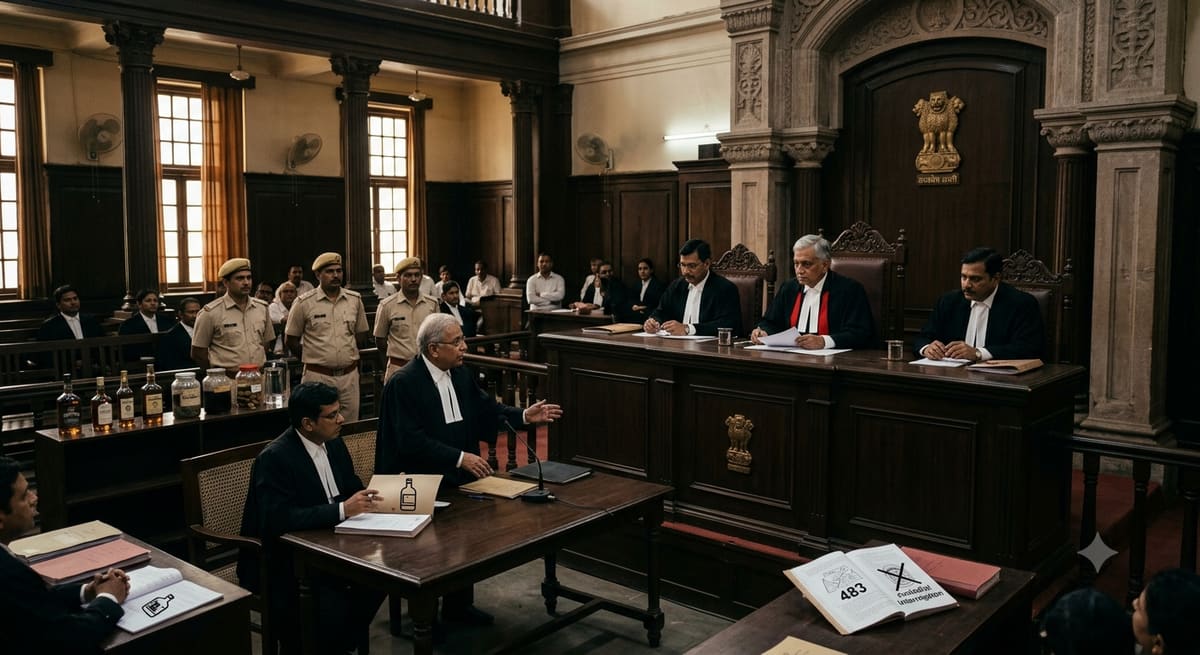
The applicant, Virendra Kumar Sindal, was arrested on 09.04.2026 in connection with FIR/Crime No. 176/2026 registered at Police Station Nilganga, District Ujjain, Madhya Pradesh. The case pertains to the seizure of 54 bulk litres of illicit country-made liquor from his possession, attracting prosecution under Section 34(2) of the Madhya Pradesh Excise Act, 1915. The applicant has been in judicial custody since the date of arrest.
Key Facts
- The offence under Section 34(2) of the MP Excise Act is punishable with imprisonment up to three years and fine, and is triable by a Judicial Magistrate First Class (JMFC)
- The prosecution alleges possession of 54 bulk litres of illicit liquor, a quantity that attracts enhanced punishment under the Act
- The applicant has one prior criminal antecedent, as noted by the State
- The investigation was completed and the charge-sheet was filed prior to the bail application
- The applicant filed a first bail application in M.Cr.C. No. 18002/2026, which was withdrawn on 27.04.2026
Procedural History
- 09.04.2026: Applicant arrested and taken into custody
- Between 09.04.2026 and 27.04.2026: Investigation conducted and charge-sheet filed
- 27.04.2026: First bail application (M.Cr.C. No. 18002/2026) withdrawn by applicant
- 11.05.2026: Second bail application filed under Section 483 of BNSS, 2023 / Section 439 of Cr.P.C.
- 11.05.2026: Hearing before the High Court, Indore Bench
Relief Sought
The applicant sought regular bail on the grounds that:
- The investigation is complete and charge-sheet filed
- Trial is likely to take considerable time
- No likelihood of evidence tampering or witness influence
- He is willing to cooperate in trial and abide by all conditions
- He has been in custody for over a month without trial commencement
The Legal Issue
The central question was whether an accused charged under Section 34(2) of the MP Excise Act, with a completed investigation and filed charge-sheet, is entitled to regular bail under Section 483 of BNSS, 2023, when the trial is expected to be protracted and there is no credible risk of evidence tampering or flight, despite a prior criminal antecedent.
Arguments Presented
For the Appellant/Petitioner
Learned counsel for the applicant submitted that:
- The investigation is complete and charge-sheet filed, indicating no further need for custody for investigative purposes
- The offence, while serious, is triable by a JMFC and not by a Sessions Court, suggesting lower gravity
- The applicant has no history of absconding or obstructing justice
- He is ready to appear before the trial court on all dates and comply with all conditions
- Prolonged detention without trial violates the right to life and personal liberty under Article 21 of the Constitution
- The principle of 'bail is the rule, jail is the exception' must prevail
- The prior antecedent does not automatically disqualify him from bail, especially where no threat to investigation exists
For the Respondent/State
The State opposed bail on the grounds that:
- The offence under Section 34(2) of the MP Excise Act is serious and affects public health and revenue
- The applicant has a prior criminal antecedent
- Illicit liquor trade often involves organized crime and potential for reoffending
- Granting bail may set a precedent that undermines deterrence
- The seriousness of the offence justifies continued custody pending trial
The Court's Analysis
The Court examined the balance between the right to liberty under Article 21 and the State’s interest in ensuring trial integrity. It noted that the charge-sheet has been filed, indicating the investigation is complete and custody is no longer necessary for investigative purposes. The Court emphasized that the mere seriousness of the offence, without evidence of flight risk or tampering, cannot override the presumption of innocence.
"The principle 'bail is the rule, jail is the exception' is not a mere platitude but a constitutional imperative under Article 21. Prolonged pre-trial detention without a reasonable justification violates the very essence of personal liberty."
The Court distinguished the presence of a prior antecedent from a pattern of criminal conduct or obstruction of justice. It held that a single prior conviction, without evidence of recurrence or threat to the trial process, does not justify denial of bail where the accused is cooperative and the investigation is closed.
The Court also referenced Section 480(3) of the Bhartiya Nagrik Suraksha Sanhita, 2023, noting that adequate conditions can be imposed to mitigate any risk, rendering custody unnecessary.
The Verdict
The applicant succeeded. The High Court granted regular bail on the following terms:
- Personal bond of Rs. 50,000 with one solvent surety of like amount, to be approved by the trial court
- The applicant must appear before the trial court on all dates fixed
- He shall not influence witnesses or interfere with trial proceedings
- He shall not commit any further criminal activity
- He shall remain available for trial at all times
- He shall comply with all conditions under Section 480(3) of BNSS, 2023
- The bail order shall remain effective until the conclusion of trial
- Bail shall stand cancelled if the applicant is found involved in a similar offence or breaches any condition
What This Means For Similar Cases
Bail Cannot Be Denied Solely on Seriousness of Offence
- Practitioners must argue that seriousness alone, without evidence of flight risk or tampering, is insufficient to deny bail under Section 483 BNSS
- Courts must apply the 'bail is the rule' principle even in statutory offences like those under the MP Excise Act
Prior Antecedent Is Not a Disqualifier Per Se
- A single prior conviction does not automatically disqualify an accused from bail
- The focus must be on current conduct, cooperation, and risk to trial integrity
- Courts must distinguish between past record and present likelihood of obstruction
Trial Duration Is a Critical Factor
- When charge-sheet is filed and trial is expected to take months or years, prolonged custody becomes disproportionate
- Courts should consider the length of anticipated trial as a factor favoring bail
- This applies equally to offences under special statutes where punishment is severe but trial is summary
Conditions Can Mitigate Risk
- The Court’s imposition of specific, enforceable conditions under Section 480(3) BNSS demonstrates that bail can be granted with safeguards
- Practitioners should propose tailored conditions to address prosecution concerns
Article 21 as a Living Principle
- This judgment reinforces that Article 21 is not a passive right but an active shield against arbitrary detention
- Pre-trial detention must be justified by necessity, not convenience or deterrence