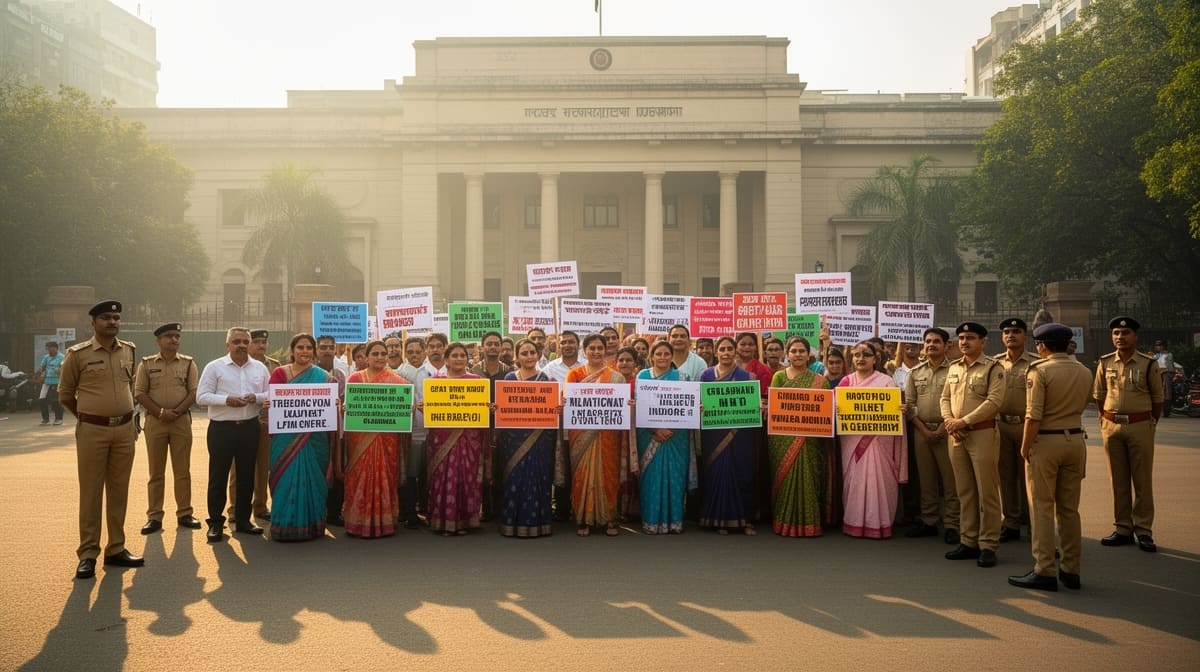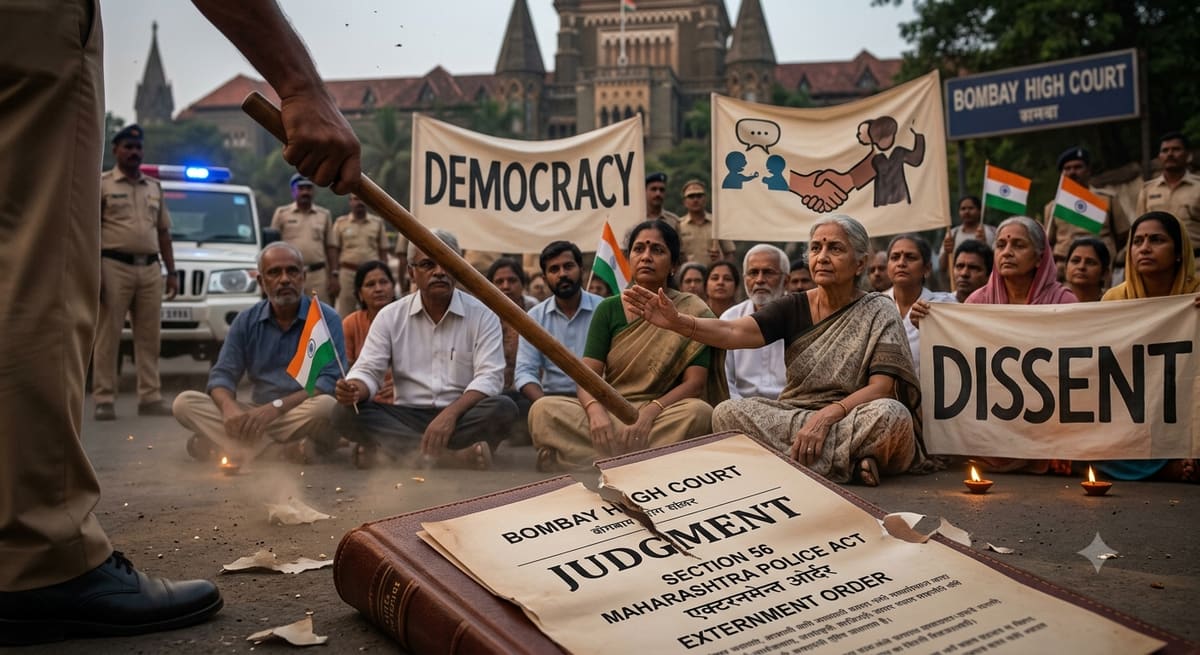
The Bombay High Court has reaffirmed that the power to extern a citizen under the Maharashtra Police Act cannot be invoked merely to silence lawful political dissent. In a significant ruling, the Court set aside an externment order against a political party secretary for organizing peaceful agitations against central government policies, holding that such action violates the fundamental rights to free speech and movement.
Background & Facts
The Dispute
The petitioner, Ahmad Abdul Wahid Chaudhary, is the Secretary of the Social Democratic Party of India (SDPI), a political party registered under Section 29A of the Representation of the People Act, 1951. The petitioner was targeted for externment under Section 56(1)(a) and (1)(b) of the Maharashtra Police Act, 1951, following a series of public demonstrations organized by the SDPI against decisions of the Government of India. These demonstrations, termed as morchas and dharnas, were conducted without police permission and resulted in multiple FIRs being registered under Section 188 of the Indian Penal Code, 1860, for disobeying public orders.
Key Facts
The petitioner organized protests in opposition to specific Union Government policies, including those related to economic and social reforms.
The protests were non-violent and did not involve destruction of property or physical harm to persons.
FIRs were registered under Section 188 IPC, which carries a maximum punishment of one month’s simple imprisonment.
No FIRs were registered under Chapters XII, XVI, or XVII of the IPC, which pertain to offences involving force, violence, or offences against the human body.
The petitioner had not been arrested or convicted in any of the cases.
The externment order was passed on 03.12.2025 by the Deputy Commissioner of Police, Zone-6, Chembur, Mumbai (Externment Order No. 472/C/43).
The petitioner filed an appeal against the externment order, which was dismissed by the Divisional Commissioner, Konkan Division, on 27.03.2026 (Externment Appeal No. 188/2025).
Procedural History
03.12.2025: Externment Order No. 472/C/43 issued by Deputy Commissioner of Police, Chembur.
27.03.2026: Divisional Commissioner dismissed the petitioner’s appeal (Appeal No. 188/2025).
2026.07.02: Writ Petition No. 1700 of 2026 filed before the Bombay High Court under Articles 226 and 227 of the Constitution.
The Parties' Positions
For the Petitioner: The petitioner’s counsel, Ms. Payoshi Roy, argued that the externment order was based solely on the petitioner’s exercise of democratic rights to protest government policies. She emphasized that the protests were peaceful, the FIRs were under Section 188 IPC (a minor offence), and there was no evidence of violence, threat to public order, or harm to property. She relied on Anuradha Bhasin v. Union of India and Mohammad Kaleem Taufiq Ahmed Siddiqui v. State of Gujarat to argue that suppression of dissent through externment is unconstitutional.
For the Respondent-State: The State, represented by Ms. S.M. Yadav, APP, contended that the petitioner’s activities caused public alarm and were calculated to cause harm. The State relied on the affidavit of the Deputy Commissioner, which claimed the petitioner’s actions disrupted public order. However, the State did not produce any evidence of actual violence, property damage, or credible threat to public safety.
Relief Sought
The petitioner sought quashing of the externment orders dated 03.12.2025 and 27.03.2026, and a declaration that the use of Section 56 of the Maharashtra Police Act to suppress political dissent violates Articles 19(1)(a), 19(1)(d), and 21 of the Constitution.
The Legal Issue
Can an externment order under Section 56(1)(a) of the Maharashtra Police Act be lawfully passed against a citizen solely for organizing peaceful protests against government policies, where the only offences alleged are under Section 188 IPC and no evidence of violence or threat to public safety exists?
Arguments Presented
For the Petitioner
The petitioner’s counsel argued that Section 56(1)(a) requires a direct nexus between the person’s acts and actual or imminent danger to person or property. The mere act of organizing a protest, even without permission, does not satisfy this threshold. She cited Anuradha Bhasin v. Union of India, where the Supreme Court held that Section 144 CrPC cannot be used to suppress legitimate expression of grievance. She also relied on Mohammad Kaleem Taufiq Ahmed Siddiqui v. State of Gujarat, where the Gujarat High Court quashed an externment order against a protester for raising grievances against the Union Government. The counsel emphasized that the petitioner’s actions were protected under Article 19(1)(a) and that the externment order was a disproportionate restriction.
For the Respondent
The State argued that the petitioner’s repeated organization of unapproved protests created a pattern of disruption and public alarm. The affidavit of the Deputy Commissioner claimed that the petitioner’s slogans and gatherings had the potential to incite unrest. However, the State did not provide any specific instances of violence, property damage, or credible threats to public safety. The State’s case rested entirely on the subjective satisfaction recorded in the externment order, without supporting material evidence.
The Court's Analysis
The Court conducted a rigorous analysis of Section 56(1)(a) of the Maharashtra Police Act, which permits externment only when a person’s movements or acts are "causing or calculated to cause alarm, danger or harm to person or property." The Court held that the term "calculated to cause" requires objective, material evidence - not speculative or generalized assertions.
"There is no material on record to show that the movements or acts of the Petitioner are causing or calculated to cause alarm, danger or harm to person or property."
The Court noted that all FIRs against the petitioner were under Section 188 IPC, a non-violent, petty offence with a maximum penalty of one month’s imprisonment. The Court emphasized that such offences, even if repeated, cannot justify the extraordinary remedy of externment, which deprives a citizen of the fundamental right to free movement under Article 19(1)(d).
The Court further held that the subjective satisfaction recorded by the authorities was "vitiated" because it was not supported by any concrete evidence. The affidavit-in-reply merely repeated the allegations from the FIRs without adding any independent assessment of threat or danger.
The Court relied on Anuradha Bhasin, where the Supreme Court held that "the right to protest is an essential component of democracy," and on Mohammad Kaleem Taufiq Ahmed Siddiqui, where the Gujarat High Court explicitly ruled that "a citizen cannot be subjected to externment merely for raising grievances against the Government."
The Court concluded that the externment order was not only legally unsustainable but also a clear infringement of the petitioner’s rights under Articles 19(1)(a) and 21. The State’s action, in the absence of any violence or credible threat, amounted to a punitive measure against lawful dissent.
The Verdict
The Writ Petition is allowed. The externment order dated 03.12.2025 issued by the Deputy Commissioner of Police, Zone-6, Chembur, Mumbai (No. 472/C/43) and the order dated 27.03.2026 dismissing the appeal by the Divisional Commissioner, Konkan Division (No. 188/2025), are quashed and set aside. The petitioner is directed to be immediately restored to his full rights of free movement within the territory of Maharashtra. No costs are awarded.
What This Means For Similar Cases
Externment Cannot Be a Tool for Political Suppression
Practitioners must challenge externment orders where the sole basis is protest activity under Section 188 IPC or similar minor offences.
Courts will not uphold externment orders lacking evidence of actual or imminent threat to person or property.
The burden lies on the State to demonstrate objective grounds for externment - not mere subjective suspicion.
Peaceful Protest Is Protected Under Article 19(1)(a)
Organizing demonstrations against government policies, even without prior permission, does not automatically constitute a threat to public order.
Police must distinguish between lawful dissent and unlawful violence; the former cannot be criminalized through administrative measures like externment.
Any externment order based on political affiliation or expression of dissent is vulnerable to constitutional challenge.
Procedural Safeguards Must Be Strictly Followed
Authorities must record specific, verifiable facts supporting the claim of "alarm, danger or harm" - generalized statements are insufficient.
Courts will scrutinize the linkage between the alleged acts and the severity of the remedy imposed.
Externment under Section 56 is an extraordinary measure and must be reserved for cases involving genuine threat of violence or serious public disorder.