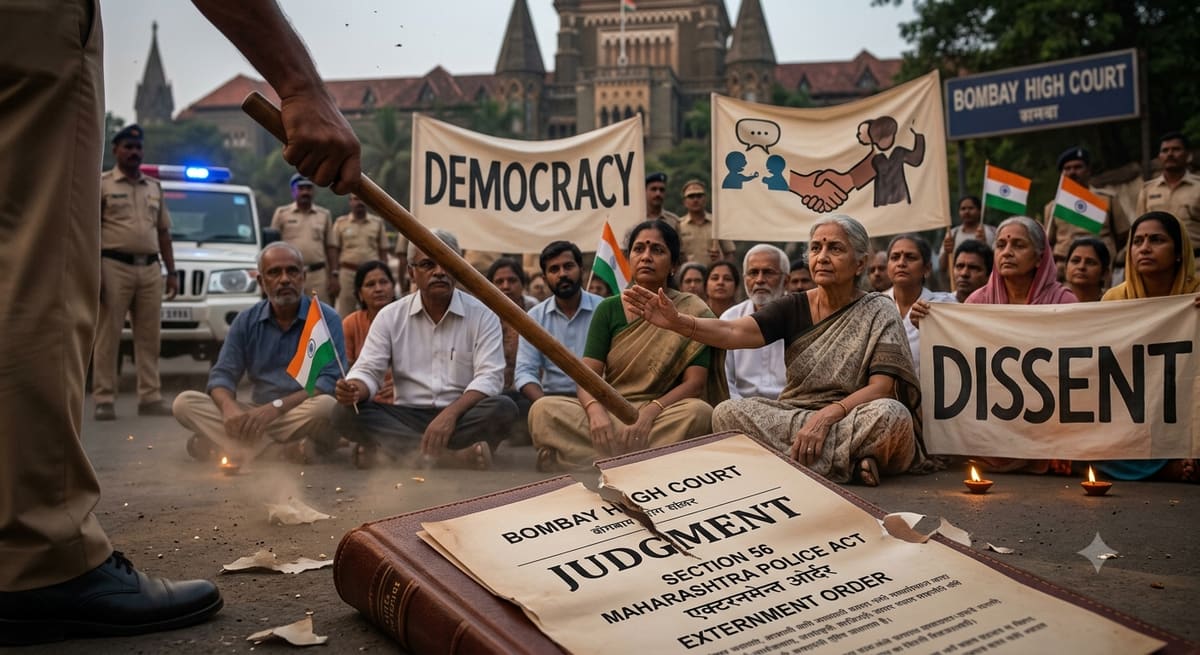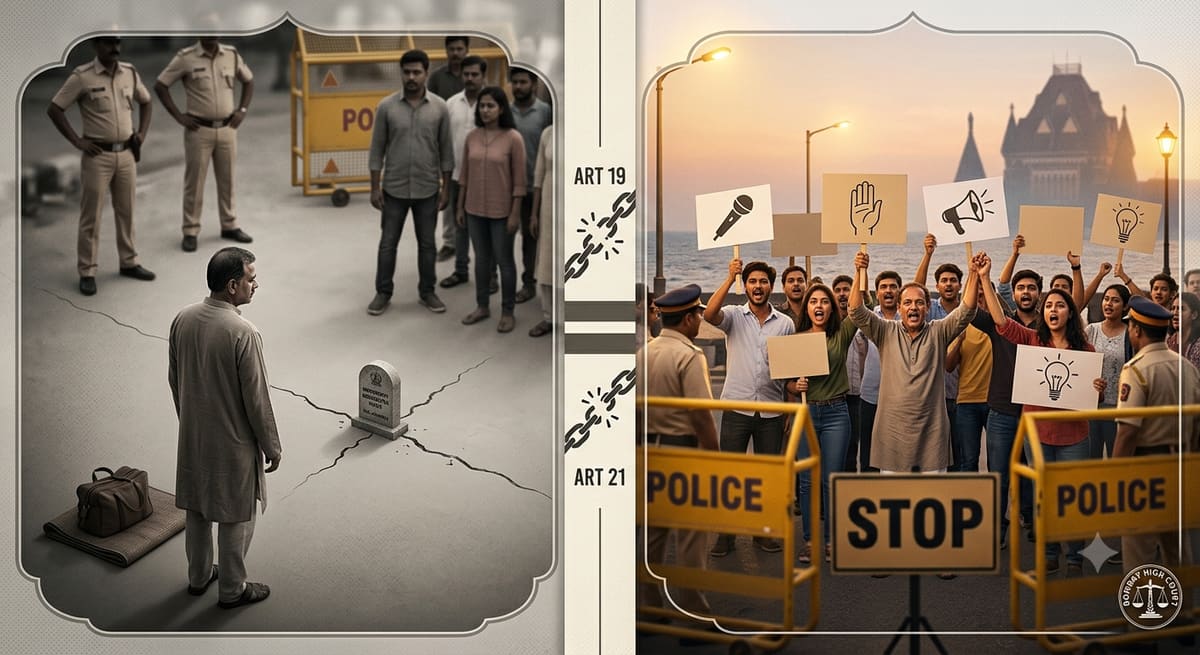
The Bombay High Court has set aside externment orders issued against the Secretary of the Social Democratic Party of India (SDPI), holding that the right to protest government decisions is a fundamental right under Articles 19 and 21 of the Constitution of India. The judgment underscores that externment orders, being extraordinary measures, cannot be used to suppress legitimate democratic dissent.
Background & Facts
The Dispute
The petitioner, Saeed Ahmad Abdul Wahid Chaudhary, is the Secretary of the Social Democratic Party of India (SDPI), a political party registered under Section 29A of the Representation of the People Act, 1951. The petitioner and his party organized agitations, morchas, and dharna protests against certain decisions of the Government of India. The police authorities refused permission for these protests, leading to multiple First Information Reports (FIRs) primarily under Section 188 of the Indian Penal Code (IPC) for conducting protests without permission.
Key Facts
The petitioner is affiliated with the SDPI, a registered political party.
Multiple FIRs were registered against the petitioner under Section 188 IPC for organizing protests without police permission.
The protests were against decisions of the Government of India.
The Deputy Commissioner of Police, Zone-6, Chembur, Mumbai, passed an externment order (Externment Order No. 472/C/43) dated 3rd December 2025 under Section 56(1)(a) and (b) of the Maharashtra Police Act.
The Divisional Commissioner, Konkan Division, dismissed the appeal (Externment Appeal No. 188/2025) against the externment order on 27th March 2026.
Procedural History
Multiple FIRs: Registered under Section 188 IPC for unauthorized protests.
3rd December 2025: Externment Order No. 472/C/43 passed by the Deputy Commissioner of Police.
30th June 2026: Affidavit-in-Reply filed by the Deputy Commissioner of Police justifying the externment order.
27th March 2026: Divisional Commissioner dismissed the appeal (Externment Appeal No. 188/2025).
Present Petition: Writ Petition No. 1700 of 2026 filed under Articles 226 and 227 of the Constitution of India challenging both orders.
Relief Sought
The petitioner sought quashing of:
The externment order dated 3rd December 2025 passed by the Deputy Commissioner of Police.
The appellate order dated 27th March 2026 passed by the Divisional Commissioner.The petitioner contended that the orders were passed without subjective satisfaction, lacked legal basis, and were mala fide.
The Legal Issue
The central question before the Court was whether Section 56 of the Maharashtra Police Act permits externment orders to be passed against individuals merely for organizing protests against government decisions, where the protests are primarily registered under Section 188 IPC and do not involve force, violence, or harm to person or property.
Arguments Presented
For the Petitioner
The externment orders were passed without any subjective satisfaction or material evidence showing that the petitioner’s actions caused alarm, danger, or harm to person or property.
The orders were mala fide and aimed at suppressing the petitioner’s fundamental right to freedom of speech and expression under Article 19 and the right to live with dignity under Article 21.
Reliance was placed on the Supreme Court’s decision in Anuradha Bhasin v. Union of India (2020) 3 SCC 637, which held that Section 144 CrPC cannot be used to suppress legitimate democratic protests.
The Gujarat High Court’s decision in Mohmmad Kaleem Taufiq Ahmed Siddiqui v. State of Gujarat (Special Criminal Application No. 8894 of 2020) was cited, where externment orders for similar protests were quashed.
For the Respondent-State
The State relied on the Affidavit-in-Reply dated 30th June 2026, which detailed the petitioner’s involvement in organizing protests without permission.
The State contended that the petitioner’s slogans and protests were calculated to cause alarm and disrupt public order.
It was argued that the externment orders were passed in accordance with law, as the petitioner’s actions fell under Section 56(1)(a) and (b) of the Maharashtra Police Act.
The Court's Analysis
The Court examined Section 56 of the Maharashtra Police Act, which empowers authorities to pass externment orders if:
The movements or acts of a person are causing or calculated to cause alarm, danger, or harm to person or property (Section 56(1)(a)).
There are reasonable grounds to believe that the person is engaged or about to engage in offences involving force, violence, or offences under Chapters XII, XVI, or XVII of the IPC (Section 56(1)(b)).
The Court observed that:
"What is contemplated by Section 56(1)(a) is that the movements or acts of any person are causing or calculated to cause alarm, danger or harm to person or property then action of externment can be taken."
However, the Court found no material on record to support the subjective satisfaction of the authorities. The FIRs against the petitioner were primarily under Section 188 IPC, which pertains to disobedience of orders promulgated by public servants and carries a maximum punishment of one month’s simple imprisonment. The Court held that:
"The other allegation is that such agitations/morchas/dharnas have been arranged without permission of the Police. The same is an offence under Section 188 of the IPC and maximum punishment is of simple imprisonment of one month. However, that cannot be a ground for passing the externment order under the provisions of the Maharashtra Police Act."
The Court further noted that the Affidavit-in-Reply merely reiterated that the petitioner’s protests were unauthorized but failed to establish that his actions caused or were calculated to cause alarm, danger, or harm to person or property. Thus, the subjective satisfaction recorded by the authorities was vitiated and lacked legal basis.
The Court relied on the Supreme Court’s decision in Anuradha Bhasin v. Union of India, which held that Section 144 CrPC cannot be used to suppress legitimate democratic protests. It also cited the Gujarat High Court’s decision in Mohmmad Kaleem Taufiq Ahmed Siddiqui v. State of Gujarat, where an externment order for similar protests was quashed. The Court observed:
"The said observations of the Supreme Court and the Gujarat High Court are squarely applicable to the present case."
The Court emphasized that externment orders are extraordinary measures that deprive citizens of their fundamental right to free movement under Article 19(1)(d). Such orders cannot be used to suppress freedom of speech and expression (Article 19(1)(a)) or the right to live with dignity (Article 21). The Court held that externing the petitioner merely for opposing government decisions violated these fundamental rights.
The Verdict
The Bombay High Court allowed the writ petition and quashed and set aside:
The Externment Order No. 472/C/43 dated 3rd December 2025 passed by the Deputy Commissioner of Police, Zone-6, Chembur, Mumbai.
The Order dated 27th March 2026 passed by the Divisional Commissioner, Konkan Division, in Externment Appeal No. 188/2025.
The Court held that the externment orders were passed without subjective satisfaction, lacked legal basis, and were mala fide.
What This Means For Similar Cases
Externment Orders Cannot Suppress Democratic Dissent
Section 56 of the Maharashtra Police Act cannot be invoked merely because an individual organizes protests against government decisions, especially when the protests are registered under Section 188 IPC and do not involve force, violence, or harm to person or property.
Authorities must establish material evidence showing that the individual’s actions are causing or calculated to cause alarm, danger, or harm to justify externment orders.
Subjective Satisfaction Must Be Backed by Evidence
The subjective satisfaction of authorities must be based on tangible evidence and not merely on the fact that protests were conducted without permission.
Externment orders passed without such evidence are vitiated and liable to be quashed.
Fundamental Rights Prevail Over Executive Overreach
Articles 19 and 21 of the Constitution protect the right to protest and the right to live with dignity.
Courts will strictly scrutinize externment orders that infringe upon these rights, especially when the underlying offences are minor (e.g., Section 188 IPC).
Practitioners should argue that externment orders are extraordinary measures and cannot be used to stifle legitimate democratic expression.