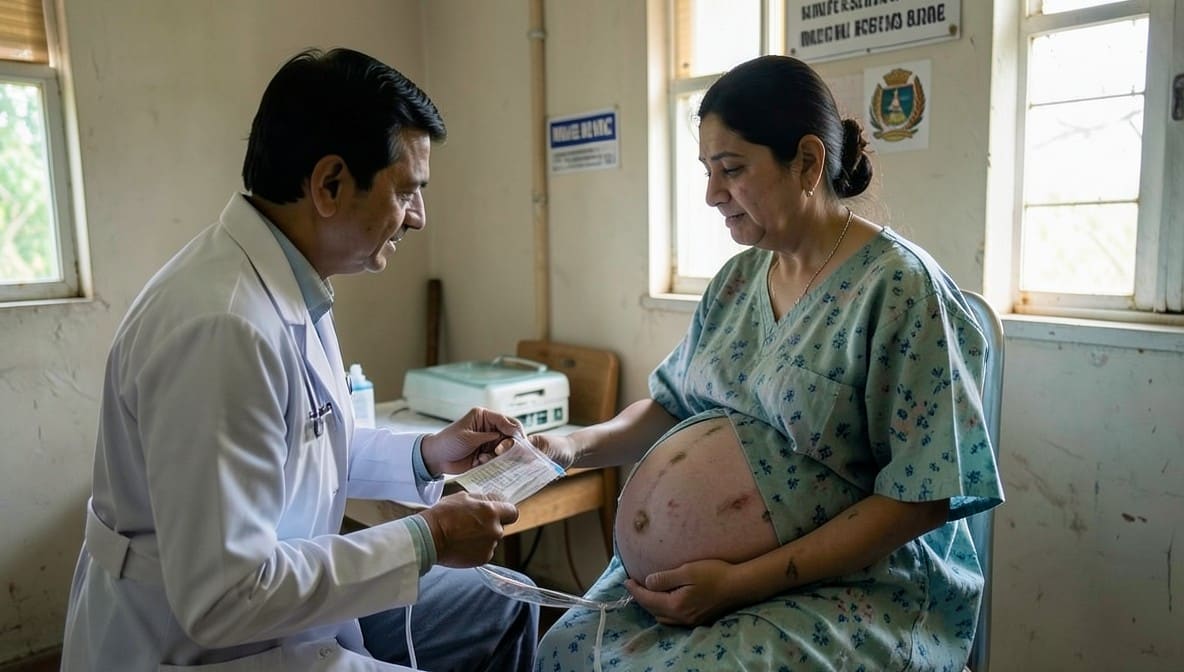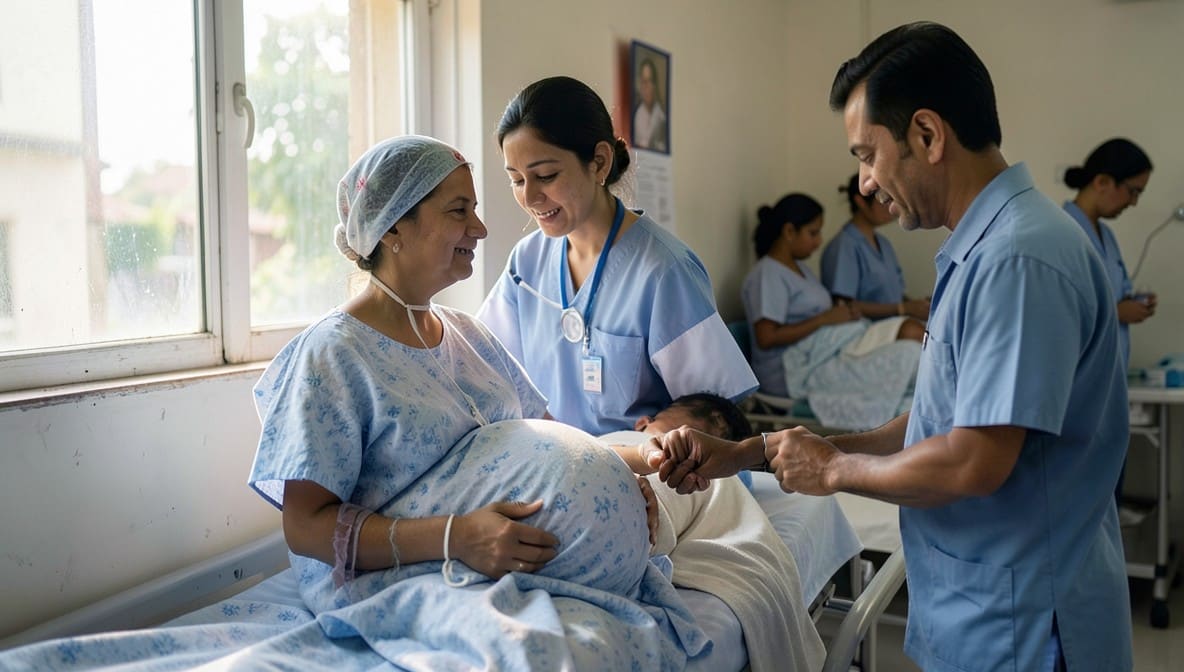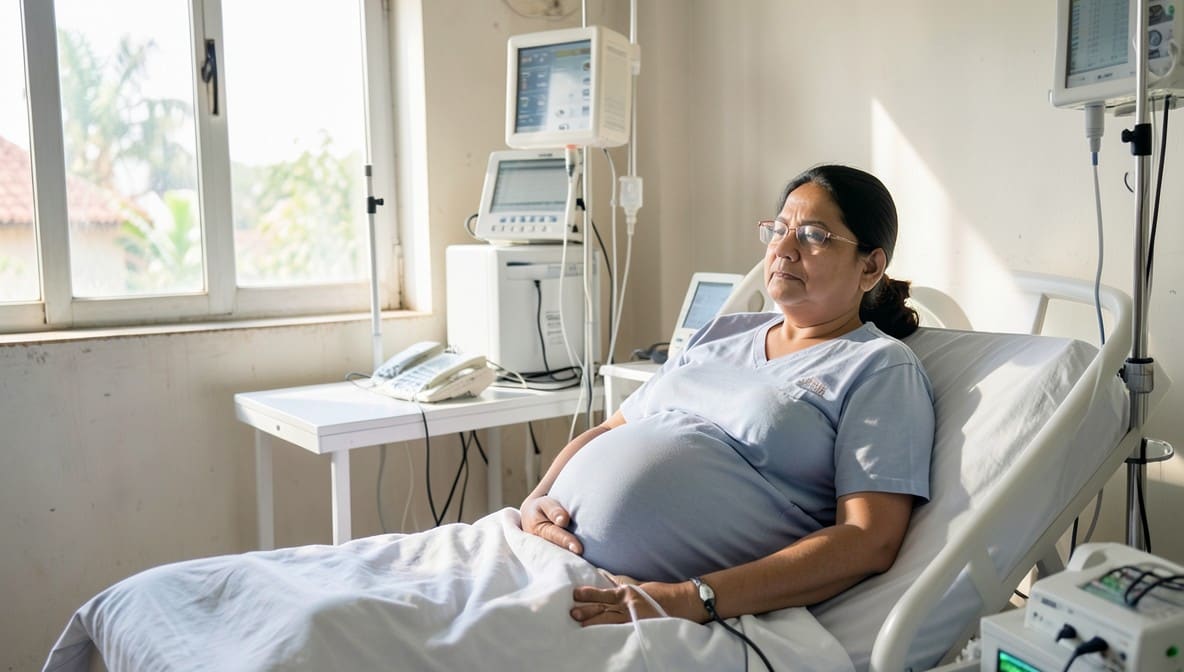
The Madhya Pradesh High Court has reaffirmed that the health and safety of a pregnant accused, particularly in a high-risk pregnancy, must override rigid procedural timelines. In granting a further extension of temporary bail, the Court underscored that constitutional protections extend to the unborn and that judicial discretion must be exercised with compassion where life and health are at stake.
Background & Facts
The Dispute
The petitioner, Seema, was granted temporary bail by this Court on 30.01.2026 in M.Cr.C. No. 3805 of 2026, on account of her advanced pregnancy and the anticipated due date of 12.02.2026. The temporary bail was initially granted for a period of two months, expiring on 30.03.2026. As the bail period neared its end, the petitioner sought a further extension, citing her deteriorating medical condition.
Key Facts
- The petitioner is currently in the third trimester of a high-risk pregnancy.
- She is currently hospitalized and under medical supervision.
- Her due date was 12.02.2026, but complications have necessitated continued hospitalization beyond that date.
- Medical records submitted to the Court confirm the risk to both maternal and fetal health if she is required to surrender to custody.
- No allegations of flight risk or obstruction of justice have been raised by the State.
Procedural History
- 30.01.2026: Temporary bail granted for two months in M.Cr.C. No. 3805 of 2026.
- 26.03.2026: Petition filed under Section 528 of the Bharatiya Nagarik Suraksha Sanhita, 2023 (equivalent to Section 482 Cr.P.C.) seeking extension of bail.
- 26.03.2026: Hearing conducted before the Hon’ble Justice Subodh Abhyankar.
- 26.03.2026: Order passed extending bail.
Relief Sought
The petitioner sought an extension of temporary bail for a further period of three months, citing medical necessity and the imminent risk to her life and that of the unborn child.
The Legal Issue
The central question was whether the Court may extend temporary bail beyond the initially granted period when the petitioner’s health, particularly in a high-risk pregnancy, renders surrender to custody life-threatening.
Arguments Presented
For the Petitioner
Counsel for the petitioner argued that forcing surrender during active hospitalization in the third trimester of a high-risk pregnancy would violate Article 21 of the Constitution, which guarantees the right to life and personal liberty. The submission emphasized that medical evidence confirmed the danger to both mother and child, and that delivery could not be safely managed in a prison setting. Reliance was placed on judicial precedents recognizing the special protection owed to pregnant women in custody.
For the Respondent/State
The State opposed the extension, contending that delivery can be arranged even in a hospital setting and that the petitioner should surrender as scheduled. The argument was procedural: the bail was granted for a fixed term, and no statutory provision permits indefinite extension.
The Court's Analysis
The Court acknowledged the State’s procedural concerns but held that the right to life under Article 21 is not subordinate to rigid timelines. The Court noted that the petitioner’s condition had not improved but worsened, with hospitalization continuing beyond the due date. The Court observed that the State had not disputed the medical urgency or raised any concern regarding the petitioner’s potential to abscond.
"The health of a pregnant woman, particularly in a high-risk pregnancy, cannot be subjected to the rigidity of procedural deadlines when the consequence may be irreversible harm to both mother and child. The Court’s discretion under Section 528 of the Bharatiya Nagarik Suraksha Sanhita must be exercised with humanity and in accordance with constitutional imperatives."
The Court further clarified that temporary bail is not a matter of right but a discretionary relief, and its extension is justified when circumstances materially change and pose a grave threat to life. The Court rejected the State’s argument that delivery can be arranged in any hospital, noting that the petitioner’s condition required continuous specialized care unavailable in custodial facilities.
The Verdict
The petition was allowed. The temporary bail granted on 30.01.2026 is extended for a further period of two months. The petitioner shall surrender before the Trial Court on or before 26.05.2026. The Court directed that the petitioner be permitted to remain under medical supervision until surrender, and the Trial Court shall make necessary arrangements for her medical care upon surrender.
What This Means For Similar Cases
Medical Emergency Overrides Procedural Deadlines
- Practitioners may now cite this judgment to seek bail extensions for pregnant accused in high-risk conditions, even beyond initial bail periods.
- Medical reports must be submitted with specificity: dates of hospitalization, doctor’s certification of risk, and prognosis.
- Courts are likely to treat pregnancy-related health emergencies as material changes warranting discretionary relief under Section 528 BNS.
Custody Cannot Override Right to Life
- The judgment establishes that the State’s interest in custody cannot override the fundamental right to life under Article 21 when medical evidence shows imminent danger.
- This principle may extend to other vulnerable categories: elderly accused, persons with chronic illness, or those requiring dialysis or chemotherapy.
- Courts must conduct a balancing test: risk to health versus risk of flight - with health taking precedence when substantiated.
Judicial Discretion Must Be Human-Centered
- This case reinforces that bail jurisprudence under Section 528 BNS is not mechanical.
- Judges are expected to consider the human cost of detention, especially for those whose condition is inherently unstable.
- Advocates should frame bail extension applications not as requests for leniency, but as assertions of constitutional rights.