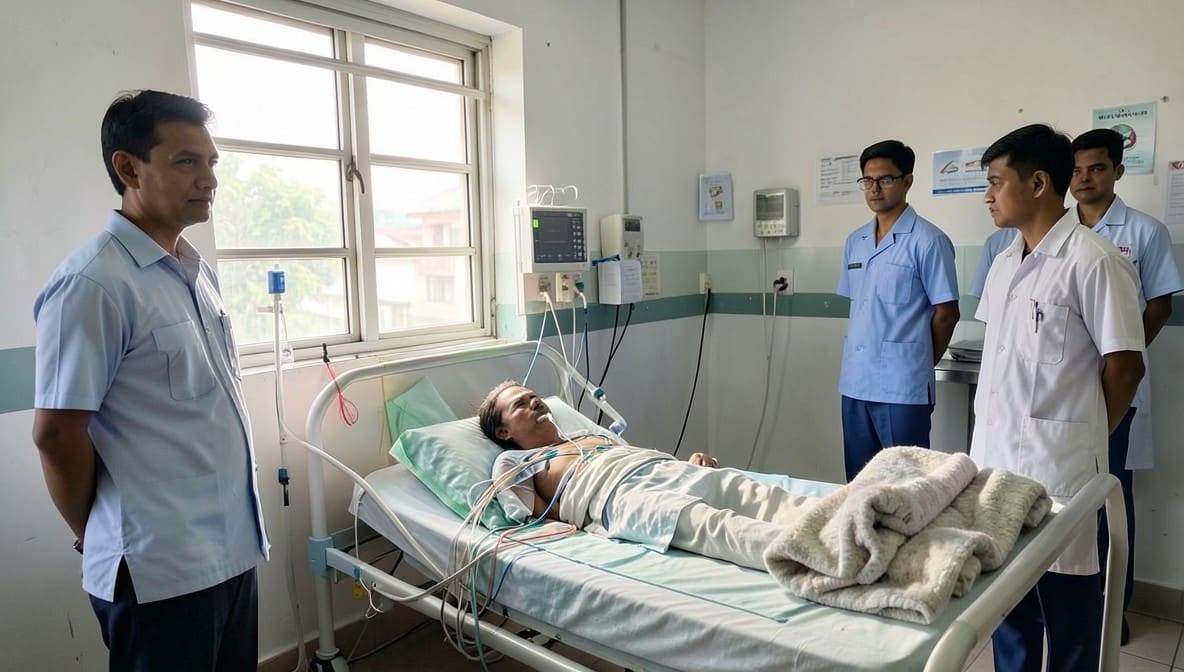
The Rajasthan High Court has recognized that the right to life under Article 21 includes access to timely medical treatment, even for accused persons in serious criminal cases. In a significant humanitarian ruling, interim bail was granted to an accused suffering from carcinoma to enable life-saving radiation therapy, setting a clear precedent for balancing prosecutorial interests with fundamental health rights.
Background & Facts
The Dispute
The petitioner, Yogendra Singh S/o Shri Gopal Singh, aged approximately 30 years, is an accused in FIR No. 03/2026 registered at Police Station CBN Neemuch, Pratapgarh, under Sections 8 and 22 of the Narcotic Drugs and Psychotropic Substances Act, 1985. He has been lodged in District Jail, Pratapgarh, since his arrest.
Key Facts
- The petitioner was diagnosed with carcinoma of the lower alveolus and underwent surgical intervention.
- Post-surgery, the Department of Radiation Oncology at R.N.T. Medical College & M.B. Hospital, Udaipur, advised External Beam Radiation Therapy as the next critical stage of treatment.
- The radiation therapy was scheduled to commence on 04.05.2026 and is expected to continue for approximately two months.
- Due to his incarceration, the petitioner was unable to commence the prescribed therapy.
- The petitioner submitted medical records and doctor’s advice to the Court to substantiate the urgency of treatment.
- The investigation in the case is complete, and the petitioner is no longer required for further investigative purposes.
Procedural History
- FIR Registration: 2026 (exact date not specified, but case registered in early 2026)
- Arrest: Date not specified, but petitioner was in custody prior to 11.05.2026
- 11.05.2026: Interim bail application filed under Section 483 of the Bharatiya Nagarik Suraksha Sanhita (BNSS)
- 11.05.2026: Hearing conducted before the High Court of Judicature for Rajasthan at Jodhpur
The Parties' Positions
For the Petitioner
- Counsel Mr. Ramesh Chandra Purohit argued that the petitioner is not a flight risk and has no history of absconding.
- Emphasized that the investigation is complete and the accused’s presence is no longer required for probe.
- Highlighted the medical emergency and the irreversible harm that would result from delay in radiation therapy.
- Submitted an undertaking that the petitioner will not commit any further offence and will fully cooperate with trial proceedings.
For the Respondent
- The Special Public Prosecutor, Mr. Thana Ram Bishnoi, opposed bail on grounds of the serious nature of NDPS offences.
- However, the Public Prosecutor verified the petitioner’s medical condition and confirmed the authenticity of the treatment requirement.
Relief Sought
The petitioner sought interim bail for a period sufficient to complete the prescribed radiation therapy, with conditions to ensure compliance with judicial process and public safety.
The Legal Issue
Can an accused person in a serious case under the NDPS Act be granted interim bail on humanitarian grounds to receive life-saving medical treatment, even if the offence is non-bailable and the investigation is technically complete?
Arguments Presented
For the Petitioner
The petitioner relied on the constitutional right to life under Article 21, which includes the right to health and timely medical care. He cited State of Punjab v. Baldev Singh and Sanjay Chandra v. CBI to argue that bail should not be denied solely on the gravity of the offence when life is at stake. He emphasized that the treatment is time-sensitive, and delay could be fatal. The petitioner undertook not to tamper with evidence, influence witnesses, or leave the designated districts.
For the Respondent
The State acknowledged the medical urgency but maintained that NDPS offences are grave and warrant strict deterrent measures. However, having verified the medical records, the Public Prosecutor did not contest the factual basis of the claim, effectively conceding the medical necessity.
The Court's Analysis
The Court explicitly declined to express any opinion on the merits of the criminal case, focusing solely on the humanitarian imperative. It recognized that the right to life and health is not suspended upon arrest. The Court noted that the investigation is complete and the accused’s presence is not required for further probe, reducing the risk of obstruction.
"This Court deems it appropriate, on humanitarian grounds and for the purpose of enabling the petitioner to undergo further treatment as advised by the Oncologist, to grant interim bail to the petitioner."
The Court weighed the severity of the offence against the immediacy of the medical need and concluded that the latter outweighs the former in this specific context. The Court emphasized that the grant of bail is interim, time-bound, and subject to strict conditions to prevent abuse.
The Verdict
The petitioner succeeded. The Court granted interim bail for a period of 15 days, commencing from 13.05.2026, to enable radiation therapy at R.N.T. Medical College & M.B. Hospital, Udaipur. The petitioner is required to furnish a personal bond of ₹1,00,000 with two sureties of like amount, subject to conditions including: no tampering with evidence, no criminal activity, mandatory court appearances, and restriction to the revenue districts of Pratapgarh and Udaipur. The petitioner must surrender to prison authorities upon completion of the 15-day period, and the surrender report must be submitted through the Trial Court to the High Court.
What This Means For Similar Cases
Medical Emergency Overrides Offence Gravity
- Practitioners may now invoke Article 21 to seek interim bail for accused persons requiring urgent, time-bound medical treatment, even in non-bailable offences under NDPS, IPC, or other serious statutes.
- Courts are likely to prioritize verified medical reports over the nature of the charge when life or permanent health is at risk.
Conditions Must Be Specific and Enforceable
- Bail orders must clearly define: duration, location of treatment, travel routes, surrender deadlines, and reporting mechanisms.
- Personal bonds with sureties remain mandatory, even in humanitarian bail.
- Travel restrictions should be geographically precise (e.g., district-level limits) to prevent evasion.
Investigation Completion Is a Critical Factor
- If the investigation is closed and the accused is not needed for further questioning or forensic reconstruction, courts are more likely to grant interim relief.
- Lawyers should file medical affidavits with hospital stamps, doctor’s signatures, and treatment schedules to substantiate claims.
No Precedent on Duration
- While this order grants 15 days, future applications may seek longer periods for chemotherapy, dialysis, or surgeries - courts will assess medical necessity on a case-by-case basis.
- The judgment does not create a blanket right but establishes a procedural pathway for urgent medical bail.