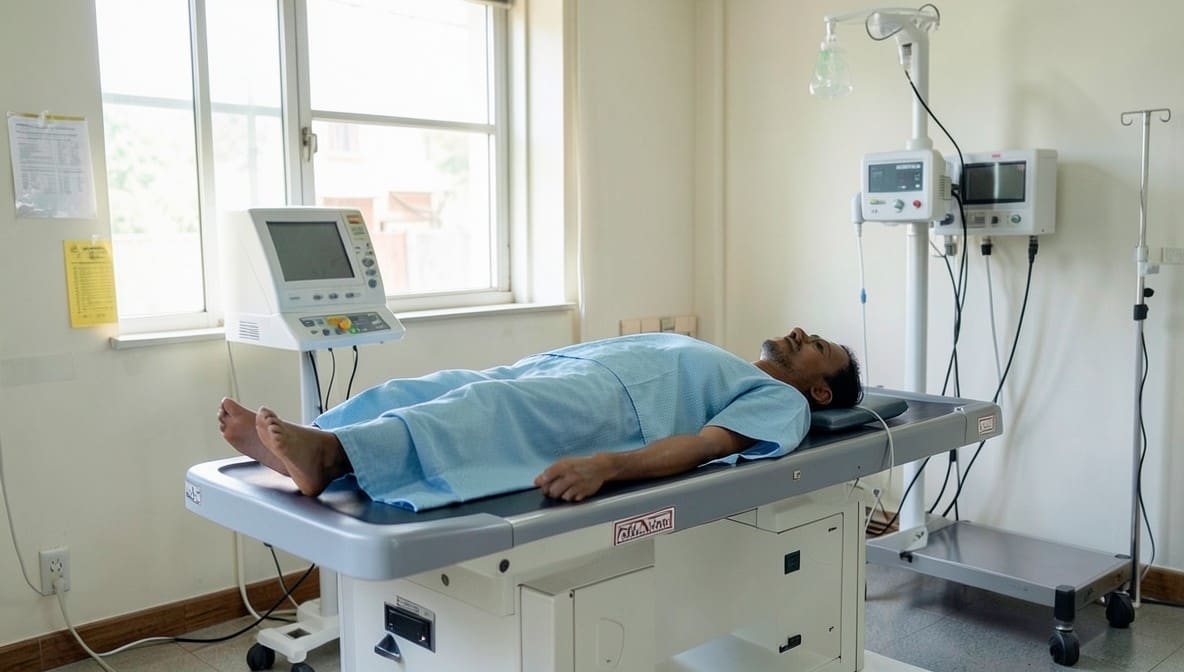
The Punjab & Haryana High Court has affirmed that humanitarian considerations, including the critical medical needs of a close family member, can justify interim bail even in cases under the stringent Narcotic Drugs and Psychotropic Substances Act. This ruling clarifies that the rigours of Section 37 NDPS Act, which typically restrict bail in commercial drug offences, do not override the court’s inherent power to grant temporary relief on compelling personal grounds.
Background & Facts
The Dispute
The petitioner, Aashish Verma, is accused under Sections 8, 22(c), 25, 29 and 60 of the NDPS Act in connection with a narcotics case registered by the Narcotics Control Bureau in Amritsar. He seeks interim bail to care for his 70-year-old mother, who suffers from severe, chronic illnesses requiring dialysis, intravenous medications, and round-the-clock supervision.
Procedural History
- 07.02.2025: FIR registered against petitioner under NDPS Act
- March 2026: Petition filed under Section 483 of BNSS seeking interim bail on medical grounds
- 09.03.2026: Respondent filed affidavit disputing the necessity of petitioner’s presence
- 11.03.2026: Hearing before Justice Sumeet Goel
Relief Sought
The petitioner seeks a 10-day interim bail to personally oversee his mother’s medical treatment, citing discharge summaries showing her dependence on hemodialysis thrice weekly, multiple IV medications, and nutritional support. He argues that no other family member can provide the level of care he alone can offer.
The Legal Issue
The central question was whether Section 37 of the NDPS Act, which imposes strict conditions for bail in commercial drug offences, bars the grant of interim bail on humanitarian grounds such as the critical illness of a dependent family member.
Arguments Presented
For the Petitioner
Counsel relied on the petitioner’s mother’s medical records and cited Jaswinder Singh alias Kala v. State of Punjab to argue that Section 37 NDPS Act does not apply to interim bail pleas grounded in medical exigencies. They emphasized the court’s inherent power under Section 483 BNSS to prevent injustice and ensure humane treatment, even in serious cases.
For the Respondent
The NCB contended that the petitioner’s assertion of family neglect was factually incorrect, citing a verification report showing his adult son, daughter, and sister-in-law were present and capable of caring for the mother. They argued that the gravity of the NDPS charges, coupled with the petitioner’s prior pending case, made him a flight risk and that granting bail would undermine deterrence.
The Court's Analysis
The Court examined the interplay between the restrictive nature of Section 37 NDPS Act and the broader principles of justice, equity, and good conscience under Section 483 BNSS. It distinguished between regular bail applications and interim relief granted for temporary, compelling reasons.
"A bill plea on merits... involving commercial quantity... is essentially required to meet with the rigour(s) of Section 37 of NDPS Act. The rigour(s) of Section 37... do not apply to a bail plea(s) on medical ground(s), interim bail on account of any exigency including the reason of demise of a close family relative etc."
The Court held that while Section 37 imposes high thresholds for regular bail, it does not extinguish the court’s discretion to grant temporary relief where human suffering is acute and demonstrable. The medical evidence was deemed credible and specific, and the court declined to second-guess the petitioner’s emotional and practical role in his mother’s care. The respondent’s verification report, while noting other family members were present, did not disprove the petitioner’s unique responsibility or emotional necessity.
The Court further emphasized that interim bail is not a determination of guilt or a final bail order, but a temporary measure to balance humanitarian need with public interest.
The Verdict
The petitioner won. The Court granted interim bail for 10 days, holding that Section 37 of the NDPS Act does not preclude humanitarian bail on medical grounds. The petitioner must furnish a bail bond of Rs. 10 lakhs, surrender his passport, maintain communication with investigators, and return to custody after the period expires.
What This Means For Similar Cases
Medical Exigency Overrides Strict Bail Provisions
- Practitioners may now invoke Jaswinder Singh to seek interim bail in NDPS cases where a dependent’s life-threatening condition requires the accused’s direct care
- Medical records must be detailed, contemporaneous, and specific - generic claims will not suffice
- Courts will prioritize verifiable medical necessity over speculative family availability
Interim Bail Is Not a Precedent for Regular Bail
- This ruling applies only to temporary relief, not permanent bail
- The burden remains on the petitioner to prove irreplaceable personal involvement in care
- Courts retain discretion to impose strict conditions, including financial bonds and electronic monitoring
Verification Reports Must Be Contextual, Not Conclusive
- A family member’s physical presence does not automatically negate the need for the accused’s presence
- Courts will assess the nature of care required - emotional, logistical, and medical - beyond mere availability
- Investigative verification should not be used to dismiss humanitarian claims without substantive analysis