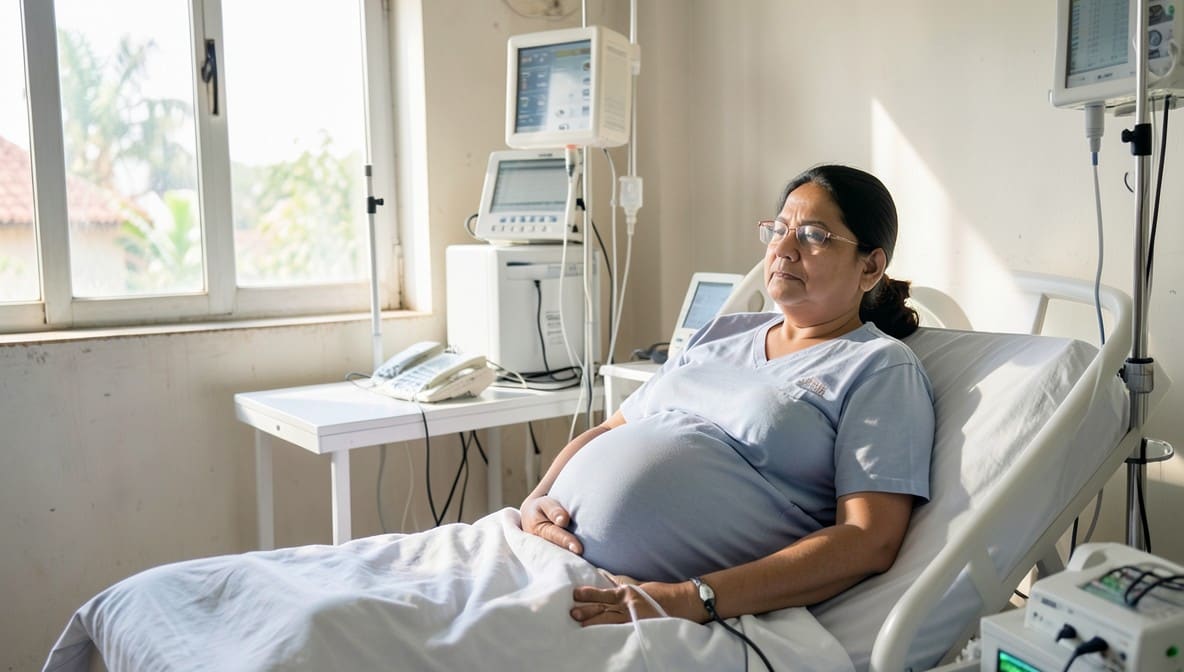
The Rajasthan High Court has recognized the humanitarian imperative of allowing an accused to be present during his wife’s childbirth, granting interim bail under Section 483 of the BNSS despite charges under the NDPS Act. This order underscores that personal circumstances, even in serious drug-related offences, may warrant temporary relief when no alternative care exists.
Background & Facts
The Dispute
The petitioner, Prakash s/o Mangaram, aged 27, is accused in connection with F.I.R. No. 135/2026 registered at Police Station RICO Area, District Barmer, for offences under Sections 8, 21, 25, and 29 of the Narcotic Drugs and Psychotropic Substances (NDPS) Act. He has been lodged in District Jail, Barmer, since his arrest. His application for interim bail was filed on the ground that his wife is pregnant, with an expected date of delivery on 09.07.2026, and no other family member is available to provide care during her confinement.
Key Facts
- The petitioner is the sole male adult family member available to support his pregnant wife
- The wife’s pregnancy is confirmed and medically documented
- No other relative or caregiver is present to assist during delivery or postnatal period
- The petitioner has no prior criminal record under the NDPS Act
- The charges relate to possession and trafficking of narcotics, but no violence or public endangerment is alleged
Procedural History
- Date of F.I.R.: 2026 (exact date not specified, but registered at RICO Area Police Station, Barmer)
- Date of Arrest: Not specified, but petitioner was in custody prior to 21.06.2026
- 21.06.2026: Verification report submitted by the State, confirming the petitioner’s claims regarding his wife’s pregnancy and lack of family support
- 23.06.2026: Interim bail application filed under Section 483 of the BNSS
- 23.06.2026: Court hears arguments and passes order granting interim bail
Relief Sought
The petitioner sought interim bail for a period of 30 days to be present during his wife’s delivery, with conditions to ensure compliance with the judicial process.
The Legal Issue
Can an accused person charged under serious provisions of the NDPS Act be granted interim bail under Section 483 of the BNSS on the ground of his wife’s advanced pregnancy and absence of alternative caregivers?
Arguments Presented
For the Petitioner
Counsel for the petitioner, Mr. Dwarka Das, submitted that the petitioner’s presence is essential during his wife’s delivery due to the absence of any other family member. He emphasized that the right to family unity and the dignity of human life under Article 21 of the Constitution extend to accused persons. He relied on the verification report dated 21.06.2026, which corroborated the factual claims, and argued that interim bail is a discretionary remedy meant to serve justice in exceptional humanitarian circumstances.
For the Respondent
The Public Prosecutor, Mr. Vikram Singh, did not oppose the application. He confirmed the accuracy of the verification report and acknowledged that the petitioner’s claims were substantiated by official records. He submitted that there was no public interest in denying temporary release under these unique circumstances.
The Court's Analysis
The Court examined the nature of the relief sought - not a regular bail, but an interim measure under Section 483 of the BNSS, which empowers courts to grant temporary release in exceptional situations. The Court noted that while the offences under the NDPS Act are grave, the purpose of interim bail is not to determine guilt but to address urgent personal exigencies that do not compromise the integrity of the investigation or trial.
"This Court is of the opinion that the petitioner deserves to be granted interim bail so that he may remain with his wife at the time of her delivery."
The Court emphasized that the verification report, filed by the State itself, validated the petitioner’s claim. The absence of any other caregiver, the advanced stage of pregnancy, and the temporary nature of the relief were decisive factors. The Court also considered the petitioner’s lack of prior criminal history and the absence of allegations of violence or threat to witnesses. The conditions imposed were designed to ensure that the petitioner’s release did not impede the judicial process.
The Court distinguished this from applications for regular bail, noting that Section 483 BNSS is specifically intended for such temporary, compassionate relief. The Court held that denying bail under these circumstances would amount to undue hardship inconsistent with constitutional values.
The Verdict
The petitioner succeeded. The Court granted interim bail to Prakash s/o Mangaram for a period of 30 days from the date of his actual release. He is required to furnish a personal bond of Rs. 1,00,000 with two sound and solvent sureties, each of Rs. 50,000, one of whom must be a close relative. He must surrender before jail authorities on expiry of the 30-day period unless extended by a competent court. He is prohibited from tampering with evidence, contacting witnesses, leaving Rajasthan without permission, and must keep mobile phones active with prior intimation of any number change. The matter is listed for compliance report on 27.07.2026.
What This Means For Similar Cases
Humanitarian Grounds Can Override Gravity of Offence
- Interim bail under Section 483 BNSS is available even in serious drug cases if compelling personal circumstances exist
- Courts will prioritize family welfare and human dignity where no alternative care is available
- The burden is on the applicant to substantiate claims with official verification
Conditions Are Non-Negotiable
- Personal bonds and sureties must be strictly adhered to, with at least one surety being a close relative
- Compliance reporting is mandatory; failure to surrender triggers automatic cancellation
- Restrictions on movement and contact with witnesses are standard and enforceable
Verification Reports Are Decisive
- State-submitted verification reports carry significant weight in interim bail applications
- Courts are unlikely to grant relief without corroborative documentation
- Practitioners must ensure affidavits and official confirmations are filed promptly