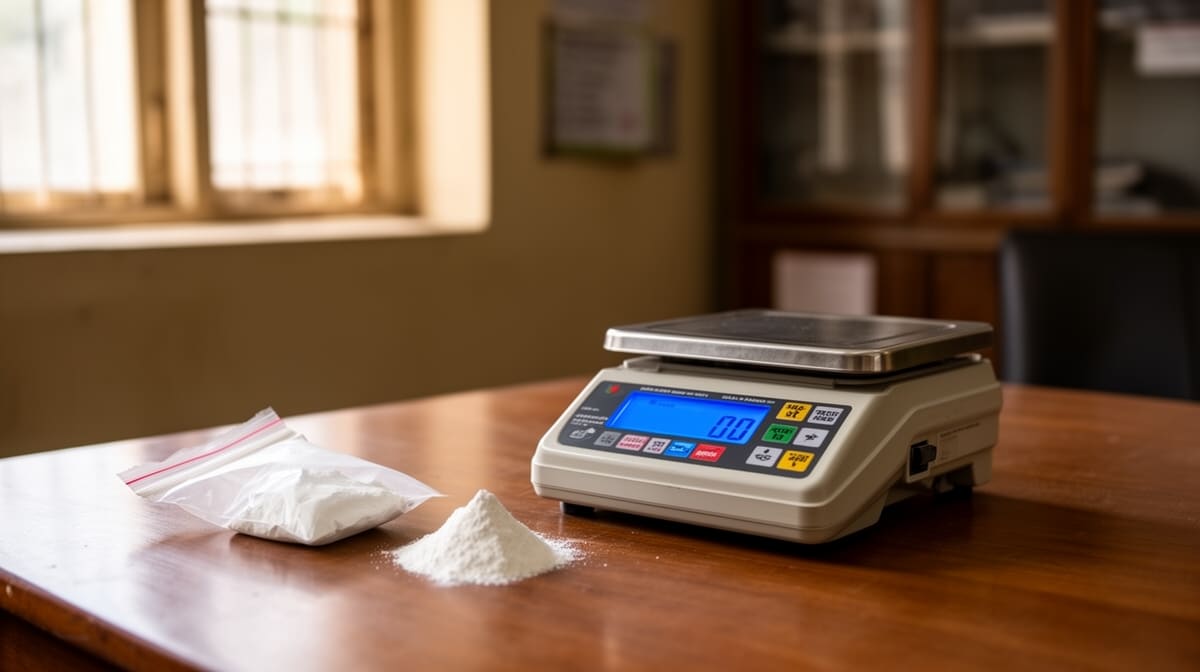
The Allahabad High Court has granted bail in a case under the NDPS Act despite the recovery of contraband exceeding the statutory commercial quantity, emphasizing procedural non-compliance under Section 52-A as a decisive factor. The judgment underscores that technical violations in evidence handling can outweigh quantitative thresholds in bail determinations, reinforcing the principle that procedural fairness is integral to substantive justice.
Background & Facts
The Dispute
The applicant, Rohit, was arrested and charged under Sections 8 and 21 of the Narcotic Drugs and Psychotropic Substances (NDPS) Act, 1985, in connection with Case Crime No. 418 of 2025, registered at Police Station Khatauli, District Muzaffarnagar. The case stems from the recovery of 141.70 grams of Alprazolam tablets from his possession on or about 07.11.2025. The applicant has been in judicial custody since the date of arrest.
Key Facts
- The contraband recovered consisted of 141.70 grams of Alprazolam tablets, including the polythene wrapper in which they were contained
- The statutory commercial quantity for Alprazolam under the NDPS Act is 100 grams
- The recovery was conducted without separating the contraband from its packaging prior to weighing
- The applicant was not provided with a copy of the panchnama or the seizure memo at the time of arrest
- No independent witness was present during the sealing and forwarding of the sample to the forensic laboratory
- The prosecution did not produce evidence of compliance with Section 52-A of the NDPS Act, which mandates proper handling and documentation of seized contraband
Procedural History
- 07.11.2025: Arrest of applicant and seizure of contraband at Khatauli Police Station
- 08.11.2025: First production before Magistrate; remand ordered
- 15.11.2025: Charge sheet filed under Sections 8 and 21 of NDPS Act
- 20.12.2025: Trial court rejected initial bail application
- 10.01.2026: Review application dismissed
- 15.03.2026: Criminal Misc. Bail Application No. 13311 of 2026 filed under Section 483 of Bharatiya Nagarik Suraksha Sanhita, 2023
- 29.04.2026: Hearing before the High Court; order passed on same day
The Parties' Positions
The applicant contends that he has been falsely implicated and that the recovery is tainted by procedural irregularities. He argues that the weight of the contraband, including the wrapper, renders the quantity unreliable and that the failure to comply with Section 52-A invalidates the prosecution’s case. He further submits that the trial is unlikely to conclude soon due to heavy pendency.
The State, through the Additional Government Advocate, opposes bail but concedes that the contraband was weighed along with its wrapper. It asserts that the recovered quantity exceeds the commercial threshold and that Sections 52-A and 105 of BNSS were duly followed.
Relief Sought
The applicant seeks release on bail pending trial, with conditions to ensure cooperation with the investigation and trial process.
The Legal Issue
The central question was whether the failure to comply with Section 52-A of the NDPS Act - specifically, the weighing of contraband along with its packaging - renders the recovery legally defective to the extent that bail should be granted despite the quantity exceeding the statutory commercial limit.
Arguments Presented
For the Appellant/Petitioner
Learned counsel for the applicant relied on Union of India v. Shiv Shanker Kesari (2007) 7 SCC 798 and Nadeem Ahmad v. State of West Bengal (2025 INSC 993) to argue that procedural lapses in handling contraband vitiate the prosecution’s case. He emphasized that Section 52-A mandates that seized narcotics must be weighed in the presence of independent witnesses and without the packaging. The inclusion of the polythene wrapper in the weight measurement, he submitted, renders the quantity inaccurate and legally unsustainable. He further argued that the applicant’s prolonged incarceration without a realistic prospect of early trial warrants bail under the principle of presumption of innocence.
For the Respondent/State
The Additional Government Advocate contended that the recovery of 141.70 grams exceeds the commercial quantity of 100 grams for Alprazolam, triggering the stringent bail conditions under Section 37 of the NDPS Act. He submitted that Sections 52-A and 105 of BNSS were followed, though he conceded the packaging was weighed with the tablets. He argued that the technical defect, if any, does not negate the existence of contraband and that bail should be denied due to the seriousness of the offence.
The Court's Analysis
The Court examined the statutory framework under Section 52-A of the NDPS Act, which requires that seized narcotic substances be weighed in the presence of independent witnesses and without the container or packaging. The Court noted that the prosecution’s own admission - that the 141.70 grams included the polythene wrapper - constitutes a clear violation of this mandatory provision. The Court observed:
"The integrity of the evidence is compromised when the weight of the contraband is not determined free from its packaging. This is not a mere technicality; it strikes at the foundation of evidentiary reliability under the NDPS Act."
The Court further relied on Union of India v. Shiv Shanker Kesari, which held that non-compliance with Section 52-A renders the recovery suspect and may justify bail even in cases involving commercial quantities. It also cited Nadeem Ahmad v. State of West Bengal, where the Supreme Court emphasized that procedural safeguards under the NDPS Act are not optional but essential to prevent abuse of power.
The Court rejected the State’s argument that the quantity alone should override procedural defects, stating that the legislature’s intent in enacting Section 52-A was precisely to prevent arbitrary or inflated measurements. The Court noted that the applicant had been in custody for over five months with no indication of an early trial, and that the applicant had offered to comply with stringent bail conditions.
The Court clarified that its decision was not an endorsement of the applicant’s innocence but a recognition that the prosecution’s case, as currently constituted, is legally vulnerable due to non-compliance with mandatory procedures.
The Verdict
The bail application is allowed. The applicant, Rohit, shall be released on bail upon furnishing a personal bond of Rs. 50,000 with two sureties each in the like amount. He must comply with five conditions: (i) no intimidation of witnesses or tampering with evidence; (ii) no pressure on prosecution witnesses; (iii) personal appearance before the trial court for opening of case, framing of charge, and recording of statement under Section 351 of BNSS; (iv) no request for adjournment when witnesses are present; and (v) presence before the court on all dates, personally or through counsel. Breach of any condition shall lead to cancellation of bail. The Court explicitly clarified that this order does not prejudge the merits of the case.
What This Means For Similar Cases
Procedural Compliance Is Non-Negotiable in NDPS Cases
- Practitioners must now treat non-compliance with Section 52-A as a ground for bail, even where quantity exceeds commercial limits
- Any weighing of contraband with packaging must be challenged as a fatal defect in the prosecution’s evidence chain
- Bail applications under Section 483 BNSS should routinely cite Shiv Shanker Kesari and Nadeem Ahmad when Section 52-A is violated
Delay in Trial Supports Bail in Narcotics Cases
- Pendency of cases is now a recognized factor in bail decisions under NDPS, especially where procedural defects exist
- Courts are increasingly willing to grant bail where trial timelines are indefinite, balancing the accused’s liberty against the State’s interest
- Applicants should file affidavits on court pendency statistics to substantiate claims of delayed trial
Weight Measurement Must Be Precisely Documented
- Forensic reports must explicitly state whether packaging was included in weight
- Defence counsel should demand disclosure of the original panchnama and laboratory records
- Any ambiguity in weight measurement should be raised as a ground for exclusion of evidence under Section 24 of the Evidence Act