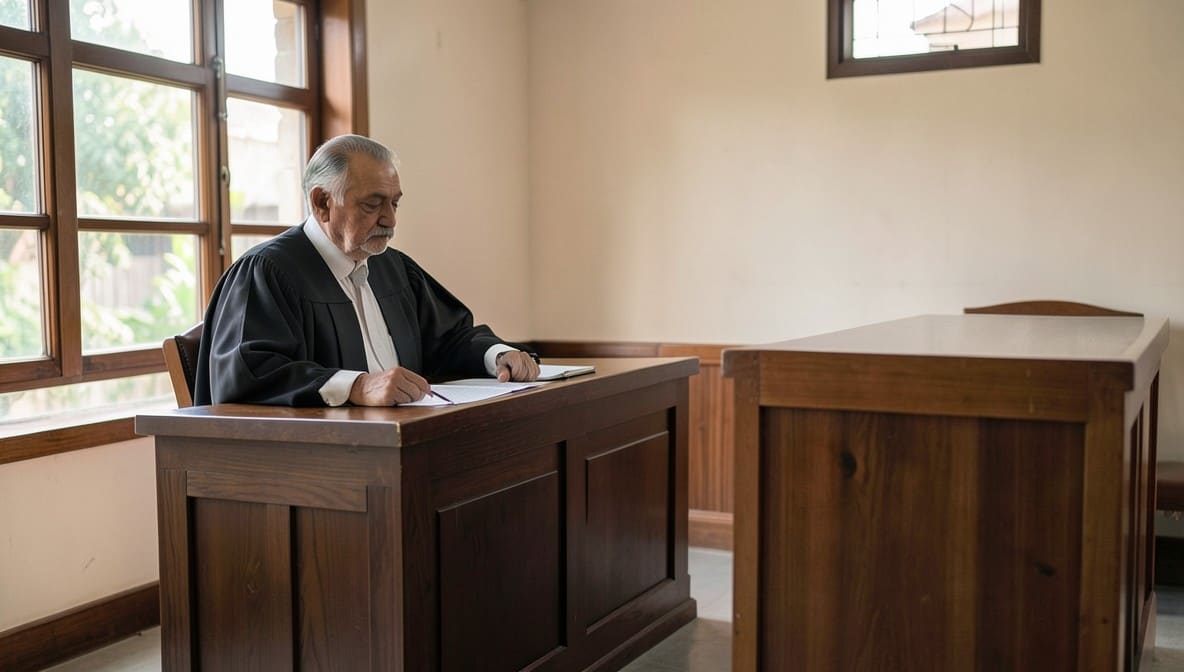
The Madhya Pradesh High Court has clarified that bail conditions must be proportionate and not unduly obstructive to a petitioner’s fundamental rights, particularly when the accused is a young student pursuing higher education. In a significant ruling under Section 482 CrPC, the Court struck down a mandatory fortnightly police reporting condition as excessive and unreasonable.
Background & Facts
The Dispute
The petitioner, Ayush Sharma, a 25-year-old recent graduate pursuing higher education, was granted bail in a criminal case by a co-ordinate Bench of this Court in M.Cr.C. No. 54006/2024 dated 21.01.2025. Among the conditions imposed was Condition No.7, requiring him to appear before the concerned police station once every fortnight until the conclusion of the trial.
Key Facts
- The petitioner is 25 years old and has recently completed his undergraduate degree.
- He is currently enrolled in a postgraduate program requiring regular academic attendance and research commitments.
- The condition of fortnightly police reporting necessitates physical presence at a police station every 14 days, regardless of academic schedule or location.
- The petitioner has no prior criminal record and is not alleged to have committed a heinous or non-bailable offence of extreme gravity.
- No allegation has been made that he is likely to flee, tamper with evidence, or intimidate witnesses.
Procedural History
- 21.01.2025: Bail granted by a co-ordinate Bench of the High Court in M.Cr.C. No. 54006/2024, with seven conditions including Condition No.7.
- 05.04.2026: Petitioner filed the present M.Cr.C. No. 18236/2026 under Section 482 CrPC seeking deletion of Condition No.7.
- 04.05.2026: Hearing conducted before Justice Rajesh Kumar Gupta.
Relief Sought
The petitioner sought deletion of Condition No.7 - the fortnightly police reporting requirement - on the grounds that it severely interferes with his right to education and personal liberty under Article 21 of the Constitution.
The Legal Issue
The central question was whether a condition mandating fortnightly police reporting during the pendency of trial, imposed on a young student with no flight risk or tampering tendency, constitutes an unreasonable restriction under Section 482 of the CrPC.
Arguments Presented
For the Petitioner
Shri Ankur Maheshwari, Advocate for the petitioner, submitted that the condition is disproportionate and violates the petitioner’s right to education and personal liberty. He relied on Arnesh Kumar v. State of Bihar to argue that bail conditions must be minimal and not punitive. He emphasized that the petitioner is a first-time accused, engaged in higher studies, and poses no threat to the investigation. The fortnightly appearance, he argued, disrupts academic schedules, incurs unnecessary travel costs, and imposes psychological burden without any demonstrable benefit to the investigation.
For the Respondent/State
Shri Harish Sharma, Public Prosecutor, did not oppose the prayer. He acknowledged that the petitioner is a young student with no antecedents and that the condition, while standard in many cases, may be relaxed in appropriate circumstances. He submitted that the State had no objection to the deletion of Condition No.7 if the Court found it excessive.
The Court's Analysis
The Court examined the nature of the condition and its impact on the petitioner’s fundamental rights. It noted that while courts have the power to impose conditions under Section 437 and 438 CrPC, such conditions must be reasonable, necessary, and proportionate to the facts of the case.
"The obligation to report to the police station once every fortnight, in the absence of any specific threat of flight or interference with investigation, imposes an undue burden on a young student pursuing higher education. Such a condition, while routine, cannot be applied mechanically."
The Court held that the condition in question was not tailored to the petitioner’s personal circumstances. It observed that the petitioner’s conduct since grant of bail had been compliant, and there was no indication of non-cooperation or risk to the trial process. The Court further noted that the State had not demonstrated any need for such frequent reporting, nor had it shown that less restrictive alternatives - such as monthly reporting or telephonic verification - were inadequate.
The Court emphasized that personal liberty under Article 21 includes the right to education and the pursuit of professional development. Imposing a condition that directly impedes academic progress, without justification, amounts to an arbitrary restriction.
The Verdict
The petitioner succeeded. The Court deleted Condition No.7 - the requirement to appear before the police station once every fortnight - from the bail order dated 21.01.2025. All other conditions of the bail order remain intact. The Court directed that the present order be read in conjunction with the earlier bail order. The petition is disposed of accordingly.
What This Means For Similar Cases
Fortnightly Reporting Is Not Automatic
- Practitioners must now challenge routine fortnightly reporting conditions when imposed on students, employed individuals, or those with demonstrable legitimate commitments.
- Courts must conduct a case-specific assessment before imposing such conditions - mere precedent is insufficient.
- The burden shifts to the prosecution to justify why less restrictive alternatives are inadequate.
Education as a Legitimate Consideration in Bail
- The judgment establishes that pursuit of higher education is a protected facet of personal liberty under Article 21.
- Academic schedules, examination dates, and institutional requirements can be valid grounds for modifying bail conditions.
- Courts should consider alternatives such as monthly reporting, video verification, or written affidavits in lieu of physical appearance.
Proportionality Must Guide Bail Conditions
- Bail conditions must be tailored to the risk profile of the accused, not applied as a blanket rule.
- The Court’s reasoning reinforces the principle from Arnesh Kumar v. State of Bihar: bail is the rule, jail is the exception.
- This precedent can be cited in cases involving young professionals, persons with caregiving responsibilities, or those with chronic health conditions requiring regular medical attention.