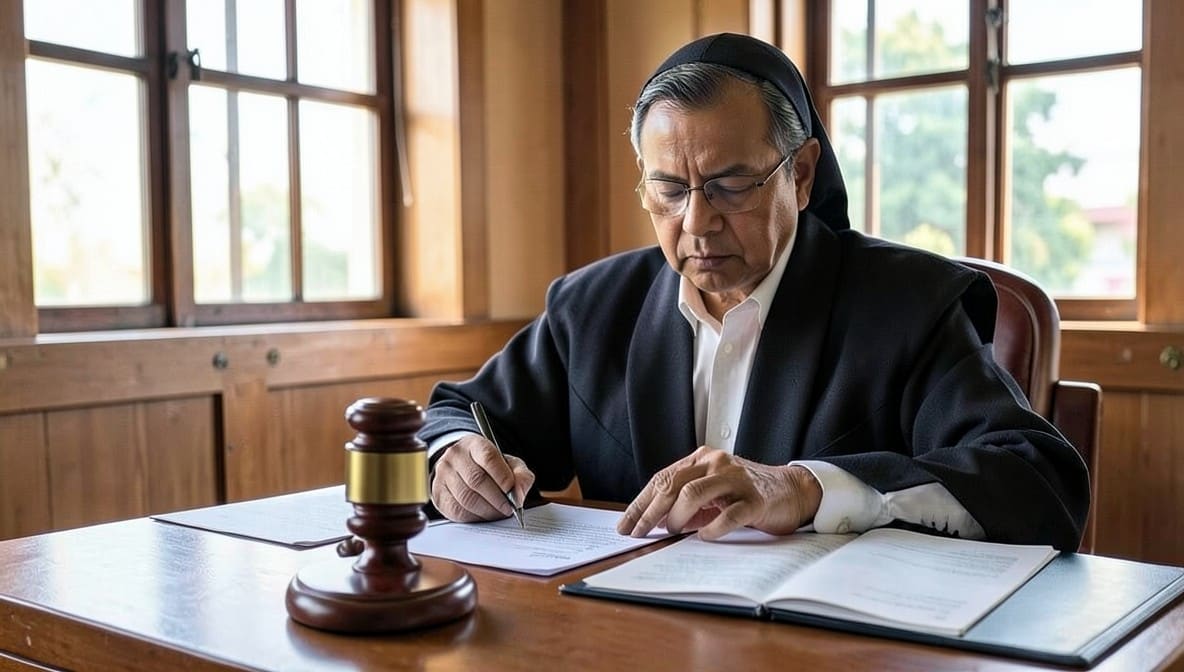
The Karnataka High Court has reiterated that bail conditions must be reasonable and not impose undue hardship on the accused. In a recent order, the Court set aside a bi-monthly attendance condition imposed on a Kerala resident accused of cheating under Section 420 of the Indian Penal Code (IPC), emphasizing that such conditions cannot be mechanically imposed without considering the accused's circumstances.
Background & Facts
The Dispute
The petitioner, Rajesh Ebrahimkutty, a resident of Trivandrum, Kerala, was accused of an offence punishable under Section 420 IPC (cheating). He was granted bail by the LIII Additional City Civil and Sessions Special Judge, Bengaluru, subject to certain conditions. One of these conditions required him to mark his attendance before the jurisdictional police station (Cubbon Park Police Station, Bengaluru) bi-monthly.
Key Facts
- The petitioner resides in Kerala, while the alleged offence and investigation pertain to Bengaluru, Karnataka
- The offence alleged is under Section 420 IPC
- The petitioner sought relaxation of the bail condition requiring bi-monthly attendance before the police
- The trial court imposed the attendance condition while considering a petition for relaxation of bail conditions (Crl.Misc.No.5093/2025)
Procedural History
- 12.08.2025: The LIII Additional City Civil and Sessions Special Judge, Bengaluru, imposed the bi-monthly attendance condition while considering the petitioner’s application for relaxation of bail conditions (Crl.Misc.No.5093/2025)
- 2025: The petitioner filed the present criminal petition under Section 482 of the Code of Criminal Procedure (CrPC) (filed under Section 528 of the Bharatiya Nagarik Suraksha Sanhita (BNSS)), challenging the attendance condition
Relief Sought
The petitioner sought the setting aside of the order dated 12.08.2025, specifically the additional condition directing him to mark his attendance before the Cubbon Park Police Station bi-monthly.
The Legal Issue
The central question before the Court was whether a bail condition requiring the accused to mark attendance before the jurisdictional police bi-monthly, especially when the accused resides in a different state, is reasonable and legally sustainable under Section 437(3) CrPC (or its equivalent under BNSS).
Arguments Presented
For the Petitioner
Learned counsel for the petitioner argued that the trial court erred in imposing the bi-monthly attendance condition, as it was onerous and unreasonable given the petitioner’s residence in Kerala. The counsel contended that such conditions must be tailored to the facts of the case and should not impose undue hardship on the accused.
For the Respondent
The Additional State Public Prosecutor (SPP) appearing for the respondent-State did not present any specific counter-arguments to justify the imposition of the attendance condition. The State’s position was not explicitly detailed in the judgment.
The Court's Analysis
The Court observed that bail conditions must be reasonable and not impose unnecessary hardship on the accused. It noted that the petitioner resides in Kerala, while the offence and investigation pertain to Bengaluru, making the bi-monthly attendance condition impractical and onerous.
The Court relied on the principle that bail conditions should be proportionate to the offence and the accused’s circumstances. It held that mechanically imposing such conditions without considering the accused’s residential location and the nature of the offence violates the spirit of Section 437(3) CrPC, which empowers courts to impose conditions while granting bail but mandates that such conditions be just and reasonable.
The Court did not cite any specific precedents but emphasized the general principle that bail conditions must not be arbitrary or oppressive.
The Verdict
The Court allowed the criminal petition and set aside the order dated 12.08.2025 passed by the LIII Additional City Civil and Sessions Special Judge, Bengaluru, only to the extent of the additional condition directing the petitioner to mark his attendance before the Cubbon Park Police Station bi-monthly. All other bail conditions, if any, were left intact.
What This Means For Similar Cases
Bail Conditions Must Be Reasonable and Practical
- Courts must ensure that bail conditions are tailored to the facts of the case and do not impose undue hardship on the accused
- Conditions requiring physical attendance before police stations, especially when the accused resides in a different state, are likely to be set aside if found impractical
- Practitioners should argue for relaxation of onerous conditions by highlighting the accused’s residential location, the nature of the offence, and the lack of necessity for such conditions
No Mechanical Imposition of Conditions
- The judgment reinforces that bail conditions cannot be imposed mechanically and must be justified by the circumstances of the case
- Trial courts should consider the accused’s personal circumstances, such as residence, occupation, and health, before imposing attendance or other onerous conditions
- This decision serves as a reminder that Section 437(3) CrPC (or its equivalent under BNSS) mandates that bail conditions be just, fair, and reasonable