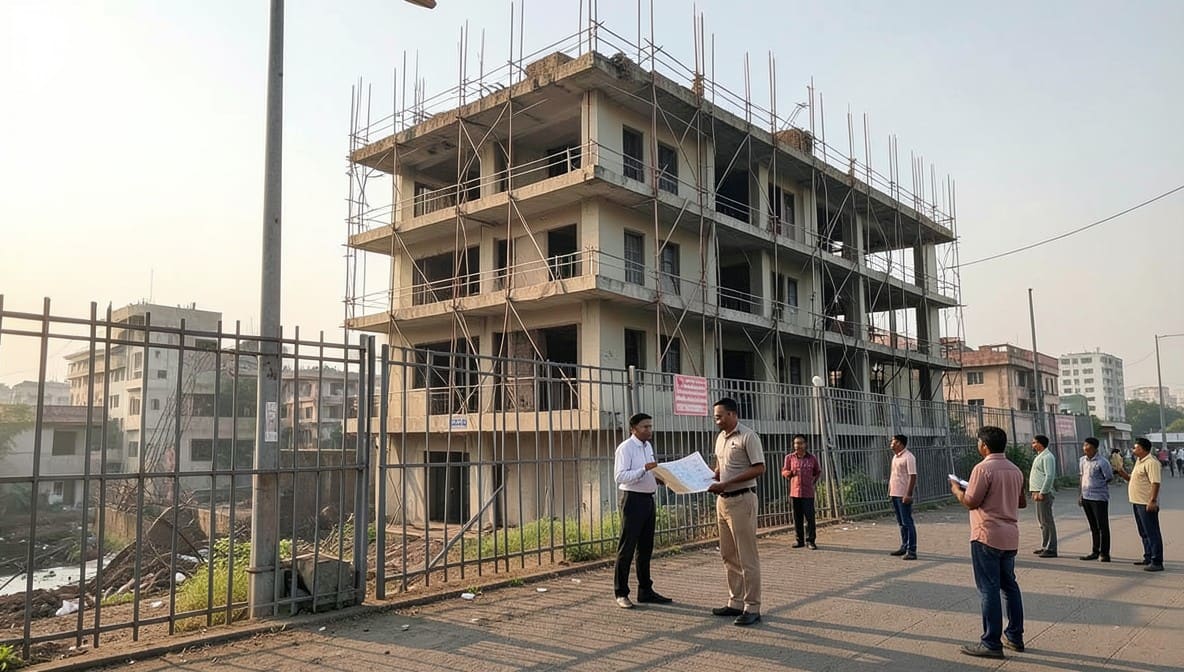
The Madhya Pradesh High Court has reinforced the procedural sanctity of statutory appeals under the Madhya Pradesh Land Revenue Code, 1959, by mandating that appellate authorities must hear such appeals expeditiously and stay enforcement of impugned orders until final adjudication. This judgment clarifies the balance between administrative action and the right to effective remedy in land disputes.
Background & Facts
The Dispute
The petitioner, Shankar Yadav, is the occupant of Plot No. 58, Survey No. 3453/1, measuring 167 square meters, located in Abadi land at Ishanagar, Chhatarpur. A legal inspection conducted by the Halka Patwari confirmed his possession of the land. However, the Tehsildar, Chhatarpur, issued an order dated 20.01.2026 (Annexure-P/5) directing the removal of construction on Plot No. 580, Survey No. 3451/1, which the petitioner claims is the same parcel. The Tehsildar relied on a survey report indicating encroachment and ordered demolition.
Key Facts
- The petitioner’s possession of the land was documented in a Panchanama prepared by the Halka Patwari
- The Tehsildar’s order dated 20.01.2026 directed removal of construction on the disputed plot
- On 04.05.2026, the Tehsildar issued a letter (Annexure-P/1) instructing the SHO, Ishanagar Police Station, to deploy police force for enforcement of the demolition order
- The petitioner asserts that the plot in question (Plot No. 58, Survey No. 3453/1) is identical to Plot No. 580, Survey No. 3451/1, and that the order is based on erroneous identification
- The petitioner has not been granted any opportunity to present his case before the Tehsildar
Procedural History
- 20.01.2026: Tehsildar, Chhatarpur, passes order directing removal of encroachment on Plot No. 580, Survey No. 3451/1
- 04.05.2026: Tehsildar issues letter to SHO, Ishanagar, directing police assistance for demolition
- Before 04.05.2026: Petitioner files statutory appeal under Section 44(1) of the M.P. Land Revenue Code, 1959, before the Sub-Divisional Officer (SDO), Chhatarpur
- 04.05.2026: Petitioner files this writ petition under Article 226 of the Constitution seeking stay of demolition and quashing of the notice
- 07.05.2026: Hearing before the High Court on the question of admission
Relief Sought
The petitioner sought:
- Quashing of the notice dated 04.05.2026
- A writ of mandamus restraining respondents from executing the order dated 20.01.2026 until final disposal of the statutory appeal
- Any other relief deemed fit
The petitioner clarified that he no longer seeks the relief of calling for the entire record.
The Legal Issue
The central question was whether the pendency of a statutory appeal under Section 44(1) of the M.P. Land Revenue Code, 1959 mandates an automatic stay of execution of the impugned order, and whether the appellate authority must hear such appeal expeditiously to prevent irreparable prejudice.
Arguments Presented
For the Petitioner
The petitioner’s counsel argued that the order dated 20.01.2026, if executed before the statutory appeal is heard, would cause irreparable harm by destroying the subject matter of the appeal. He relied on the principle that statutory appeals under the M.P.L.R.C. are designed to provide an effective remedy, which would be rendered illusory if enforcement proceeds during pendency. He submitted that the appeal had already been registered and that the petitioner had no alternative remedy.
For the Respondent/State
The Government Advocate conceded that the statutory appeal had been filed and was pending. He did not oppose the prayer for stay of execution, and affirmed that the appellate authority would consider the appeal in accordance with law.
The Court's Analysis
The Court observed that the petitioner had invoked the statutory remedy provided under Section 44(1) of the M.P. Land Revenue Code, 1959, which explicitly provides for an appeal against orders of the Tehsildar. The Court emphasized that such appeals are not mere formalities but substantive rights intended to correct errors in revenue adjudication.
"The right to appeal is meaningless if the order sought to be appealed against is executed before the appellate authority has had an opportunity to examine the merits of the case."
The Court noted that the petitioner’s construction, if removed, would result in the destruction of property and loss of possession - remedies which cannot be restored even if the appeal is later allowed. The Court further held that the State’s concession that the appeal would be heard in accordance with law did not absolve the appellate authority of its duty to act expeditiously.
The Court rejected the notion that the pendency of an appeal alone creates an automatic stay, but held that in cases involving irreversible consequences, the appellate authority must be directed to hear the matter promptly and execution must be stayed until disposal.
The Verdict
The petition was disposed of with directions. The Sub-Divisional Officer, Chhatarpur, is directed to decide the statutory appeal under Section 44(1) of the M.P.L.R.C., 1959, within two months from the date of this order, after affording the petitioner a full opportunity of hearing. The execution of the order dated 20.01.2026 is stayed until the appeal is finally decided. The final outcome of the appeal shall be communicated to the petitioner immediately.
What This Means For Similar Cases
Statutory Appeals Require Expedited Hearing
- Practitioners must now insist on timelines for appellate disposal in land revenue matters under M.P.L.R.C. 1959
- Courts will intervene where delay threatens to nullify the appeal’s purpose
- Applications for stay of execution should be filed alongside the appeal, not as an afterthought
Execution Stay Is Not Automatic But Presumptive in Irreversible Cases
- Where demolition, dispossession, or destruction of property is threatened, courts will presume irreparable harm
- The burden shifts to the revenue authority to show why execution should proceed before appeal
- This principle applies equally to orders under Sections 43, 44, and 45 of the M.P.L.R.C.
Procedural Fairness Trumps Administrative Expediency
- Revenue authorities cannot rely on technicalities to justify immediate enforcement
- The right to be heard must precede deprivation of property
- Failure to provide opportunity before enforcement may render the order voidable
Documentary Evidence Prevails Over Oral Assertions
- Panchanamas and survey records carry presumptive weight in land disputes
- Courts will not permit demolition based on vague or unverified claims
- Petitioners should always preserve and produce survey maps, possession records, and inspection reports
The Limits of Judicial Intervention
- Courts will not substitute their opinion for that of the appellate authority
- The direction to decide within two months is procedural, not substantive
- The final decision on title or encroachment remains with the SDO